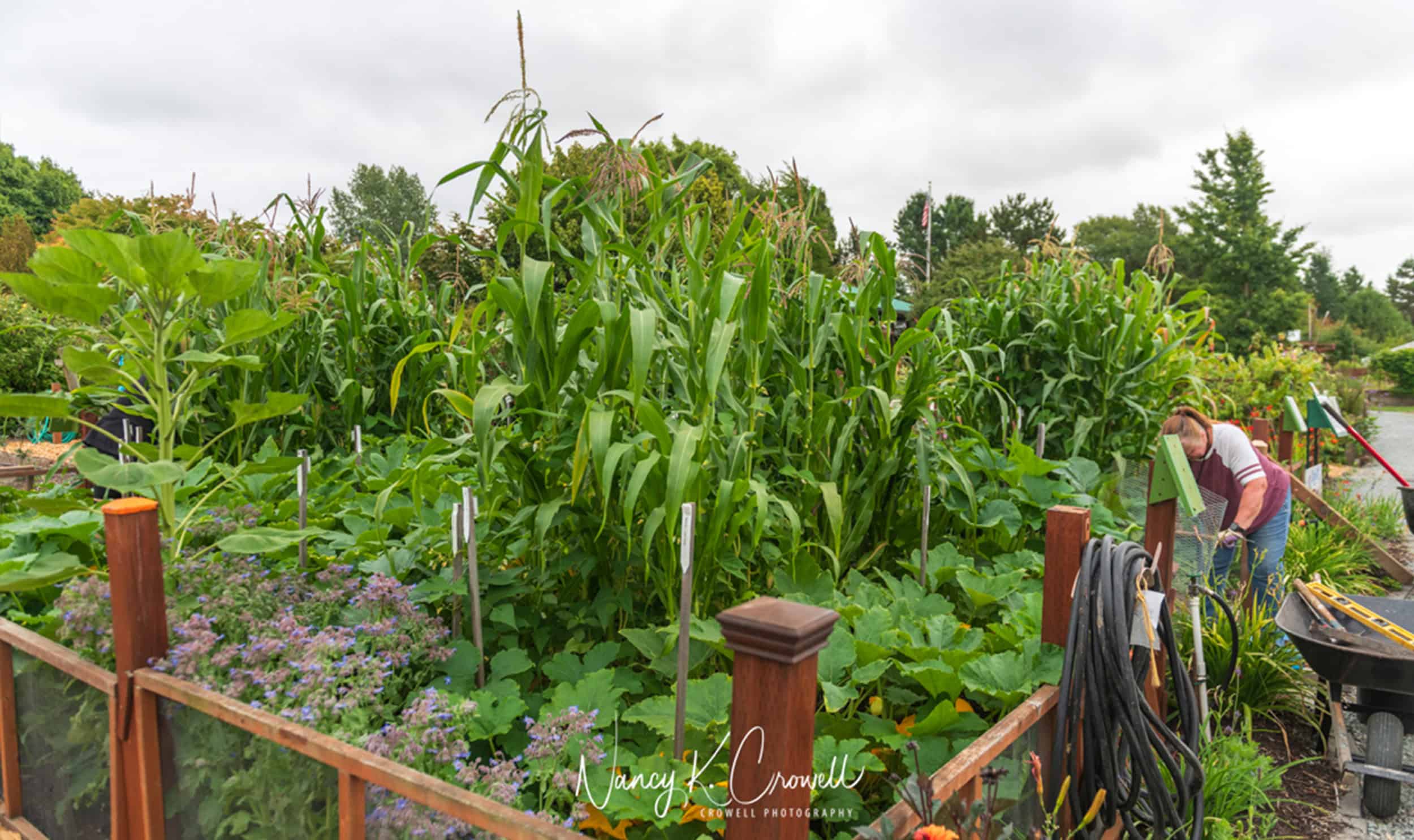
garden with corn, beans and squash growing
The companion planting system known as the “Three Sisters” is combination of corn, beans, and squash. Practiced by Indigenous peoples of the Americas for centuries, it is scientifically proven. Photo © Crowell Photography.com

Post: May 15, 2026

Subscribe to the Blog >

The Science Behind Plant Partnerships

It’s not magic; it is ecology in action

<alt>

Rae Barto

By Rae Barto, Skagit County WSU Extension Master Gardener

Companion planting, the practice of growing different plant species together for mutual benefit, has long been part of gardening traditions across cultures. Historically, it has been framed through folklore, anecdote, and trial and error. But in the last two decades, scientific research has begun to validate, refine, and sometimes debunk these claims.

Modern researchers increasingly view gardens and farms as ecosystems rather than isolated plant beds. Companion planting is best understood as a form of polyculture, where multiple species create a more biodiverse and resilient environment. This biodiversity enhances nutrient cycling, reduces pest pressure, improves water retention, and carbon sequestration.

At its core, companion planting operates through several scientifically documented mechanisms.

Resource partitioning involves physical competition between plants. Plants with different growth habits, root depths, or nutrient requirements can coexist more efficiently than those competing for identical resources. Studies using isotope tracing have demonstrated that companion plantings access different soil layers and nutrient pools, thereby reducing competition.

Allelopathy — the chemical interaction between plants — represents one of the most studied aspects. Plants release various compounds through their roots, leaves, and decomposing matter that can either inhibit or promote the growth of nearby species. Research is identifying specific chemicals responsible for these interactions, providing a biochemical explanation for traditional planting combinations.

The attraction and repulsion of insects through companion planting is getting a lot of attention, and agricultural research proves plants produce volatile organic compounds (VOCs) that can either deter harmful insects or attract beneficial predators and pollinators. Aromatic plants can confuse or mask host plant odors, reducing pest pressure. They are typically short-range, not garden-wide.

Nitrogen Fixation: The Three Sisters and Beyond

Perhaps the most scientifically validated companion planting system is the “Three Sisters” combination of corn, beans, and squash, practiced by Indigenous peoples of the Americas for centuries. Research has confirmed that leguminous beans form symbiotic relationships with rhizobia bacteria, converting atmospheric nitrogen into plant-available forms that benefit neighboring crops.

While these benefits come primarily after the legume decomposes, planting beans next to corn (a heavy nitrogen feeder) allows the corn roots to obtain a trickle of nitrogen from the beans during the growing season. The beans utilize the corn stalks as natural trellises, while the broad squash leaves create living mulch that suppresses weeds and retains soil moisture, effects quantified through controlled field experiments.
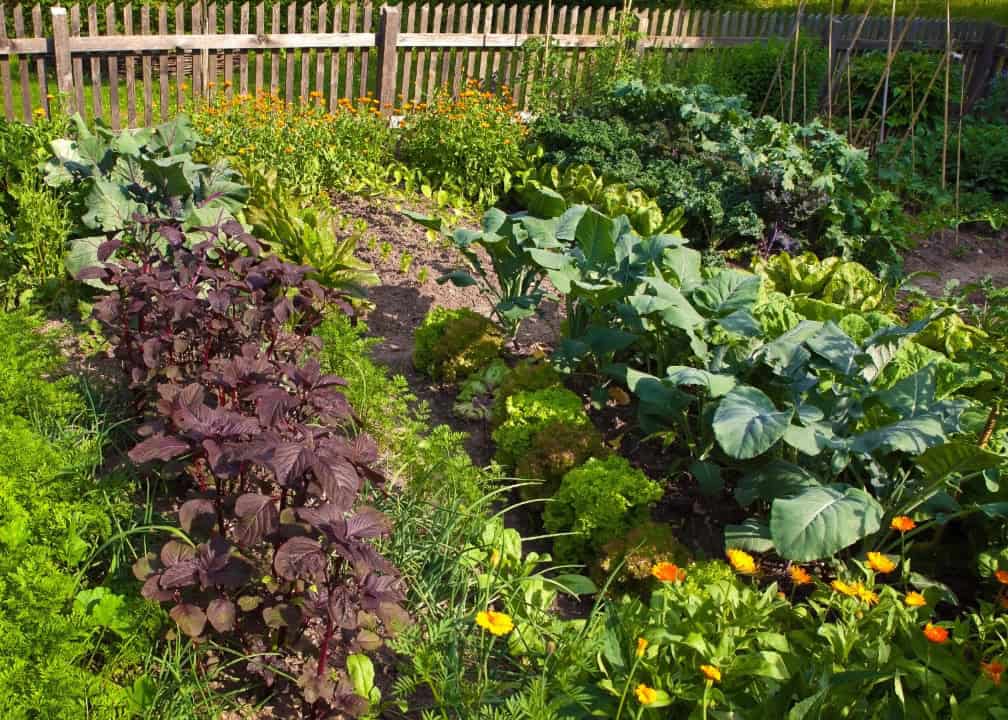
vegetables growing in rows of a garden
Soil type, climate, and local pest populations can influence the effectiveness of plant combinations, underscores the importance of adapting companion planting strategies to local conditions. Photo © Adobe Stock
woman pruning rhododendron

Pruning Shrubs for the Home Gardener

May Know & Grow

Free. No registration required.

Presentor: Anne Kurt, Skagit County WSU Extension Master Gardener and Certified Master Pruner

Tuesday, May 19, 2026 ~ 1 p.m.

Sakuma Auditorium
16650 SR 536, Mount Vernon, WA 98273

Come learn some simple seasonal pruning tips to encourage the health and appearance of your garden shrubs. Learn to identify growth habit and determine the right time to prune and how. You will gain confidence and your garden will thrive.

Photo © Skagit County Master Gardener Foundation

Modern research has expanded our understanding of nitrogen-fixing partnerships beyond traditional combinations. Studies have documented beneficial relationships between leguminous cover crops and subsequent plantings with measured increases in soil organic matter and nitrogen availability lasting multiple growing seasons.

Pest Management through Plant Chemistry

Scientific investigation of companion planting for pest control has revealed sophisticated chemical defense networks. Brassicas (cabbage family plants) produce glucosinolates — sulfur-containing compounds that break down into pest-deterrent chemicals. Research has shown that these compounds can reduce populations of aphids, flea beetles, and other common garden pests when brassicas are interplanted with susceptible crops.

Beneficial Insect Attraction and Habitat Creation

Companion planting’s role in supporting beneficial insects has been thoroughly documented through field studies and insect population surveys. Flowering companions provide nectar and pollen sources that sustain parasitic wasps, predatory beetles, and other natural pest controllers through the growing season.

Research has shown that gardens with diverse flowering plants maintain higher populations of beneficial insects, leading to measurable reductions in pest damage. Studies tracking parasitoid wasp populations have demonstrated direct correlations between the presence of nectar-producing plants and improved biological pest control.

Habitat diversification through companion planting creates microclimates that support beneficial species. Research has documented how varied plant heights, leaf textures, and bloom times provide overwintering sites, hunting grounds, and nesting opportunities for natural pest predators.

Aromatic herbs like basil, rosemary, and thyme have been studied extensively for their pest-repelling properties. Laboratory and field studies have identified specific essential oils and their concentrations that effectively deter insects. For example, research has demonstrated that basil planted near tomatoes can reduce populations of hornworms and whiteflies by releasing volatile compounds such as eugenol and linalool.

logo with white dogwood flower

Save the Date:

Discovery Garden Open House

Celebrating 30 years of education, inspiration and dedication to the community

Saturday, June 27 ~ 10 am – 2 pm
Free Admission and Parking

Discovery Garden
16602 State Route 536, Memorial Highway, Mount Vernon

Soil Health and Nutrient Cycling

One of the most significant advances in understanding companion planting comes from soil microbial ecology. Plants shape the microbial communities around the roots, and when species are grown together, these communities interact in complex ways.

Scientific studies of companion planting’s effects on soil health reveal complex underground interactions.

Mycorrhizal networks
The symbiotic relationship between plant roots and beneficial fungi, called a mycorrhizal network, can be enhanced through strategic plant combinations. Research using molecular techniques has shown how certain companion plants can expand these fungal networks, improving nutrient uptake and plant resilience.
Root exudate interactions
The carbon-rich compounds released by roots have been studied extensively, revealing how different plants can modify soil chemistry to benefit neighbors. For example, research has shown that certain plants release organic acids that help solubilize phosphorus, making this essential nutrient more available to companion plants with different root chemistries.
Carbon sequestration
The process by which plants capture and store atmospheric carbon dioxide (CO2) is called carbon sequestration. Studies have shown that soil organic matter improves with diverse plantings. Research demonstrates that polyculture systems often store more carbon in soil than monocultures, thereby contributing to long-term improvements in soil fertility and structure.
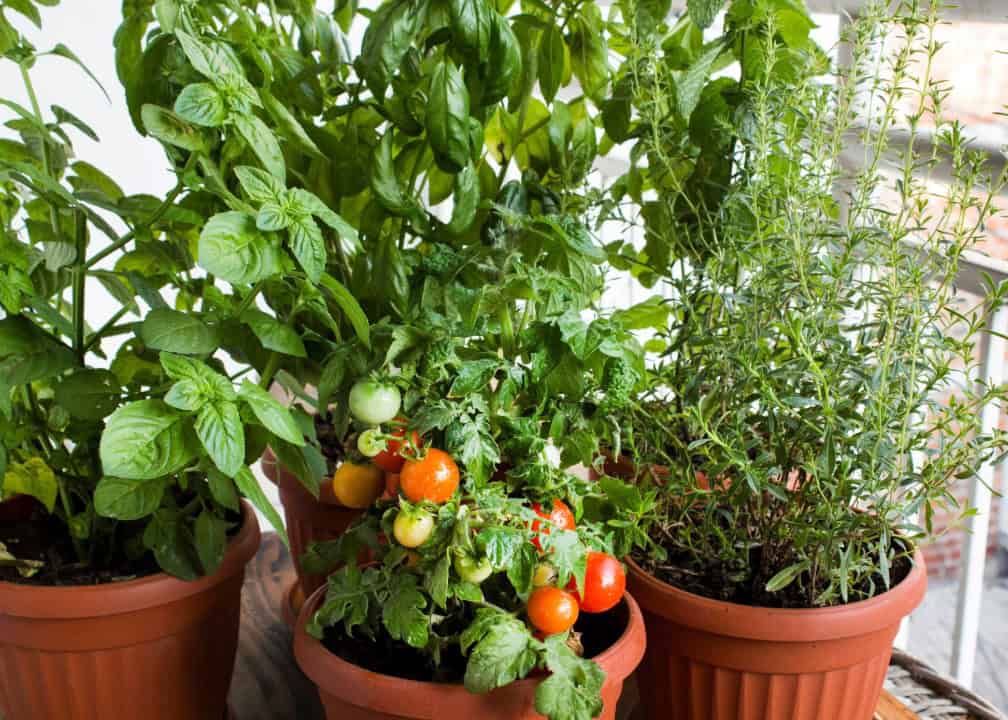
tomatoes and basil growing in pots by a window
Tomatoes and basil have been studied extensively, and research has confirmed that basil can deter certain pests. Photo © Adobe Stock
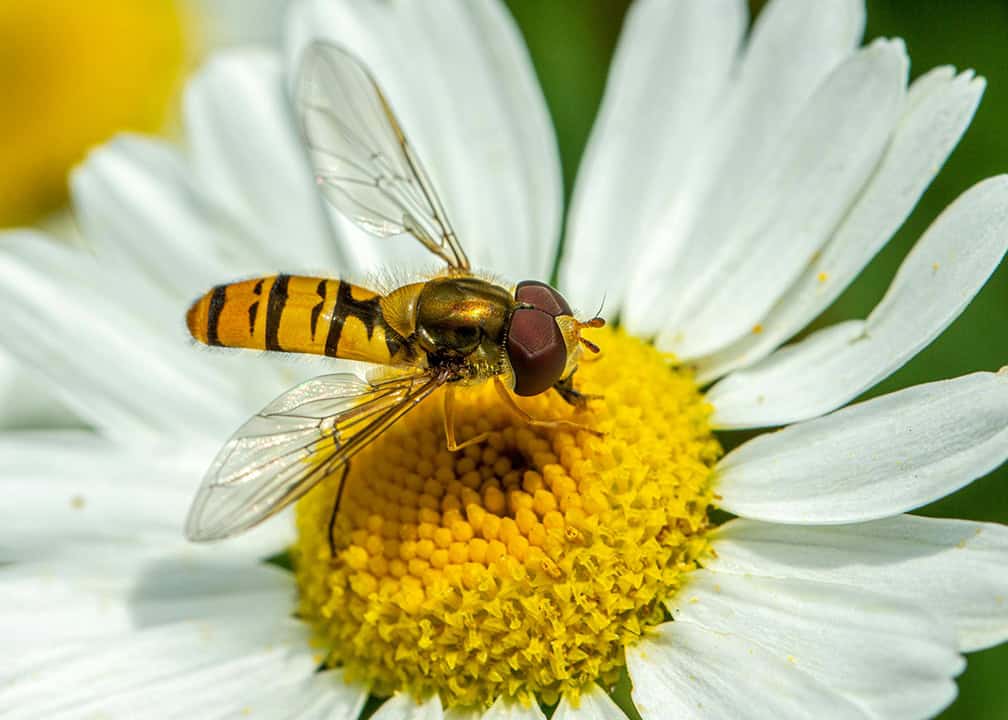
overfly on daisy
This hoverfly is a sign of a well-balanced garden habitat. It is important for the gardener to know the difference between beneficial insects (and what their eggs look like) and harmful insects. Photo © Antonio Friedemann | Pexels.com

Limitations and Considerations

Scientific research also reveals important limitations of companion planting.

Allelopathic inhibition
A biological phenomenon where plants release chemical compounds (allelochemicals) into the environment that suppress the germination, growth, or reproduction of neighboring plants or microorganisms can occur when incompatible plants are grown together. Studies have documented how certain combinations can reduce yields rather than improve them.
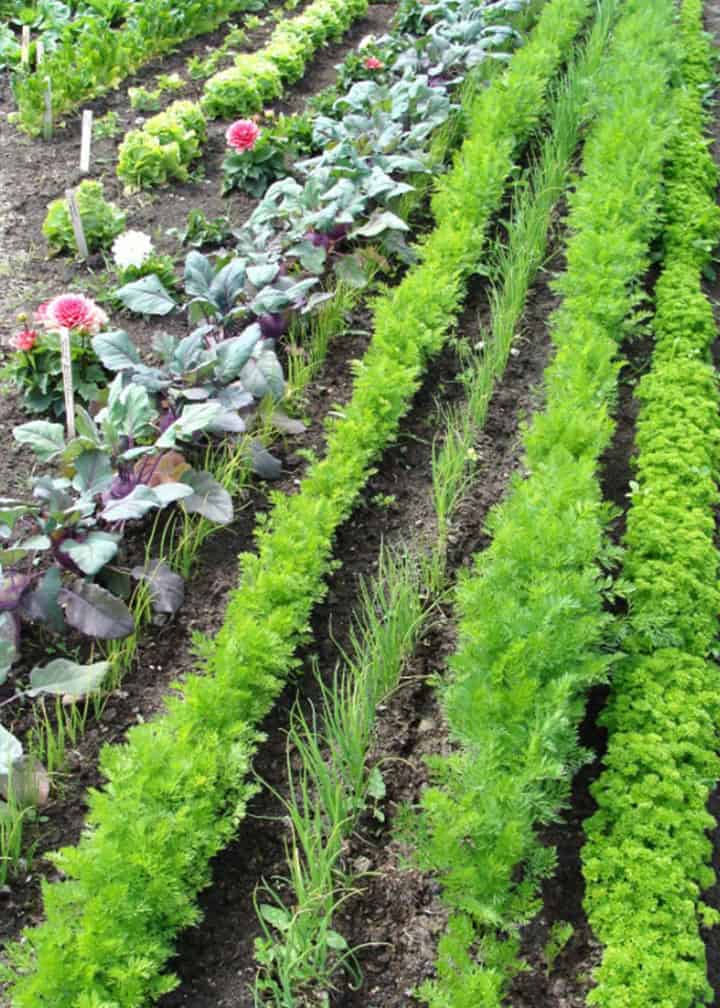
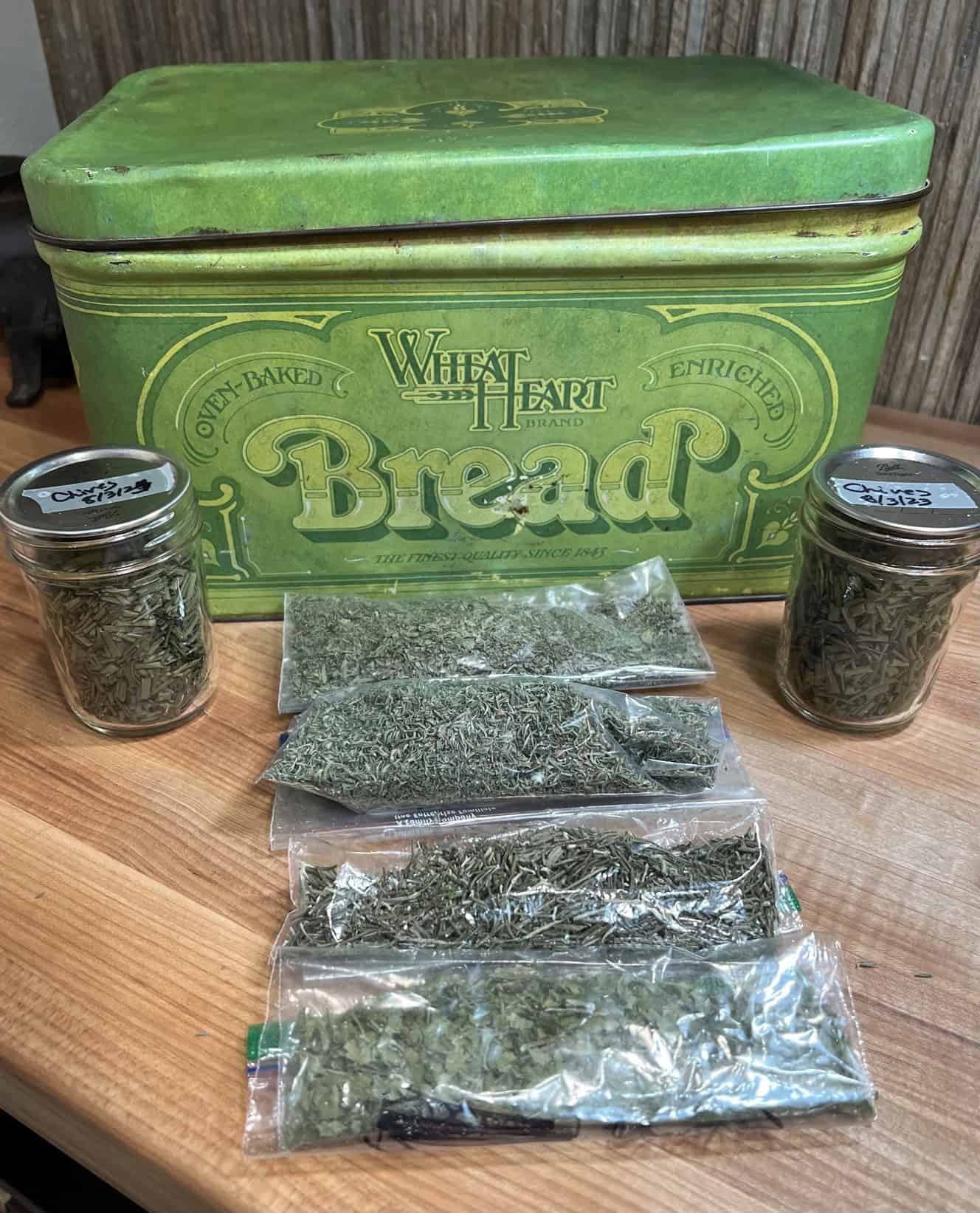
rows of carrots, chives growing in garden

Carrot and chive studies have shown that chives can repel carrot rust flies through the release of sulfur compounds; while differing root depths allow effective resource use. Photo © Adobe Stock

Competition
The effects of competition must be considered, as research shows that plants grown too closely can compete for water, nutrients, and light regardless of species compatibility. Scientific studies emphasize the importance of proper spacing and timing in companion planting systems.
Environmental variability
Research demonstrates that soil type, climate, and local pest populations can influence the effectiveness of plant combinations. This underscores the importance of adapting companion planting strategies to local conditions.
Evidence-Based Companion Combinations
Tomatoes and basil have been studied extensively, and research has confirmed that basil can deter certain pests.

Carrot and chive studies have shown that chives can repel carrot rust flies through the release of sulfur compounds; while differing root depths allow effective resource use.

Lettuce and tall plants demonstrate the shade tolerance principle, with research showing that partial shade can extend lettuce growing seasons and reduce bolting in hot weather.

Practical guidance:

  • Focus on increasing diversity, not specific “magic” pairings. Polycultures reduce pest outbreaks and improve soil health.
  • Include flowering plants to attract and support beneficial insects.
  • Use legumes for nitrogen fixation and to build soil health; interplant beans, peas, or clover with nitrogen-demanding crops.
  • Combine plants with complementary root systems; mix deep-rooted, shallow-rooted, and tap-rooted species.
  • Use the plant’s physical structures — tall plants can support climbers or provide shade.
  • Incorporate cover crops — oats, buckwheat, winter rye, and cowpeas improve soil structure and fertility.
  • Focus on soil microbiology — choose combinations that enhance microbial diversity and nutrient cycling.
  • Observe and adapt, local conditions matter.
  • Combine with other practices, such as crop rotation and soil management.

The science of companion planting validates many traditional practices while providing a deeper understanding of the mechanisms involved. Through scientific research on plant chemistry, soil interaction, and ecological relationships, we now have evidence-based explanations for why certain plant combinations work effectively together.

By understanding the science behind companion planting, gardeners can harness these natural relationships to create thriving, resilient gardens that work with, rather than against, ecological principles. As research continues to reveal new insights into plant interactions, companion planting enables gardeners to combine traditional knowledge with modern science to create a more sustainable, productive garden.

Companion planting is a scientifically supported practice rooted in ecology, soil biology, and plant physiology. While not all traditional pairings hold up under scrutiny, many do, and modern research continues to uncover the mechanisms behind successful plant partnerships.

Companion planting works best as part of a holistic system rather than a standalone solution. Companion planting is not magic; it is ecology in action.

References and Resources

Chalker-Scott, L. (2023). Gardening with Companion Plants (Home Garden Series). Washington State University Extension.

Walliser, J. (2020). Plant Partners: Science-based Companion Planting Strategies for the Vegetable Garden. Storey Publishing, LLC.

James, D. (2014). Beneficial Insects, Spiders, and Other Mini-Creatures in Your Garden. Washington State University Extension., Pub. #EM0673.

University of California (2018). Insectary Plants, Integrated Pest Management, Agriculture and Natural Resources.

ABOUT THE AUTHOR: Rae Barto is a Skagit County WSU Extension Master Gardener, Class of 2023. Her love of plants includes anything green and growing, especially anything that can be used in cooking. She has been experimenting with companion planting for several years in her own garden. She is the coordinator of the medicinal section of the Herb Garden and is a frequent volunteer in the Plant Clinic in Burlington. 


Questions about home gardening or becoming a master gardener may be directed to Skagit County WSU Extension Office, 11768 Westar Lane, Suite A, Burlington, WA 98233; by phone: 360-428-4270; or via the Skagit County WSU Extension website.

Washington State University Extension helps people develop leadership skills and use research-based knowledge to improve economic status and quality of life. Cooperating agencies: Washington State University, US Department of Agriculture, and Skagit County. Extension programs and policies are available to all without discrimination. To request disability accommodations contact us at least ten days in advance.
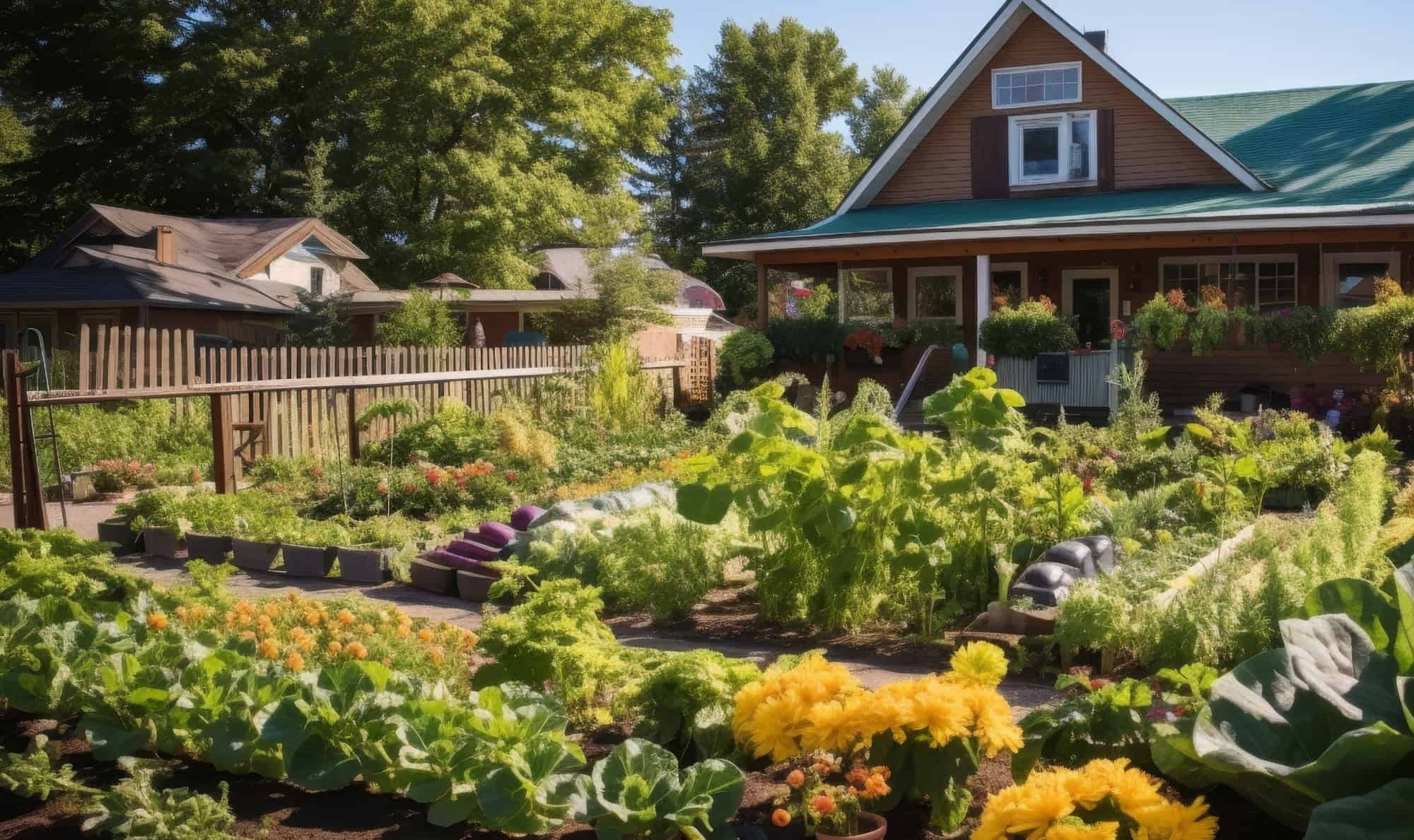

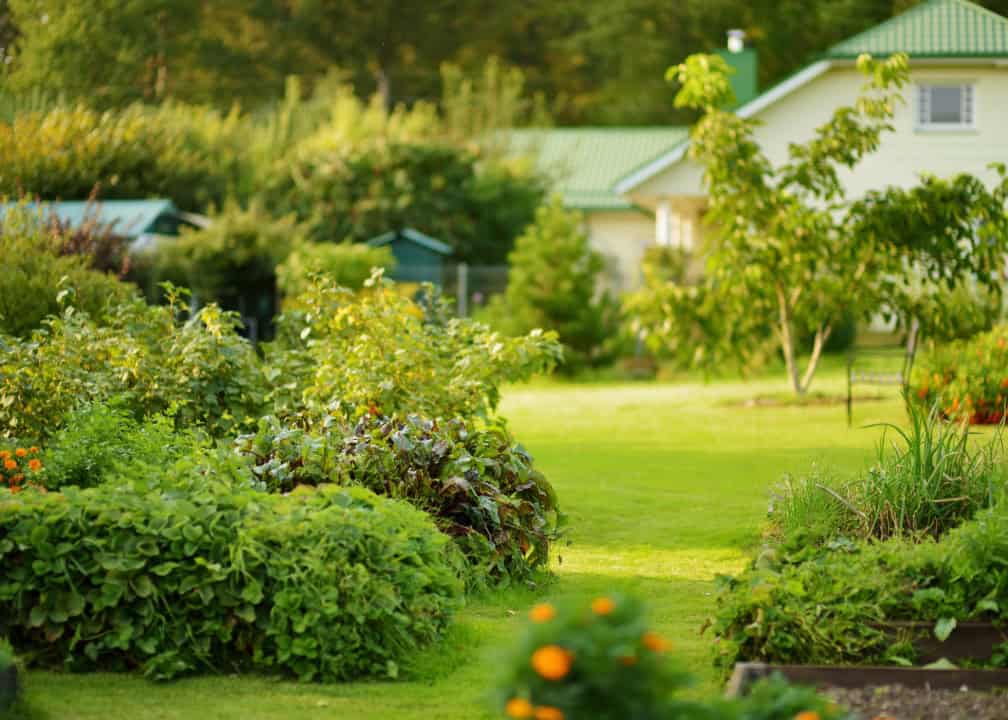
vegetable garden growing with house in background
© Adobe Stock

Post: May 1, 2026

Subscribe to the Blog >

Ready to Go Shopping?

Know your yard’s microclimates before you head to the plant sale


Kari Ranten

Perhaps nothing thrills a home gardener more than the abundance of plants available for sale in spring. A walk through a nursery lures the gardener to marvel at beautiful perennial blooms; to desire the look, texture, and color of a tree or shrub; or to seek out the amazing native plants that call the Pacific Northwest home.

With so many beautiful choices, it’s easy to quickly fill a wagon with one (or three) of everything that looks beautiful in the moment. Before making those impulse buys, take some time to think about what will thrive in your landscape. A little homework will improve the success rate for your new plants. Research your local microclimates and keep the unique details of your yard in mind to make careful selections of the right plants for the right places – a standard master gardener mantra.

Home gardeners in northwest Washington share the Zone 8b assignment on the U.S. Department of Agriculture’s (USDA) Plant Hardiness Zone map. Type in your zip code in the map tool to learn more. This resource provides an excellent overview of plants’ overall frost tolerance and offers a broad overview of the area’s climate.

Gardeners should pair this up with localized information and knowledge of their own property.

Sunset’s Western Garden Book defines a microclimate as “a small area (such as a backyard or even a portion of it) with a slightly different climate than that of its larger surroundings. . . Plants that might not survive in a specific climate zone may grow well in the right microclimate.”

Individual yards likely have one or more unique microclimates that the home gardener should learn about and understand. Microclimates include areas of shade, sun, wind, moisture, soil, and topographic features such as elevation. In northwest Washington, proximity to rivers, lakes, and the Puget Sound also plays a role. In addition, structures, pavement, and fences can create varying conditions.

Armed with this information, gardeners can review plant qualities online or at the library ahead of time, take a list of desired plants or qualities along for the shopping trip, and make smart purchases. Once at the nursery or plant sale, shoppers will benefit from a close evaluation of plant tags (with hardiness zone compatibility and other notes for proper planting conditions) and the option to talk to the experts.

Start by doing your research

Evaluate your yard by drawing a simple map and taking notes. Observe the direction each area faces, note any low-lying areas or slopes, and learn more about the soil quality. Pay attention to the location of structures or hard surfaces that may store heat on a sunny day, creating overnight warm spots, as well as large vegetation that may bring a sphere of shade and cooler temperatures. Perform timed checks every few hours (say 9 a.m., noon, and again at 3 p.m.) during the day to monitor sun and shade patterns. Be aware of elevation and rainfall.

expansive yard

32nd Annual Plant Fair Set for
Saturday, May 9 ~ 8 am – 2 pm
at the Skagit County Fairgrounds

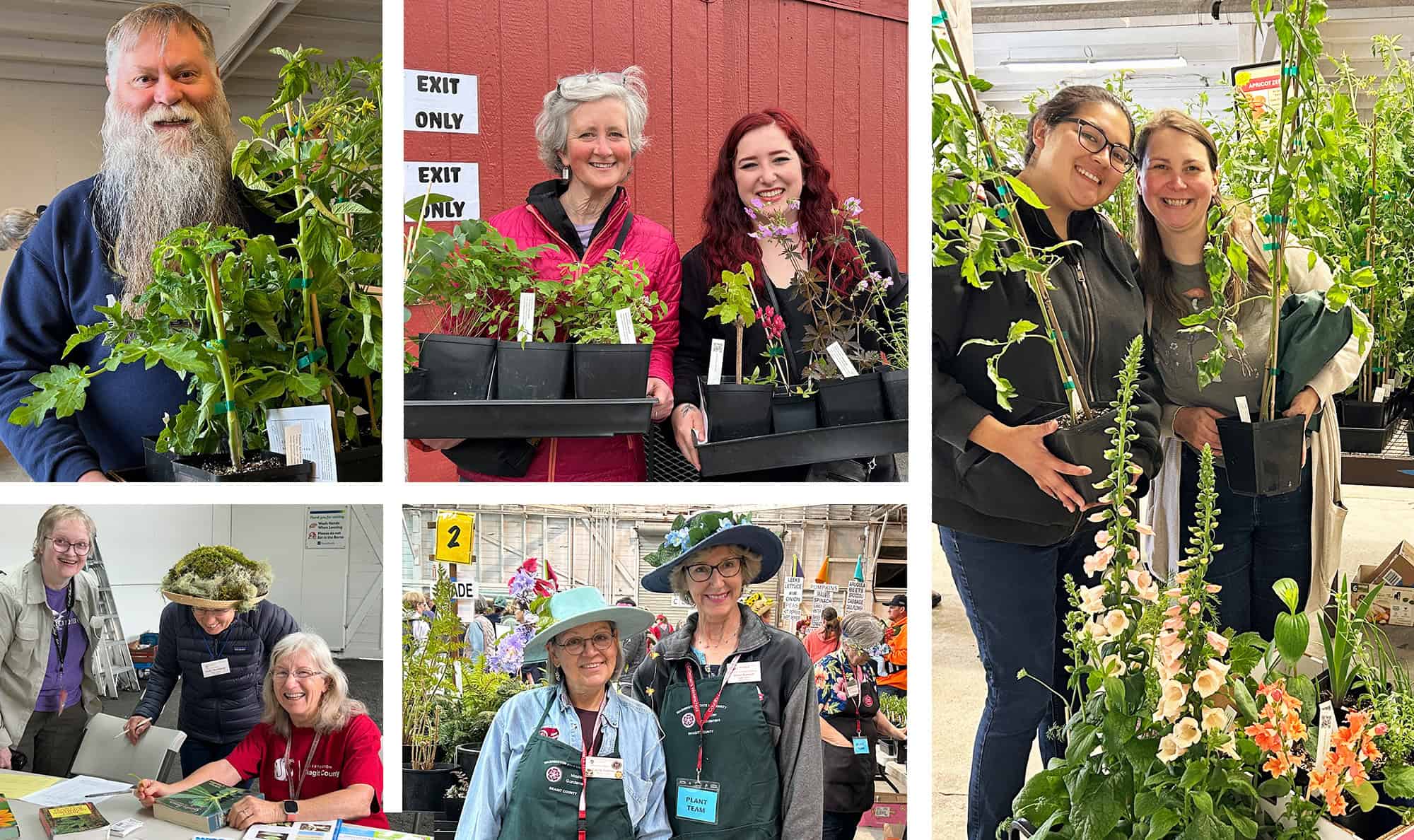
multiple photos of plant fair customers
© Skagit County Master Gardener Foundation

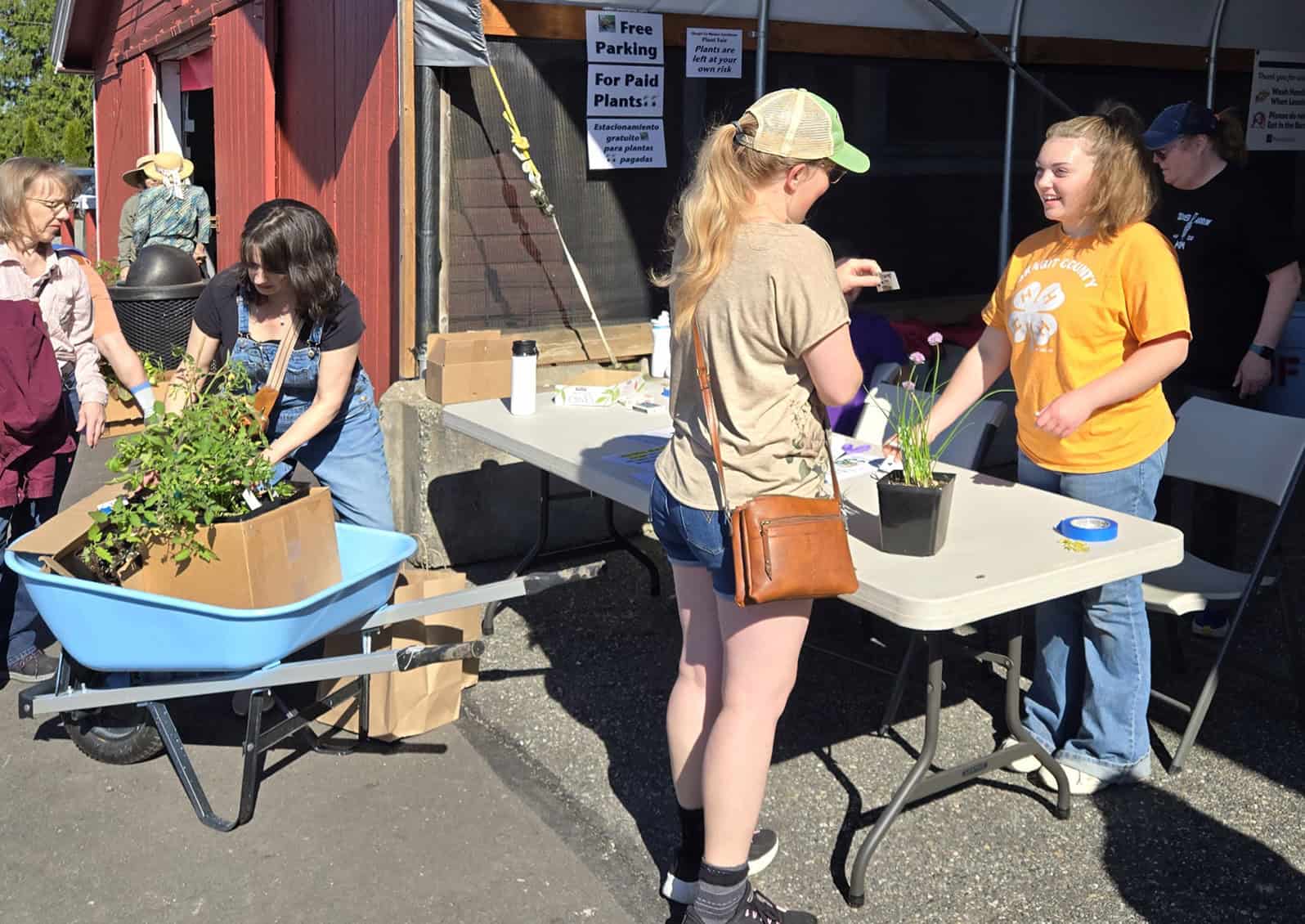
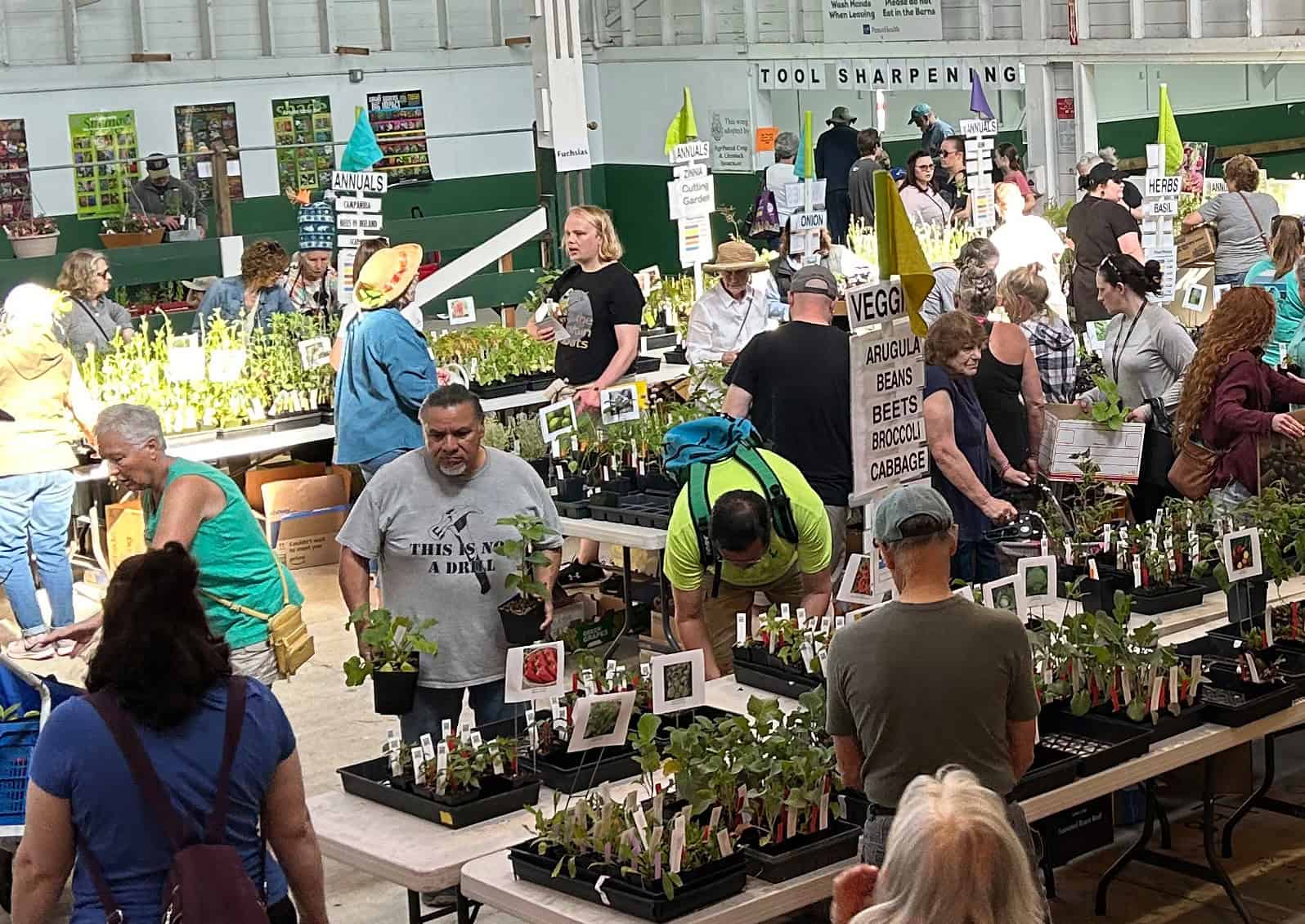
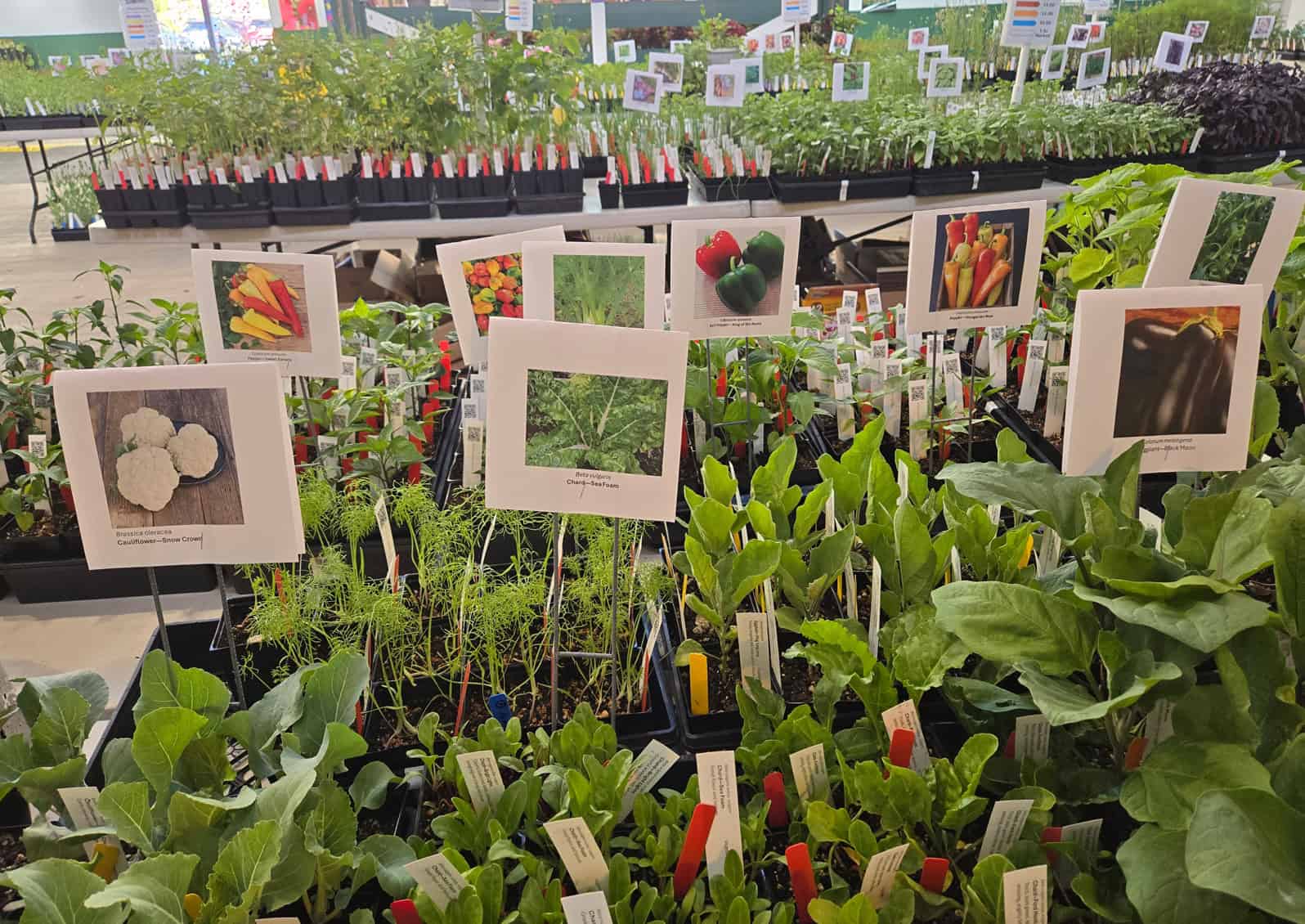
Kick off your spring plant-buying season at the Skagit County Master Gardener Foundation Plant Fair set for 8 a.m. to 2 p.m. on Saturday, May 9, 2026, at the Skagit County Fairgrounds in Mount Vernon. The event will feature more than 10,000 plants grown or tended by Skagit County WSU Extension Master Gardeners for success in northwest Washington. More than 50 varieties of tomatoes and thousands of annuals, vegetables, herbs, perennials, trees, shrubs, berries, and more will be available. In addition, dozens of vendors will be on site with many offering plants and garden-related items. Admission and parking are free. Read the full press release>

Customers can plan ahead and prepare a shopping list by reviewing lists of plants that master gardeners will offer:


The Skagit County WSU Extension Master Gardener Program helps our communities with their gardening needs by providing science-based education, answering plant questions, and helping with plant problems. Proceeds from the annual Plant Fair benefit the nonprofit Skagit County Master Gardener Foundation, which supports the Skagit County Master Gardener Program.

Soil tests from several locations in the yard will help you understand what your soil may need to support healthy plants.

Washington State University’s Ag Weather Net provides regional climate information from several locations in Skagit and surrounding counties about wind, temperature, and precipitation information. A home garden weather station can help gather and archive data at your specific location.

The University of California Agriculture and Natural Resources Marin County Master Gardeners provides a detailed spreadsheet to help assess microclimates and the factors to consider when planning a garden or landscape.

Another research opportunity is to observe thriving landscapes or yards in your neighborhood or community, and to visit botanical gardens in the region to see and learn about plants that thrive in the northwest environment. The 30-plus garden “rooms” of the Skagit County WSU Extension Master Gardener Discovery Garden on Memorial Highway west of Mount Vernon offer many ideas and inspiration for gardens with themes ranging from naturescape and shade to dryscape or succulents. The Discovery Garden is open daily from dawn until dusk.

Say you have a one-third-acre lot with a single-level home in central Skagit County: 

Watch the frost and snow patterns. It’s not uncommon for the north side of the house to harbor frost eight to 10 feet north of the structure for hours after the white frosty layer has melted from the rest of the yard. Snow can remain in place for days in that swath. Plants in that area must be cold and moisture-tolerant. That’s a microclimate. Well-established plants such as a June-blooming rhododendron or a David viburnum (Viburnum davidii) can continue to thrive. Adding shade-loving ferns like Asian saber fern (Polystichum neolobatum), western sword fern (Polystichum munitum), or dragon tail fern (Asplenium ebenoides) along with a couple of perennials like bleeding heart (Dicentra spectabilis) and Solomon’s seal (Polygonatum) add texture and interest in the spring and appear year over year.

woman pruning rhododendron

Pruning Shrubs for the Home Gardener

May Know & Grow

Free. No registration required.

Presentor: Anne Kurt, Skagit County WSU Extension Master Gardener and Certified Master Pruner

Tuesday, May 19, 2026 ~ 1 p.m.

Sakuma Auditorium
16650 SR 536, Mount Vernon, WA 98273

Come learn some simple seasonal pruning tips to encourage the health and appearance of your garden shrubs. Learn to identify growth habit and determine the right time to prune and how. You will gain confidence and your garden will thrive.

Photo © Skagit County Master Gardener Foundation

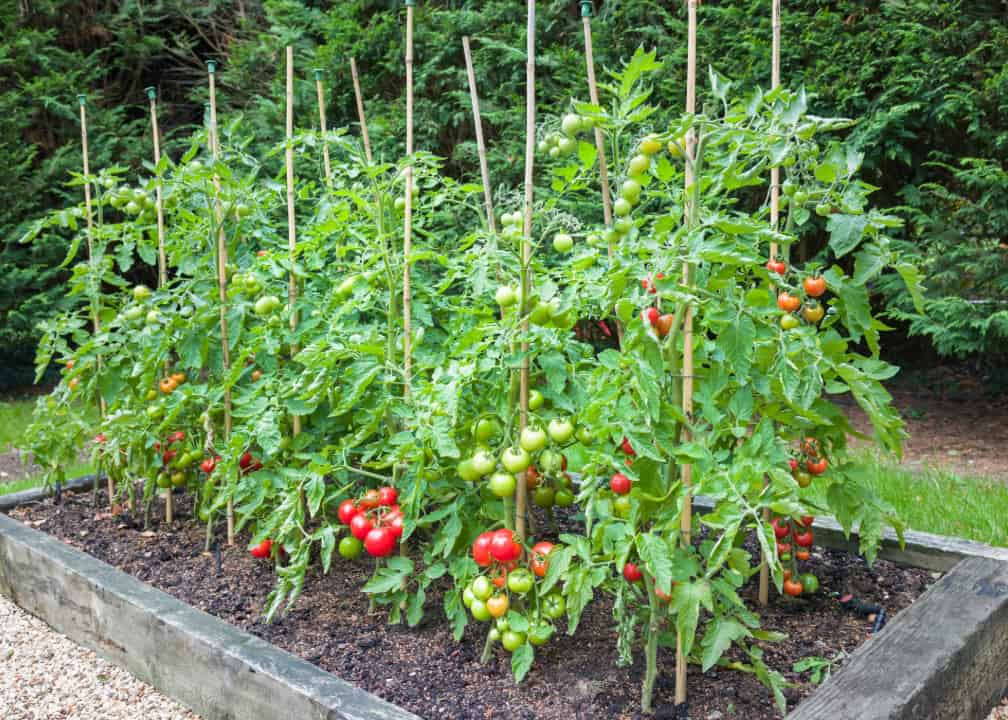
The south side of the house can be quite a different microclimate. A large, south-facing patio and the house’s siding would make a true hot spot, even on warm spring days, much less on a 90-degree summer afternoon. A few plants in hanging baskets could thrive through the summer without an irrigation system. A raised bed or large pots tucked next to a south-facing wall or fence provide warmth and light reflection that tomatoes love, yielding lots of delicious fruit, steps away from the kitchen.

With careful plant selection and regular (sometimes twice daily) watering, larger pots filled with annuals and perennials can produce a beautiful abundance of color for the season. Plants with bright red and orange flowers, such as firecracker plant (Cuphea hybrid), Mexican lobelia (Lobelia laxiflora), and lantana (Verbenaceae) attract a number of pollinators including hummingbirds.

tomato plants growing in raised bed
backyard vegetable garden

Make good plant selections. Create a list of plants that suit the landscape’s microclimates. This includes trees, shrubs, perennials, and annuals. Photos © Adobe Stock


Based on research and data gathered for your yard, you have options:

  1. Make changes to manage a microclimate:
  • Consider adding organic matter to improve soil moisture capacity or install an irrigation system for dry areas.
  • Use raised beds for plants that need drainage and warmer soil temperature.
  • Look into drains for slopes to allow water to flow in wet areas.
  • Move and group plants that appreciate similar conditions.
  • Protect more fragile plants with a shelter of tall plantings or a fence.
  1. Make good plant selections. Create a list of plants that suit the landscape’s microclimates. This includes trees, shrubs, perennials, and annuals. Gardeners have access to a variety of resources for plant lists, including:
  • Sunset’s Western Garden Book offers 30 lengthy lists with photos and plant details based on climate qualities, including sun, shade, dry areas, moisture lovers, and wind resistance.
  • Great Plant Picks, the educational program of the Elisabeth C. Miller Botanical Garden in Seattle, offers many lists to support plant selections for gardeners living west of the Cascade Mountains from Eugene, Oregon, to Vancouver, British Columbia, Canada. Lists focus on drought tolerance, sun and shade, containers, and more.
  • The Washington State Noxious Weed Control Board offers a printable list of noxious weeds.
  • The Washington Native Plant Society provides information on invasive non-native plants that compete with native plants, plus lists on the plethora of Washington native plants that are special to Washington. 

Armed with details about your landscape, soil, light, and weather, along with a list of plants that are of interest, head out to the nursery or local plant sale with a disciplined plan to start with. Ask questions. Look at lots of plants. Make a measured selection of choices. Take those home, size up your status and, if needed, make another trip – oh, joy! The fun can stretch over a period of growing years as you watch and enjoy the maturation of your well-planned garden spaces tailored to your unique microclimates. 

References and Resources

City of Seattle Public Utilities. (2010) Natural Lawn & Garden Series: Choosing the Right Plants for a Beautiful, Trouble-Free Garden.

Elisabeth C. Miller Botanical Garden. (2026) Great Plant Picks.

McMoran, D, Huter, S. and Buller, S. (2015) How to Determine your Garden Microclimate. Washington State University Extension Bulletin FS181E.

Sunset Western Garden Book (2007) Sunset Publishing Corporation. Menlo Park, CA. 94025

University of California Agriculture and Natural Resources Marin County Master Gardeners. (2026) Garden Site Microclimate Evaluation Form.

U.S. Department of Agriculture’s (USDA) Plant Hardiness Zone Map. (2026) https://planthardiness.ars.usda.gov/

Washington Native Plant Society

Washington State University’s Ag Weather Net

ABOUT THE AUTHOR: Kari Ranten is a retired journalist and health care communicator who became a certified Skagit County WSU Extension Master Gardener in 2024.


Questions about home gardening or becoming a master gardener may be directed to Skagit County WSU Extension Office, 11768 Westar Lane, Suite A, Burlington, WA 98233; by phone: 360-428-4270; or via the Skagit County WSU Extension website.

Washington State University Extension helps people develop leadership skills and use research-based knowledge to improve economic status and quality of life. Cooperating agencies: Washington State University, US Department of Agriculture, and Skagit County. Extension programs and policies are available to all without discrimination. To request disability accommodations contact us at least ten days in advance.


Photos © Skagit Master Gardener Foundation and Adobe Stock
© Adobe Stock

Post: April 17, 2026

Subscribe to the Blog >

The Amazing World of Geophytes

Bulbs, corms, rhizomes, and tubers: Plant ahead for joy in the future

Kari Ranten

By Kari Ranten, Skagit County WSU Extension Master Gardeners

We’re in the middle of April, and the Skagit Valley Tulip Festival is in full swing. It’s the time of year when visitors from across the globe descend on our valley to witness the marvel of acres and acres of color. Vibrant swaths of yellow, red, purple, and orange decorate the valley floor in commercial fields and exquisite display gardens.

Many home gardeners in our region also enjoy the pop of early color afforded by daffodils and tulips, and know it’s worth planting bulbs in the fall to get the reward of a spring color.

While these spring-blooming bulb plants are common to our region, home gardeners may not be as familiar with other options that start underground, such as corms, rhizomes, or tubers.

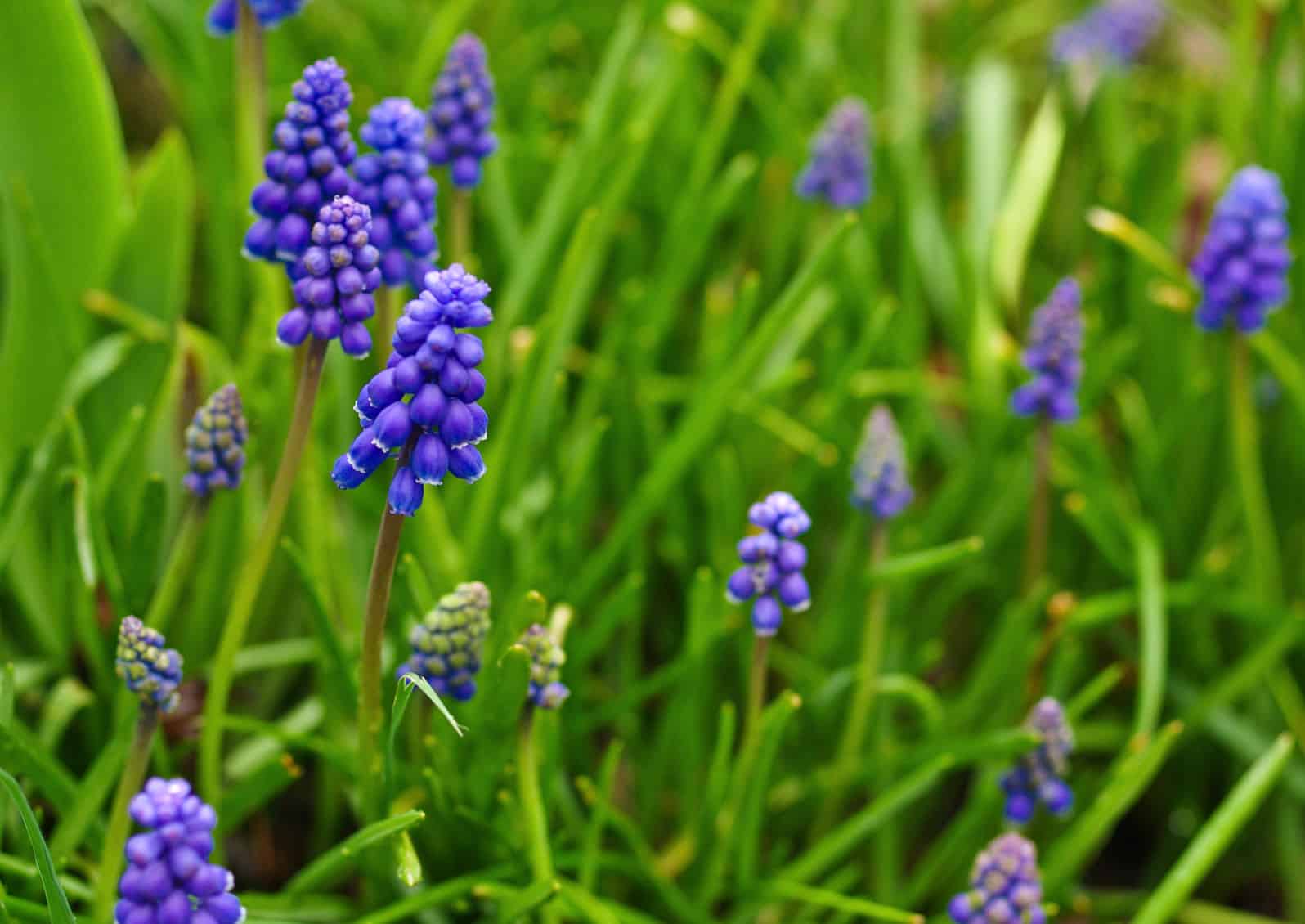
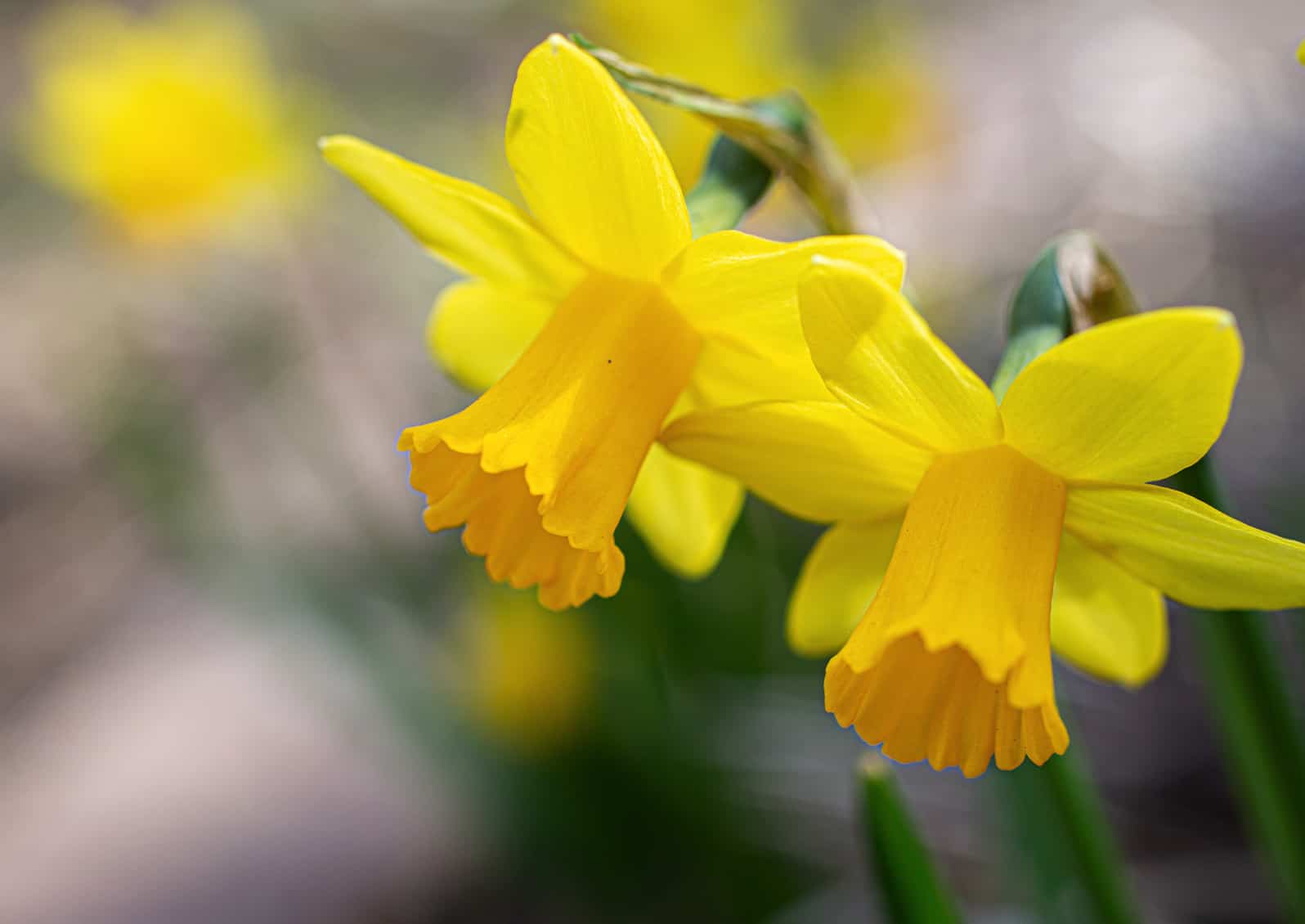
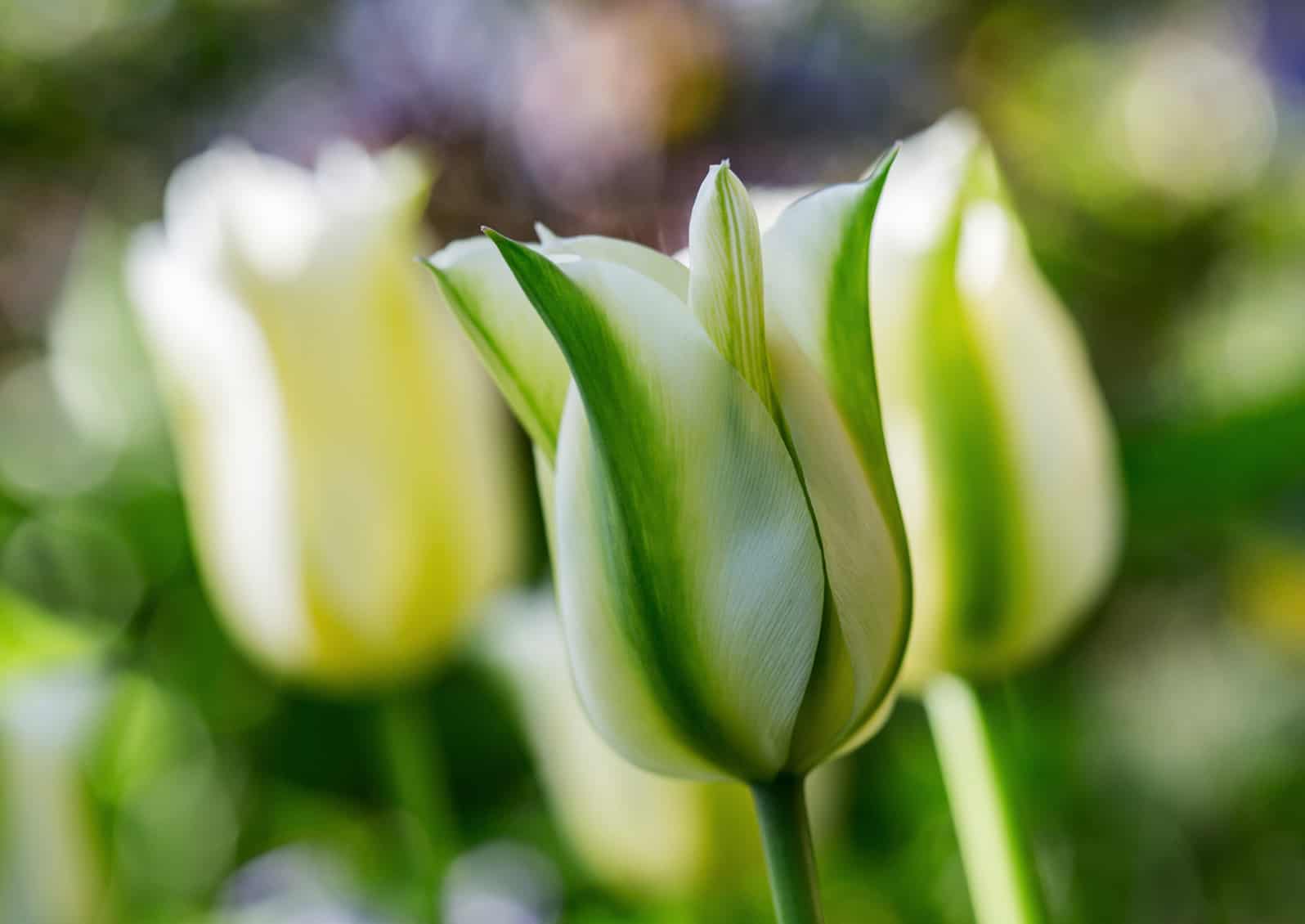
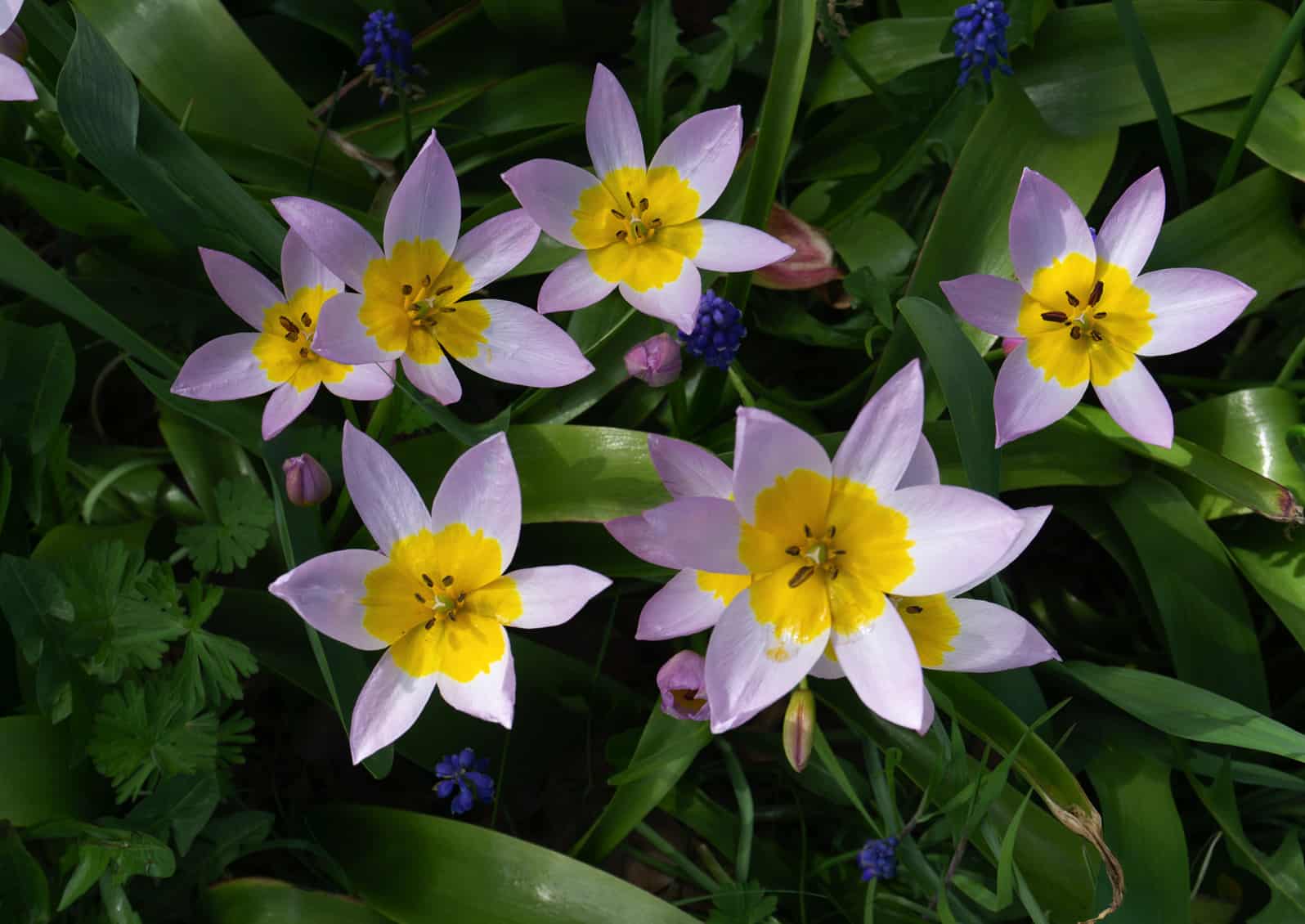
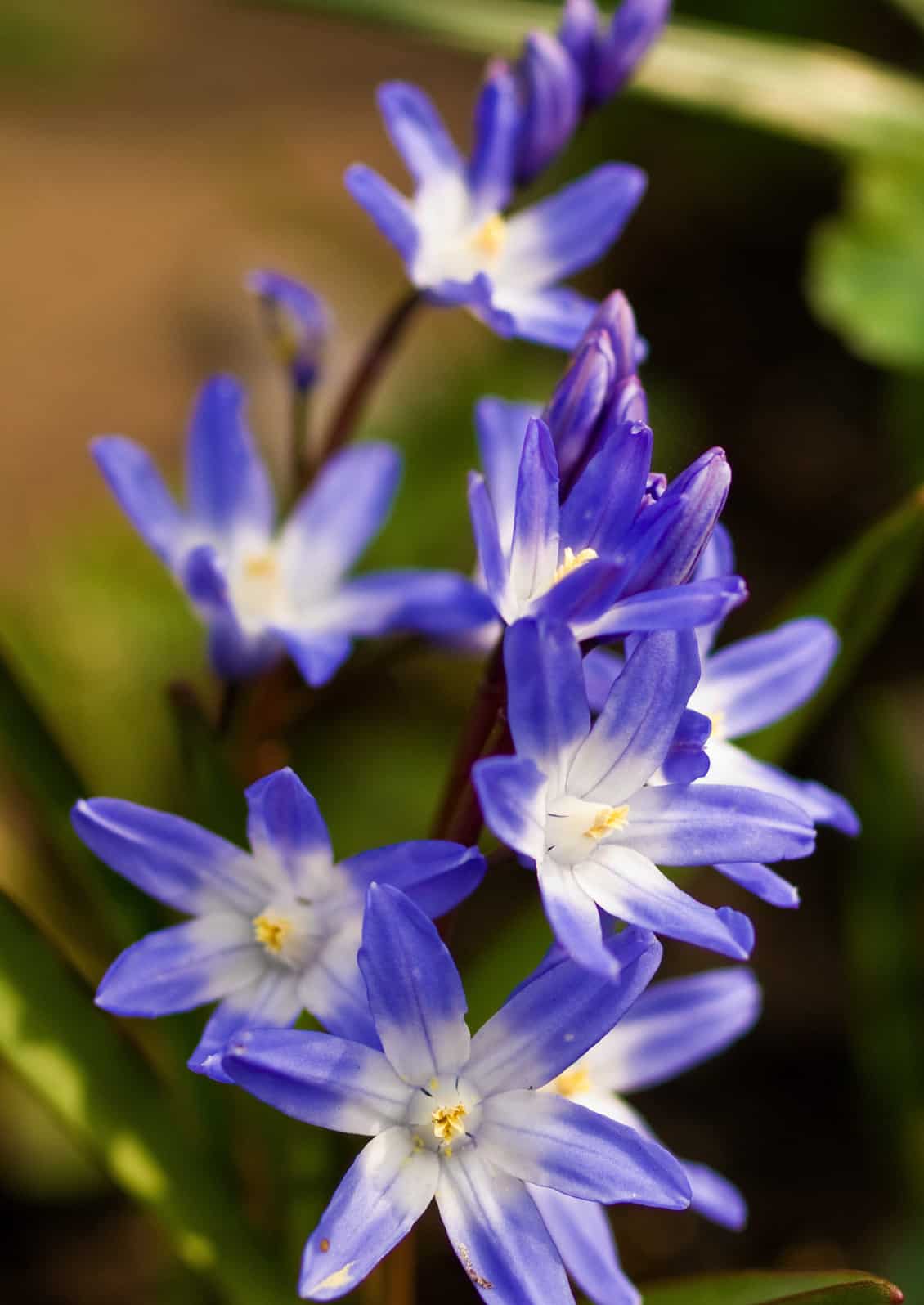
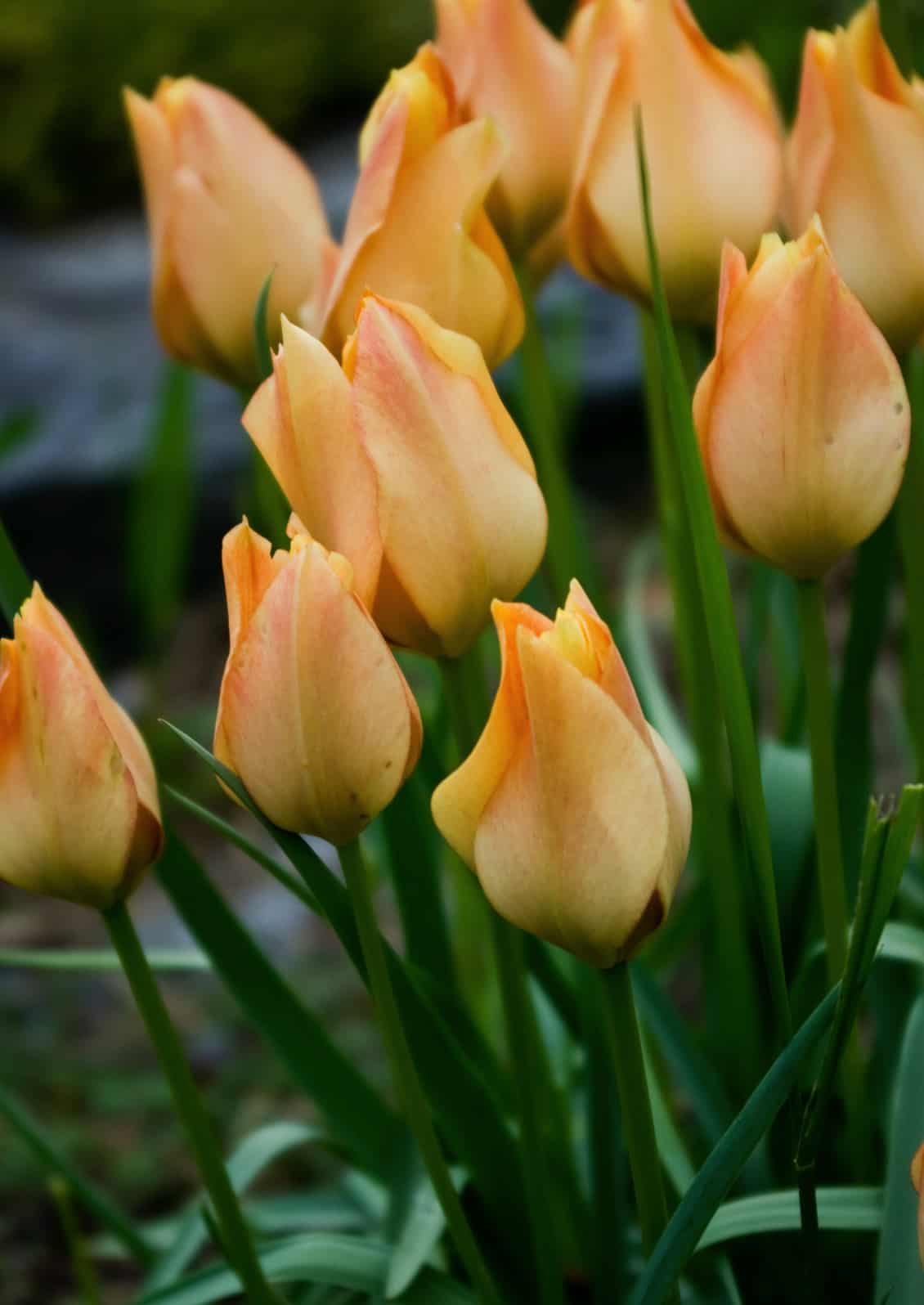
spring flowers blooming
Most of us think of bulbs as tulips, daffodils, and hyacinth, but many more plants grow from the group of geophytes which store everything they need to grow and bloom in an underground storage container. Photo © Adobe Stock
person planting tulip bulbs in soil
Depending on size, group multiples of bulbs 6 – 8 inches apart to maximize pops of color rather than individually. Photo © Adobe Stock

These are all geophytes, or “earth plants,” perennial plants with underground storage “containers” or systems. These underground storage containers are active and, when conditions are right, they grow, bloom, and reproduce after a period of dormancy. In general usage, all are referred to as “bulbs.”

Placing them all under the general category of bulbs, researchers note these plants have the common ability to store the plant’s complete life cycle in an underground storage structure. They all have a period of growth and flowering, followed by a period of dormancy.

The classification of these plants is based on their differing storage structures. True bulbs include tunicate bulbs (tulips) and imbricate bulbs (lilies). Corms (crocus, gladiolus), and tubers (dahlias) are referred to as bulbs, but have a different type of underground storage structure. Gardeners should pay attention to the bulb’s structure, the planting and emergence timetable, and planting recommendations to ensure blooming success.

Northwest Washington has been home to commercial bulb growers for decades, with more than 1,000 acres of tulips and daffodils grown annually in the Skagit Valley, yielding some 20 million bulbs and 75 million cut flowers.

While tulips are native to Central Asia, they were brought to the Netherlands by botanist Carolus Clusius in the late 1500s. Dutch immigrants to the Skagit Valley saw the potential of a maritime climate similar to Holland’s and began growing tulips and daffodils for commercial purposes in the 1940s and 1950s.

There are, however, many native bulbs in the region. The Puget Sound Chapter of the Washington Native Plant Society lists varieties of allium, lily, camas, iris, and hyacinth as native bulb plants. (See References and Resources.)

hummingbird on branch

For the Love of Hummingbirds: The Ecology of Anna and Other Hummingbirds

April Know & Grow

Free. No registration required.

With Greg Green, senior instructor at Western Washington University

Tuesday, April 21, 2026 ~ 1 p.m.

Sakuma Auditorium
16650 SR 536, Mount Vernon, WA 98273

Want to learn more about hummingbirds and the ecology surrounding them?  WWU Instructor and wildlife biologist Greg Green has been studying hummingbirds for more than a decade. His presentation will include the story of the Anna’s hummingbird march north over the past 75 years. Come hear about  this fascinating relationship between plants and animals.

Photo © Greg Green

True Bulbs: 

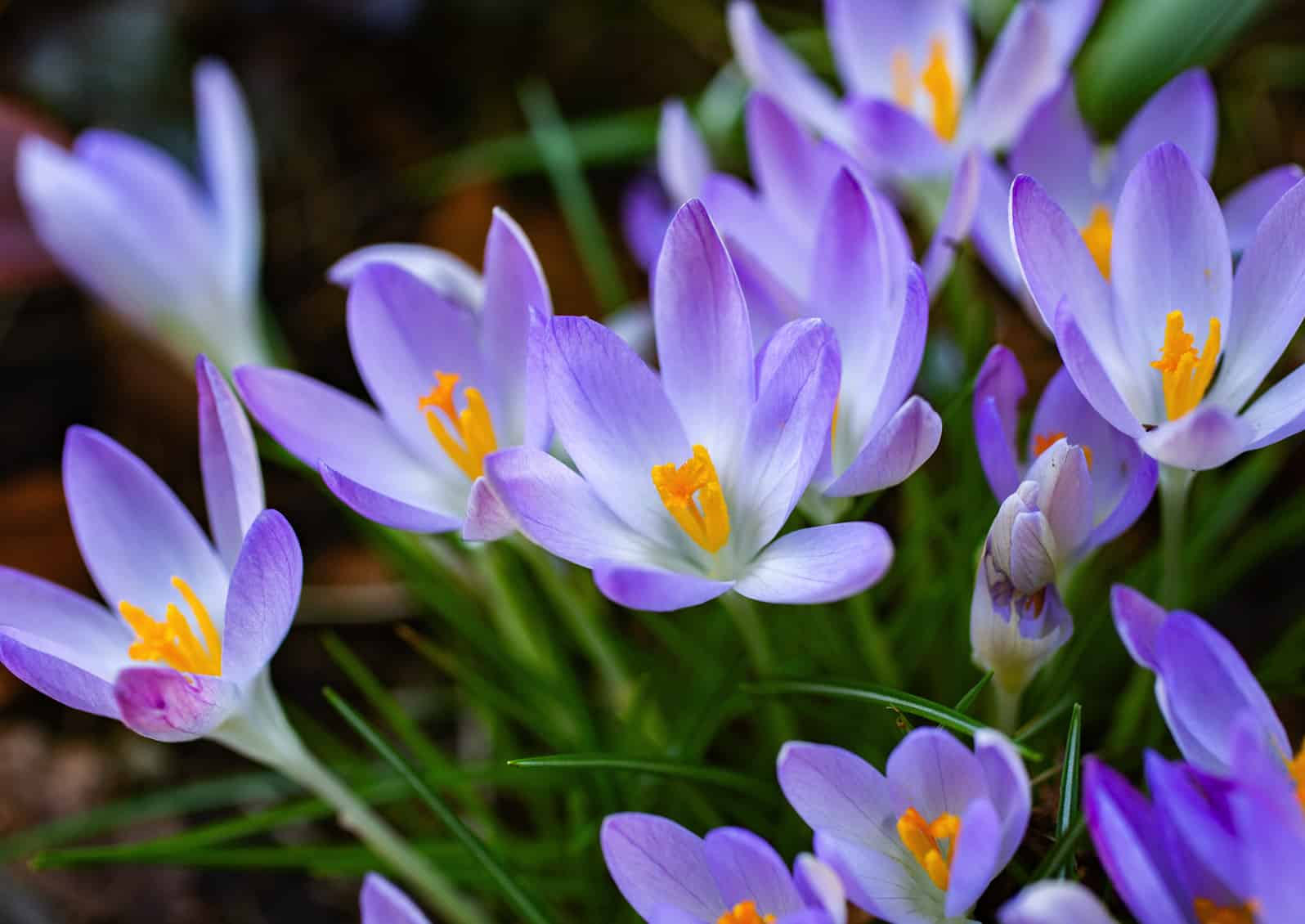
Planted in fall as soil temperature drops to 60° F, September to December, daffodils and tulips lead the way for spring-blooming bulbs. Crocus, hyacinth (Hyacinthus orientalis), grape hyacinth (Muscari armeniacum), snowdrop (Galanthus nivalis), and ornamental onion (Allium) also fit into this category.

The structure features a basal plate, or the bottom of the bulb where the roots grow; flesh that shows storage “rings;” skin that covers the outside; and the “shoot,” where the developing flower and leaves begin.

Plant spring bulbs two to three times as deep as the bulb is tall. For most larger bulbs, such as tulips and daffodils, they are planted about eight inches deep, while small ones, such as crocus, are planted three to four inches deep.

Forgot to plant your bulbs? While not ideal, it’s still OK to get them in the ground in January or even February if the soil isn’t frozen.

Spring-blooming bulbs are winter hardy. After the plants bloom and die back, they typically need no attention before repeating the perennial cycle in the home landscape. Bonus about daffodils: They are deer and rabbit-resistant.

gladiolus in bloom
gladiolus corms with green buds

Summer-blooming gladiolus grow from corms which have a swollen base and should be arranged in the soil with buds protruding up. They are planted in the mid-spring after danger of frost has passed. Photos © Adobe Stock


Corms:

Plants that grow from corms include gladiolus, crocus, and freesia. The structure is solid and features a swollen stem base. Somewhat similar to bulbs, they lack the layers of flesh and covering. Spring-blooming crocus are corms, but fall-blooming crocus are not true crocus but a bulb in the lily family.

Gladiolus corms can be dug in the fall, separated, and stored for replanting, though many gardeners in our area can leave them in the ground with minimal or no loss.


Photo © Adobe Stock
tuberous roots of dahlias in basket

Dahlias grow from tuberous roots which have buds or eyes near the crown. Photos © Adobe Stock

Rhizomes

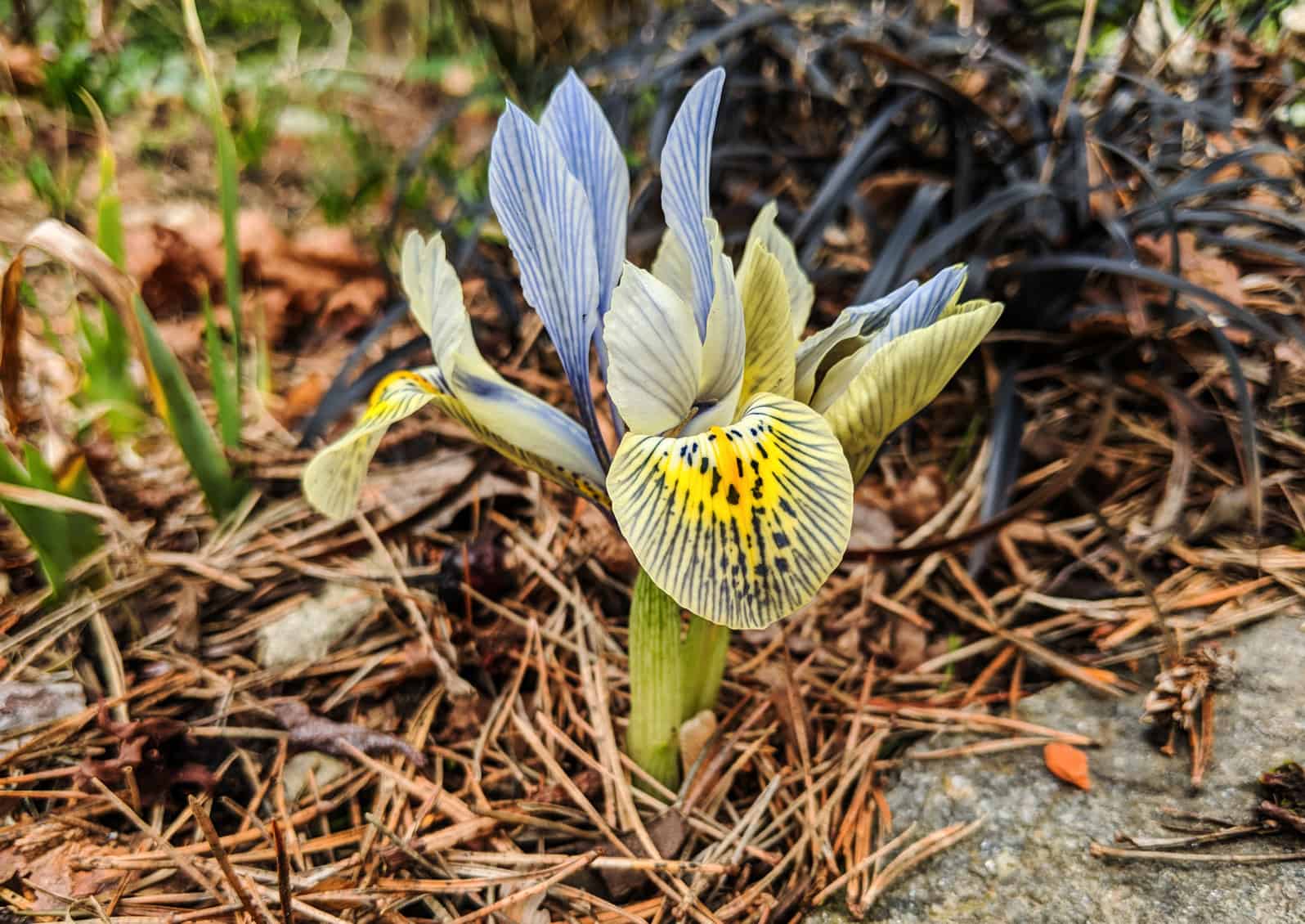
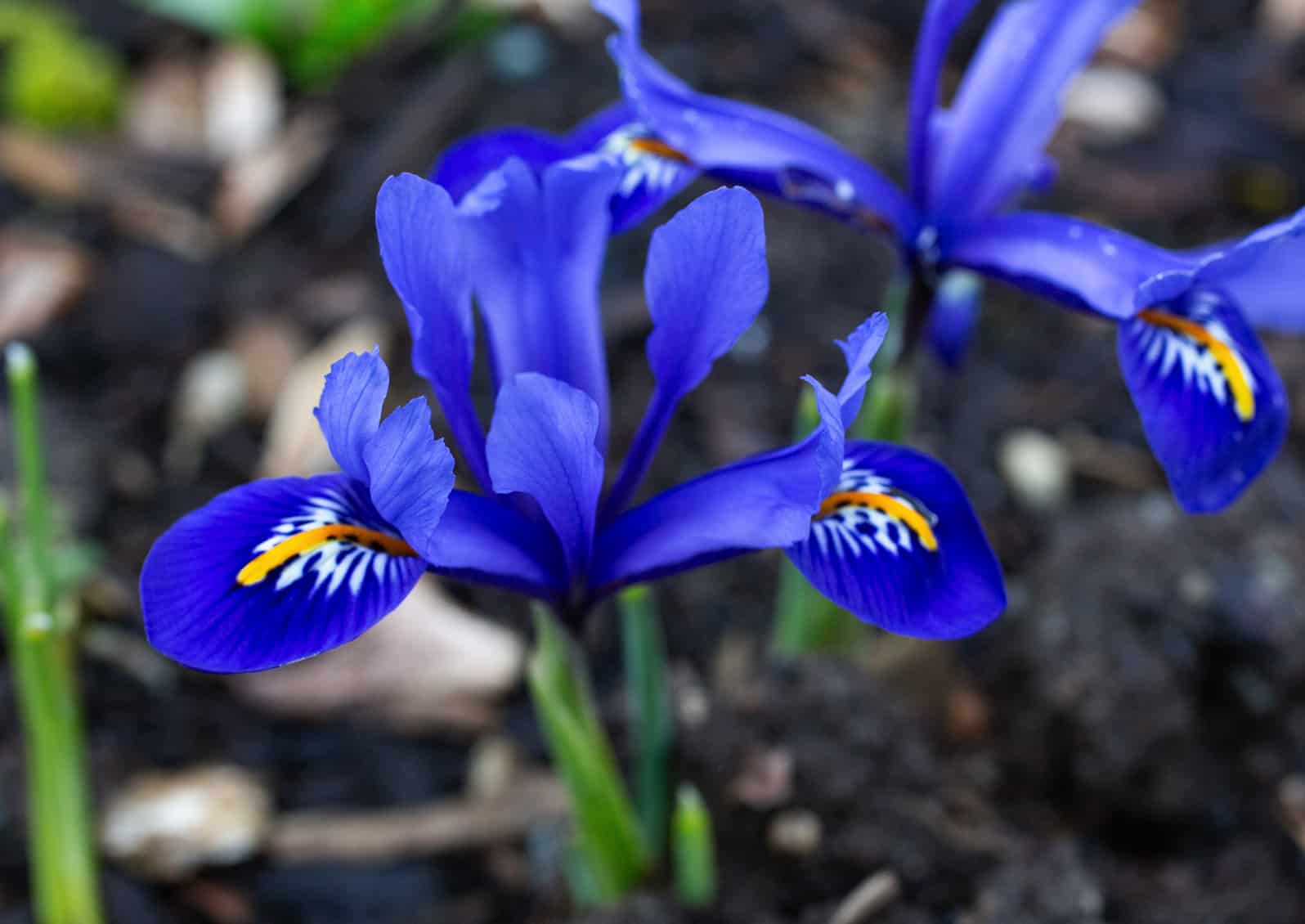
Plants developing from rhizomes, such as lily-of-the-valley (Convallaria), canna lily, and iris, grow horizontally under the soil’s surface, which can result in the plant spreading.

Though not strictly botanically classified as rhizomes, the fleshy roots of daylilies and peonies appear very similar and are sometimes referred to as rhizomes and/or tubers. The roots of these plants can store nutrients. Peony root clumps should be divided in the fall, while daylilies can be divided in the spring or fall.

Depending on your USDA zone, summer bloomers may not be winter-hardy. Each bulb type has specific spring planting requirements for timing and depth, based on the last frost-free date in your zone.

white bell flowers of lily-of-the-valley

bamboo rhizomes

Lily-of-the-Valley and bamboo both grow from another type of geophyte called rhizomes. These rhizomes can spread easily underground and can be managed with annual maintenance. Read our blog article growing bamboo Photos © Adobe Stock and Kay Torrance.

Tubers and Tuberous Roots

Caladium, Oxalis, Gloriosa, ranunculus, and anemone are all grown from tubers.

Structurally, a big difference between tubers and true bulbs or corms is the absence of a basal plate where roots develop or a tunic covering. They have “eyes” where the new plant will grow.

Dahlias fall into a slightly different category called tuberous roots. The plant’s energy is stored in an actual root, and it forms growth from buds at the top of the root or the base of the stem. Dahlias can be dug up in the fall and saved for planting the following spring, normally mid-May in northwest Washington. Other tuberous roots include all types of potatoes and daylilies.

This group of perennial plants, called geophytes-has the unique ability to store energy in their underground “storage containers” and burst forth with beautiful flowers throughout spring, summer, and fall. Identifying them as bulbs, corms, tubers, or rhizomes, helps a gardener understand what is required for successful growth. 

References and Resources

Bulbs, Corms, Rhizomes and Tubers. (2026) Penn State Extension.

Pokorny, K. (2025) Plant spring-blooming bulbs in fall for years of low-maintenance color. Oregon State University Extension.

Streich, A., Janssen, D., and Cue, K. (August 2007) Spring Flower Bulbs. University of Nebraska-Lincoln Extension, Institute of Agriculture and Natural Resources.

What is a Geophyte? (2024) Coastal Gardener. University of California Agriculture and Natural Resources.

Bulbs. (2026) Backyard Farmer. University of Nebraska-Lincoln Extension, Institute of Agriculture and Natural Resources.

Easy to grow native bulbs you should grow now. Washington Native Plant Society. Native Bulb Information

ABOUT THE AUTHOR: Kari Ranten is a retired journalist and health care communicator who became a certified Skagit County WSU Extension Master Gardener in 2024.


Questions about home gardening or becoming a master gardener may be directed to Skagit County WSU Extension Office, 11768 Westar Lane, Suite A, Burlington, WA 98233; by phone: 360-428-4270; or via the Skagit County WSU Extension website.

Washington State University Extension helps people develop leadership skills and use research-based knowledge to improve economic status and quality of life. Cooperating agencies: Washington State University, US Department of Agriculture, and Skagit County. Extension programs and policies are available to all without discrimination. To request disability accommodations contact us at least ten days in advance.


Photo: © Adobe Stock
© Adobe Stock

Post: April 3, 2026

Subscribe to the Blog >

Cultivating Community: How local libraries help grow gardeners

You’ll find resources and inspiration at your local library

By Skagit County WSU Extension Master Gardeners

For many of us, gardening is more than just a hobby that brings us joy. It’s a way of life that puts fresh food on the table and connects us to our neighbors.

For both seasoned gardeners and curious beginners, local libraries provide a valuable resource on the path to greener thumbs. Beyond books, libraries offer a vibrant array of services tailored for gardeners: from seed libraries and expert-led workshops to curated gardening resources and community events.

Earlier in the year, a group of Skagit County WSU Extension Master Gardeners set out with a list of questions to ask their local library about gardening services. The library staff at each library welcomed our questions and encouraged master gardeners’ participation in their programming and book selections.

What Libraries Have in Common for Gardeners

As expected, each library confirmed that it has a collection of non-fiction books related to gardening. They encourage questions and are happy to help with resource questions. When searching for books and DVDs in the library catalogs, they said to use multiple keywords to narrow your search; for instance, a book about learning to garden in a warming environment may be found under “Climate Change” rather than “Gardening.”

Online Resources: 

A library card from any library opens the door to Libby through the free statewide Washington Anytime digital library system. Along with hundreds of books, Libby has more than 700 magazines under the Home and Garden tab.

Events for Gardeners:

Checking or subscribing to each library’s e-newsletter, or following their social media, are the best ways to stay informed about presentations of interest to gardeners.

Library of Things: 

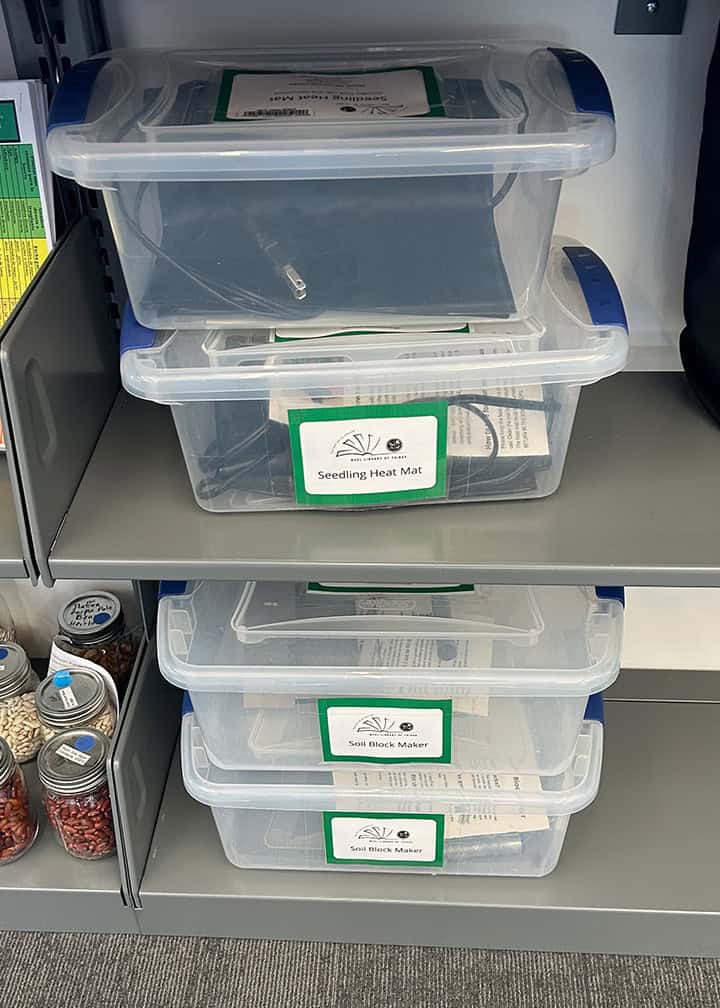
The Mount Vernon and Burlington Libraries offer a “Library of Things” for checkout. Items range from telescopes and microscopes to park passes and games, many of which are geared toward youth. Gardening items include seed starting kits, mats, seed blocks, and microscopes.

Seed Library: 

A community-driven, open-to-the-public resource, all libraries, except Central Skagit, offer a seed library. Each seed library operates differently. Mount Vernon and La Conner’s are shelved with access whenever the library is open. Others offer a seed exchange on a seasonal basis, or as a one-day event. Seed libraries are a great way to save money while trying a limited number of new varieties. Jars and packets are well-labeled with take-home envelopes provided.

Gale Research: 

For those wanting a deeper dive into a topic, all libraries subscribe to Gale Research, a renowned publishing company specializing in authoritative reference materials and digital resources for libraries, schools, and academic institutions. Its comprehensive digital research tools and collections support students, educators, and researchers in conducting in-depth research on many topics, including science and botany.

Specific Plant Questions:

The master gardeners who interviewed librarians at their local libraries noticed an interesting correlation: librarians are often avid gardeners in their off hours. That said, they can direct patrons to plant identification and other relevant resources, but plant-specific questions are best directed to the Skagit County WSU Extension Master Gardener Plant Clinic and resources.


A Note about
Skagit County Libraries:

Unlike the library systems in neighboring counties, the libraries in Skagit County are funded through each city or in some cases a local taxing district. Each library offers free cards to residents, property owners, business owners within their area of service, and all teachers and students no matter where they live. Residents in unincorporated areas can purchase a card. Cardholders have reciprocity with other libraries in the county for no extra fee. See the footnote below about reciprocal agreements between libraries.


hummingbird on branch

For the Love of Hummingbirds: The Ecology of Anna and Other Hummingbirds

April Know & Grow

Free. No registration required.

With Greg Green, senior instructor at Western Washington University

Tuesday, April 21, 2026 ~ 1 p.m.

Sakuma Auditorium
16650 SR 536, Mount Vernon, WA 98273

Want to learn more about hummingbirds and the ecology surrounding them?  WWU Instructor and wildlife biologist Greg Green has been studying hummingbirds for more than a decade. His presentation will include the story of the Anna’s hummingbird march north over the past 75 years. Come hear about  this fascinating relationship between plants and animals.

Photo © Greg Green

Anacortes Public Library

By Andrea Saxton, Skagit County WSU Extension Master Gardener

The Anacortes Public Library offers a robust selection of gardening books in nonfiction, covering topics from general techniques to landscaping, indoor and outdoor gardening, and PNW-specific practices. Part of the collection is funded by a donation from the Jeane Thomson family to the Anacortes Library Foundation.

The library subscribes to Horticulture magazine, and issues are available for browsing and checkout.

The APL hosts a Seed Library, maintained and stocked by Transition Fidalgo’s Seed Share group. Transition Fidalgo is a non-profit organization committed to climate resiliency and occasionally hosts gardening-related workshops and educational programs at the library.

Burlington Public Library

By Kari Ranten, Skagit County WSU Extension Master Gardener

The Burlington Public Library has a wide variety of gardening books ranging from bulbs to plant starts. The library has how-to books on creating different types of gardens, including cutting gardens, vegetable gardens, container gardening, and landscaping.

If a good afternoon for you includes perusing a magazine that you can hold in your hands, the BPL has subscriptions for Garden Gate, Mother Earth News, and Better Homes and Gardens

Every April, the Burlington Library holds a class on flower arranging, and in the summer, Sarah Wagstaff from SUOT Farm & Flowers hosts a story time for kids. Subscribe to the library’s newsletter to stay up-to-date about coming events at the library.

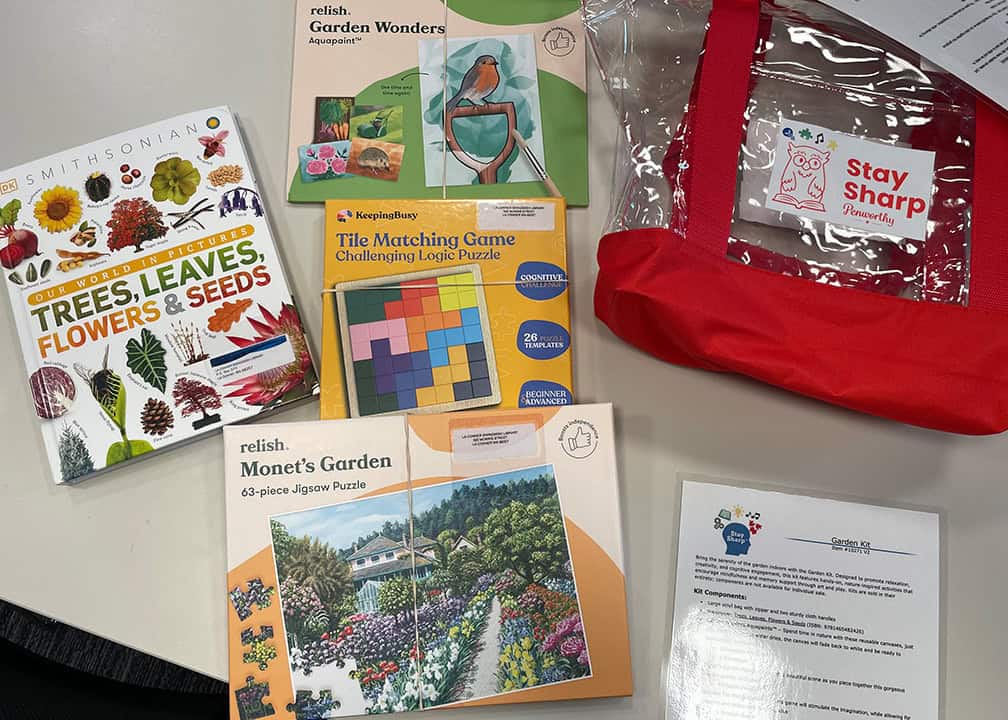
kit showing books and activities about gardening for children.
La Conner Swinomish Library “Stay Sharp” Kit for children. Photo © Aven Wright-McIntosh
Spanish books about gardening on shelf
Spanish books about gardening in Mount Vernon City Library. Photo © Ginny Bode

Central Skagit Library

By Cindy Bjorklund, Skagit County WSU Extension Master Gardener

The Central Skagit Library in Sedro-Woolley offers a wide variety of publications for the home gardener including books on fruit and vegetable gardening, flowers, gardening in the Pacific Northwest, and homesteading.

The summer reading program is titled Nature. Their physical magazine subscriptions include Self-Reliance, Mother Earth News, Fine Gardening, and Mary Jane’s Farm.

La Conner Swinomish Library

By Aven Wright McIntosh, Skagit County WSU Extension Master Gardener

The newest addition to the city library system, the La Conner Swinomish Library, reports a small but engaging adult non-fiction gardening section and a children’s section.

  • For the past several years, LCSL has hosted workshops on eliminating food waste and Master Gardener Katryna Barber’s worm composting presentation.
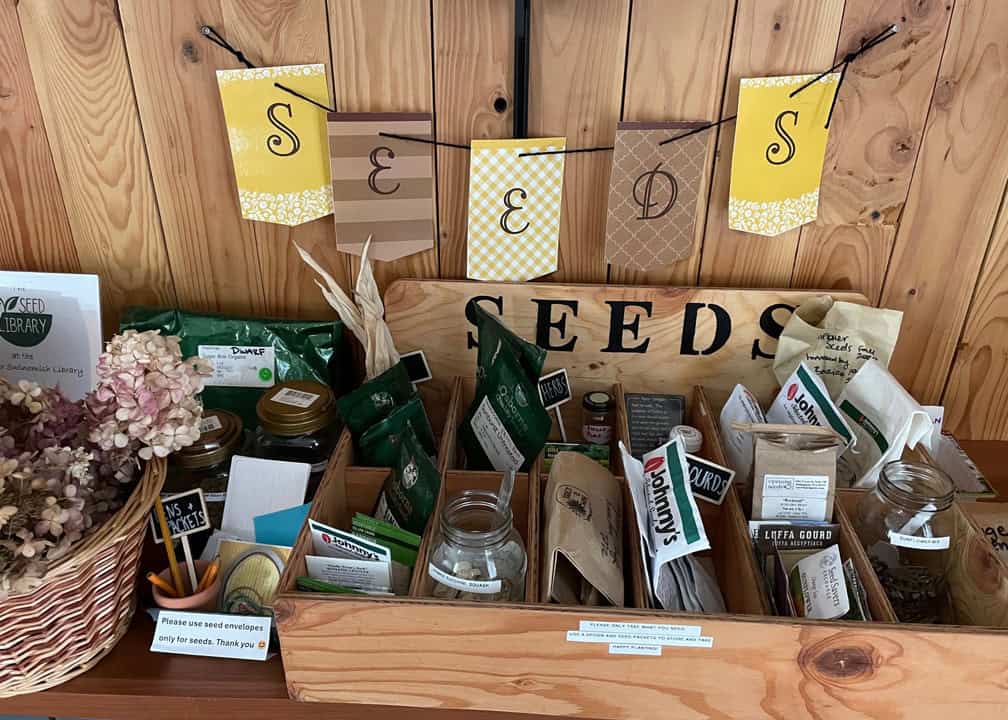
  • A small seed library with an ever-changing selection of seeds is open to the public for give-and-take. It is located in the community room and is open during library hours.

Library patrons learn how to easily research any topic on in-library computers, locate it on the shelves, or request a transfer from another in-district library. Burlington, Central Skagit, and Concrete share an in-district agreement. A La Conner Swinomish Library card still gives access to all six county libraries, it just works a bit differently for the libraries in Mount Vernon and Anacortes.

The library has the “Stay Sharp” Garden kit which can be checked out providing hands-on nature-inspired learning activities. The librarian also recommends the new “Steam Kits” program available online, which includes activities for kids’ gardening adventures.

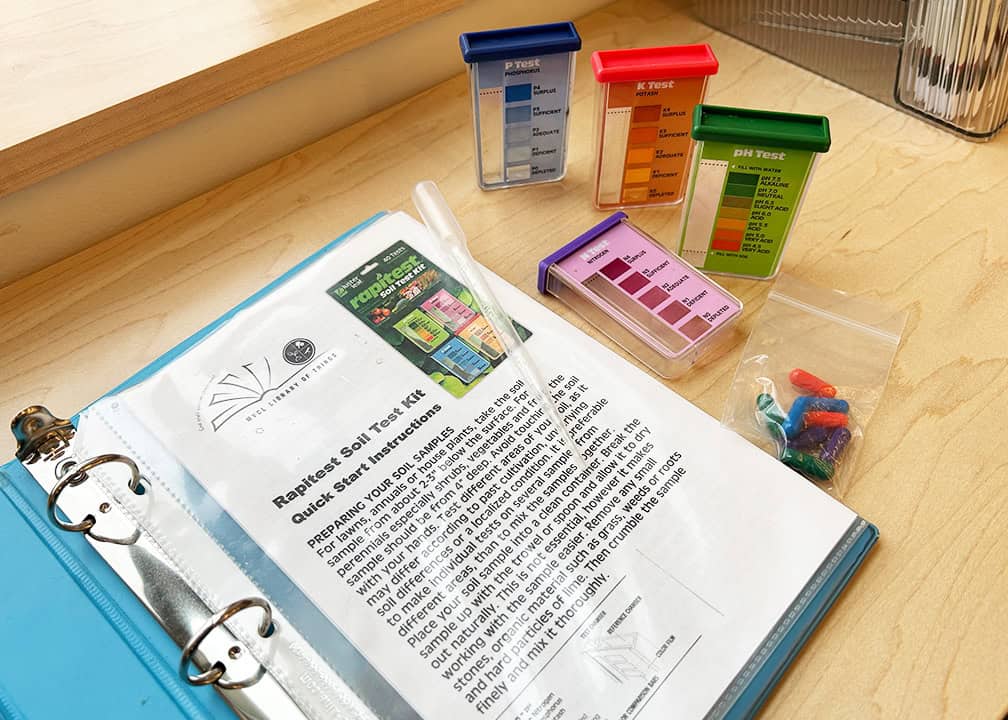
Book and vials for soil testing
‘Library of Things’ soil test kit Mount Vernon City Library. Photo © Ginny Bode
seed packets and jars in wood box
Seed Library La Conner Swinomish Library Photo © Aven Wright-McIntosh

Mount Vernon City Library

By Ginny Bode, Skagit County WSU Extension Master Gardener

Mount Vernon City Library has an excellent seed library open to the public during library hours. The seed library along with the resources of the “Library of Things” are the inspiration behind this article. Beyond the books in the Dewey Decimal category 635 Gardening, librarians encourage patrons to look for garden-related books under all the 630 categories-Agriculture and Related Technologies, as well as under 580-Plants and Botany and 550-Earth Sciences. 

The collection of resources for gardeners depends on the size of the library; this factor is particularly important when discussing resources for children learning to garden. The Mount Vernon City Library, which boasts the largest children’s collection north of Seattle, includes many children’s books about science and gardening.

Along with hard-copy books and magazines for gardeners, the MVCL has a USDA-certified commercial kitchen which can be rented by the hour. Entrepreneurs starting food-certified businesses can rent space to make food for farmers’ markets, food trucks, and restaurants. The fees are affordable and a great resource for enterprising gardeners wanting to take their recipes to the next level. Learn more about the library’s kitchen facilities

Sno-Isle Regional Library System

By Linda Olmstead, Skagit County WSU Extension Master Gardener

The Sno-Isle Library system includes 24 libraries located in Island and Snohomish Counties. Library membership allows residents access to all libraries within the system. A “Library on Wheels” option is also available. Sno-Isle has an extensive collection of gardening and related materials in a variety of formats, including books, DVDs, e-books, magazines, and academic journals. Multiple databases provide access to a wealth of materials. Sno-Isle hosts online and in-person events at many of its locations. Library staff can also help members with advanced research on topics of interest through an in-person or virtual session.

  • More than 1,000 gardening-related traditional format books are available for checkout by library members.
  • More than 1,200 online gardening-related e-books can be checked out on the library’s website.
  • The library offers gardening courses on DVD, some of which can be checked out and the remainder accessed online. Examples include “The Great Courses: How to Grow Anything,” “The Science of Gardening,” containing 24 episodes on various gardening topics, and “The Botanist’s Eye: Identifying the Plants Around You.”
  • More than 80 gardening magazines are available digitally, along with physical subscriptions to Fine Gardening, Garden Gate, Martha Stewart Gardening, Gardens Illustrated, and Gardeners’ World.
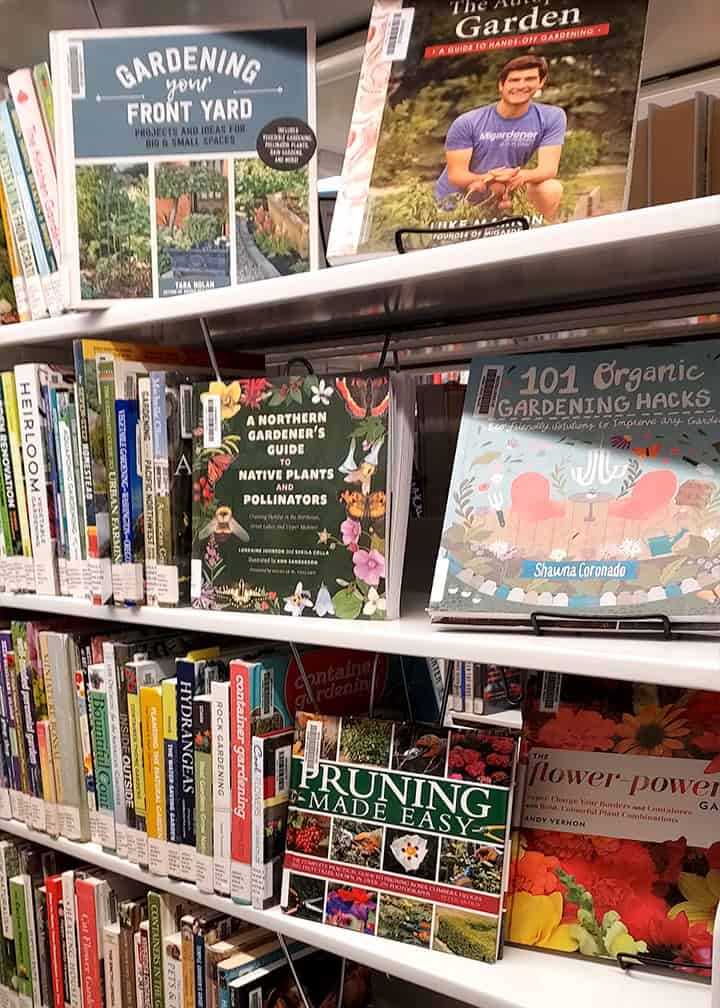
books about gardening on library shelf
The Central Skagit Library’s summer reading program is titled “Nature.” © Cindy Bjorklund
kits in plastic boxes on shelf
The “Library of Things” at the Mount Vernon City Library has a collection of items for check out which help the gardener get started. Photo © Ginny Bode

Upper Skagit Library, Concrete

By Ginny Bode, Skagit County WSU Extension Master Gardener

The Upper Skagit Library reports “all sorts of gardening books from small-scale to market gardening how-to books,” along with several field guides on PNW native plants, including weeds.

The Upper Skagit Library occupies a storefront space in Concrete and works in concert with the Central Skagit, Burlington, and La Conner Libraries, so you can get any book from those libraries delivered to the Upper Skagit Library. Their physical magazine subscriptions include Mother Earth News, Fine Gardening, and Garden Gate.

Librarian Cody Johansen suggests “Secret Gardeners: Growing a Community and Healing the Earth” as a great book on sustainable gardening practices for children.

For online local resources, the librarian recommends: 

  • “Sproutshare” is a Facebook group managed by Kerry Higgins at the Mansford Grange near Darrington. It hosts a community platform for posting available seeds, starts, and cuttings.
  • “Seedtime” is a great app for planning and has educational courses as well.
  • “Farm My Yard” is another great app for planning and shows which plants grow well in our area.

Elisabeth C. Miller Library, Seattle, Washington

By Ginny Bode, Skagit County WSU Extension Master Gardener

The Elisabeth C. Miller Library serves as a premier horticultural resource for both the public and professionals. Located near U-Village and UW Stadium, your Washington State Driver’s License qualifies you to receive a library card.

The library has more than 15,000 books and 400 magazine titles in-house. Managed by the Elisabeth C. Miller Foundation (not the UW Library system), the library is a welcome oasis for learning about all things horticultural. The large children’s library, with 1,090 books in the Youth Collection available for borrowing and another 449 in the Parent/Teacher Resource Collection. It is easy to many resources on specific areas of horticulture within the huge collection of books and periodicals focusing on gardening, botany, landscape design, and plant sciences. The library is a treasure trove of learning, offering community programs, garden walks, lectures, workshops, botanical art shows, and children’s activities.

The Miller Library website keeps an up-to-date calendar of local plant sales, garden tours, a plant answer line (much like the Skagit County WSU Extension Master Gardener Plant Clinic), and ongoing book reviews.

Whether you’re a seasoned gardener or planting your first seeds, your local library is ready to support your journey. By connecting people, sharing resources, and nurturing curiosity, libraries help gardens-and communities-flourish.

Library Reciprocity in Skagit County
(as provided by Central Skagit Librarian Anne Booker)

A brief overview: 

  • Skagit County does not have a countywide library system but rather six independent library districts. Many, but not all of the people living in Skagit County pay library-supporting taxes to one of these districts.  
  • Four of the library districts in the county have formed a consortium (Burlington, La Conner, Upper Skagit, Central Skagit). Patrons living in any of these four districts can use a card from any of these four libraries to check out at any of these four libraries.
  • These four libraries share a catalog and share materials.  
  • Folks living in either the Mount Vernon Library district boundaries or the Anacortes Library district boundaries are able to get cards at any of the other libraries, but do require a separate card.

If someone lives outside the boundaries of any library district, they are still able to obtain a library card at any of the libraries in Skagit County, but will need to pay a fee directly to the library. The fee varies from library to library and grants access only to the library where it is paid.

ABOUT THE AUTHORS:

This article was researched by a team of Skagit County WSU Extension Master Gardeners, and was compiled by Ginny Bode with Kari Ranten, Linda Olmstead, Aven Wright-McIntosh, Cynthia Bjorkland, and Andrea Saxton.


Questions about home gardening or becoming a master gardener may be directed to Skagit County WSU Extension Office, 11768 Westar Lane, Suite A, Burlington, WA 98233; by phone: 360-428-4270; or via the Skagit County WSU Extension website.

Washington State University Extension helps people develop leadership skills and use research-based knowledge to improve economic status and quality of life. Cooperating agencies: Washington State University, US Department of Agriculture, and Skagit County. Extension programs and policies are available to all without discrimination. To request disability accommodations contact us at least ten days in advance.


drops of rain on large puddle

Post: February 20, 2026

Subscribe to the Blog >

Tips on Collecting Rain Water

A self-sufficient gardening practice

By Jane Billinghurst, Skagit County WSU Extension Master Gardener

Originally published in April 13, 2018

Rain barrels are a low-cost, low-maintenance way for you to reduce your water bills and be more self-sufficient in your gardening practices. Rain might seem to be absent in the Skagit Valley over the summer, but Mount Vernon, for example, averages a little under one and three-quarter inches each month from May to September. If you have 1,000 square feet of roof draining into rain barrels, this comes to about 1,000 gallons of rainwater for each of these months-more than enough to fill an array of 55-gallon rain barrels around your house.

To put that into perspective, if you want to apply an extra inch of water to 500 square feet of garden each month in summer (in addition to rainfall), that will take just over 300 gallons of water a month or about half a dozen rain barrels’ worth, which means that one rain barrel is good, but multiple rain barrels are even better.

Site your rain barrels next to downspouts, then divert the downspout so the water flows directly into the barrel. Bear in mind that the barrel might overflow, which you definitely don’t want happening right next to your house. Therefore, you want to attach a hose pipe to an overflow spout at the top of the barrel and have it empty in a safe place (at least 15 square feet of porous ground is recommended at a minimum of 10 feet away from foundations or hard surfaces such as driveways or sidewalks and 5 feet away from neighboring property or rights of way).

gutter drain spout directed to mesh covered rain barrel

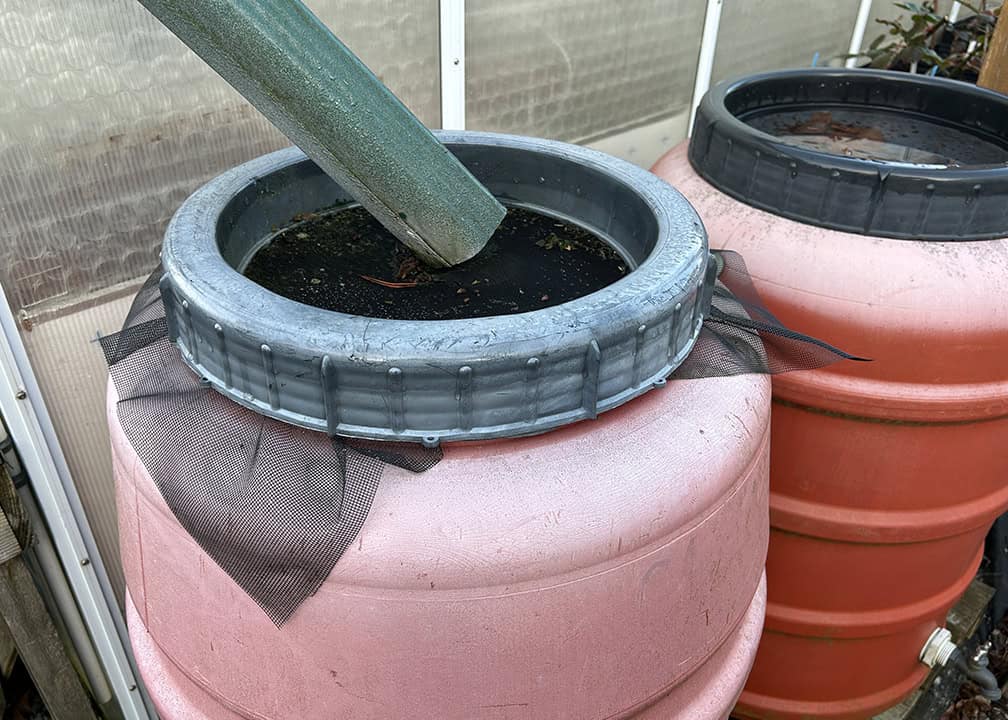
Direct the downspout so it flows directly into a rain barrel with a mesh guard on top to keep debris and mosquitoes out of the barrel. Photo © Skagit Master Gardener Foundation

rain barrels with gutter downspout directed into top

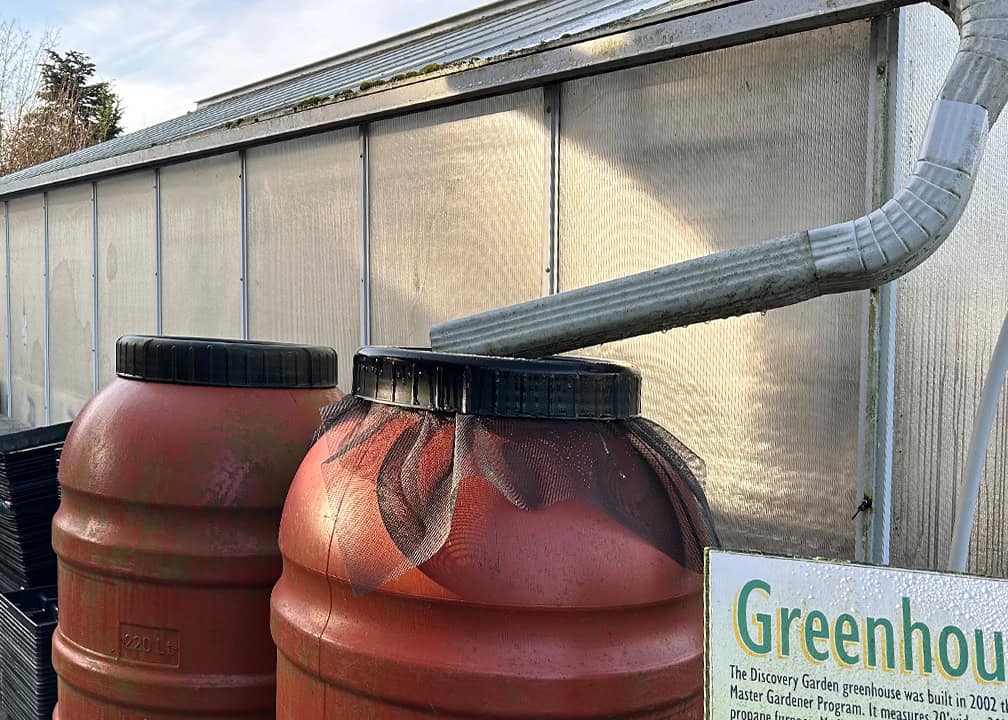
Multiple rain barrels at the Discovery Garden, west of Mount Vernon, provide all of the water needed for seed starting and plant propagation until mid-April.  Photo © Skagit Master Gardener Foundation

Alternatively, you can install a downspout diverter that temporarily diverts rainwater from the downspout into the barrel. When the barrel is full, the diverter shuts off access to the barrel, and the rainwater flows down the spout once again.

Once you have decided where you want to place your rain barrels, what next? A 55-gallon rain barrel full of water weighs over 400 pounds. You need a sturdy base to support such a heavy weight and keep it level. The barrel also needs to be elevated enough that you can fit your watering can under the spigot and enough to provide water pressure if you are using a hose to empty the barrel.

The Skagit PUD site listed at the end of this article includes some tips on connecting a series of rain barrels together to increase the amount of rainwater you can store. Other sites offer options, as well.

Make sure you put a mesh guard on top of your rain barrels to keep mosquitoes from laying eggs in them, and remember to clean off the guard regularly to prevent it from getting clogged with debris washed down the downspout.

Use a clean, food-grade container to ensure you start with a barrel free of pollutants. The container should be opaque to keep out sunlight and prevent algae growth. Since you won’t be irrigating your plants in the winter (they won’t be growing and will get plenty of rain anyway), take the opportunity to rinse out your barrels. If you store them upside down, you won’t have to worry about them collecting water and freezing over winter, which might cause them to crack. You can set them up again in March or April when temperatures warm, plants start to grow, and there’s still lots of rain to catch.

There are several factors that affect how clean the water coming off your roof is. These include your location, the composition of your roof, and whether your roof has recently been treated with chemicals to control moss or algae. WSU publication #FS280E, “Potential Contaminants in Residential Rain Barrel Water” (see resources at the end of this article), goes over these issues in detail. To be on the safe side, avoid irrigating vegetable gardens with rainwater collected from roofs. Reserve it instead for ornamental plants in your yard and containers.

A number of online sites have useful resources on rainwater collection for our region. The Centers for Disease Control and Prevention has a page on rainwater and health. Washington State Department of Ecology covers rules for collecting rainwater. Skagit County Public Utility District has information on constructing, installing, and maintaining rain barrels. Washington State University Extension goes over potential contaminants in rain barrel water, and US Climate Data gives rainfall averages where you live if you want to calculate for yourself just how much rainwater you might be able to collect. Use the formula 0.623 gallons x square footage of the catchment area x inches of rain per month or year, depending on the length of time.

two women in overalls
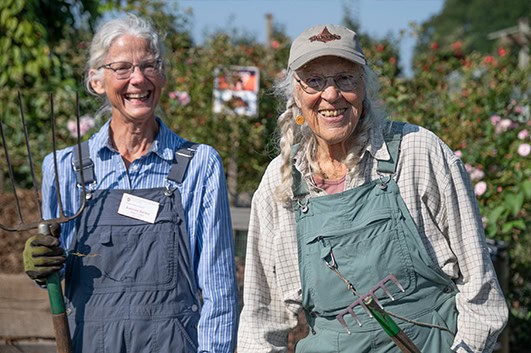
Presenters: Herta Kurp and Katryna Barber

Know & Grow Series

Composting and Vermiculture for the Home Gardener

Tues., March 17 , 2026 — 1 p.m.
— Free, no registration required —

at the NWREC Sakuma Auditorium
16650 State Route 536, Mount Vernon, WA

RESOURCES:

Collecting Rainwater and Your Health. (2024) US Centers for Disease Control


Soak up the Rain. US Environmental Protection Agency.


Rainwater Collection. Department of Ecology State of Washington


US Climate Data – Mount Vernon, Washington


Chalker-Scott, L. (Rev. 2025) Potential Contaminants in Residential Rain Barrel Water. WSU Extension Publications #FS280E Washington State University, Pullman, WA


Tate, K. Rain Barrels 101: DIY Tips & Tricks for Collecting Rainwater. Skagit Public Utility District, Mount Vernon, WA

ABOUT THE AUTHOR: Jane Billinghurst became Skagit County WSU Master Gardener in 2005. 


Questions about home gardening or becoming a master gardener may be directed to Skagit County WSU Extension Office, 11768 Westar Lane, Suite A, Burlington, WA 98233; by phone: 360-428-4270; or via the Skagit County WSU Extension website.

Washington State University Extension helps people develop leadership skills and use research-based knowledge to improve economic status and quality of life. Cooperating agencies: Washington State University, US Department of Agriculture, and Skagit County. Extension programs and policies are available to all without discrimination. To request disability accommodations contact us at least ten days in advance.


large garden with people walking on paths

Post: February 6, 2026

Subscribe to the Blog >

Getaways: Public Gardens provide inspiration from coast to coast

Master gardeners share ideas for gardens to visit across the country

By Skagit County WSU Extension Master Gardeners

Visiting a special garden in another part of the country can provide ideas, inspiration, and an education for all gardening enthusiasts. It’s no surprise that master gardeners often incorporate a garden visit into their travel itineraries, drinking in the beauty and diversity of the natural landscape in places near and far.

Of course, the focus is often on the anticipated beauty of blooms and color from spring to fall; however, many gardens host special events and features during the holidays and winter that offer lovely after-dark variations on trees, plants, and water features.

A column published this time last year focused on gardens in the Pacific Northwest. This time, several Skagit County WSU Extension Master Gardeners expand their horizons to include interesting garden destinations across the United States, from Maine to California, and in British Columbia. Details for each garden include website links, contact information, and logistics to help prepare for a visit.

Chinese building beside pond in large garden

The Chinese Garden at the Huntington is one of the largest classical-style Chinese gardens outside of China. Photo © Pexels.com | Utsukushii

path through large display garden

The themed gardens and conservatories at the Huntington feature over 84,000 plants, with extensive collections of rare plants. Photo © Pexels.com | Maxie T.

Huntington Gardens

By Ginny Bode, Skagit County WSU Extension Master Gardener

Huntington Gardens, north of Los Angeles, offers a breathtaking blend of art, history, and nature. It is difficult to choose what to explore first – the stunning themed gardens, world-class art collections, or rare manuscripts.

Originally the San Marino Ranch, the estate was acquired in 1903 by Henry E. Huntington, a railroad and real estate tycoon. He and his wife, Arabella, created a place for their passions: Art, rare books, and plants. Since 1919, the Huntington has been in a public trust for education and enjoyment.

The entrance fee offers more than can be experienced in a day and includes the 130-acre botanical garden and conservatories, as well as the rare manuscripts and art collection. The living plant collection alone encompasses 84,000 individual plants, which are tended for education, conservation, and research.

The Huntington’s desert plant collection is known as one of the world’s largest and oldest collections of cacti and other succulents – and is worth the visit alone. The new Desert Conservatory showcases both old-world succulents and new specimens, such as the echeveria (Crassulaceae family) with its large rosette leaves.

In winter, 80 species of camellias and 1,200 cultivated varieties begin to bloom, peaking in January throughout the Japanese Garden, North Vista, and Garden of Fragrance.

The three-acre curated Rose Garden was updated in the 2010s, including the concrete trellis trees working alongside the classic sculptures and pergolas. The 2,500 individual roses are auditioned for show and smell, as well as their ability to perform well without the use of insecticides or fungicides. The initial bloom begins in March and extends through November.

The serene landscapes extend west with a view of the Pacific Ocean in the distance. Vibrant flora and a tranquil atmosphere provide a perfect escape, making it an inspiring destination for plant and art lovers year-round.

Visit the Huntington Gardens website
Location: 1151 Oxford Road, San Marino, CA, 91108
Hours and tours: Online ticket reservations daily.
Admission: $28 – $34
Contact information: 616-405-2100

Butchart Gardens

By Ginny Bode, Skagit County WSU Extension Master Gardener

Butchart Gardens on Vancouver Island, near Victoria, BC is a gem of a garden get-away. A visit can be made either by car and ferry, or by boat or float plane, accessing via the dock located below the Japanese Garden on Brentwood Bay. Those who remember visits from decades ago will not be disappointed-now in its 122nd year, Butchart Gardens continues to be over-the-top-beautiful.

Designed in a depleted limestone quarry next to her husband’s cement processing plant, Jennie Butchart had an idea in 1904. She didn’t stop until it was fulfilled, using the couple’s personal wealth to create what is now a National Historic Site of Canada and drawing approximately one million visitors annually.

building with striped awnings and colorful rows of flowers in front
Open year around, Butchart Gardens is a show garden rather than a botanical garden. Photo © Ginny Bode
pond surrounded by dense bushes and trees
Designed in a depleted limestone quarry, Butchart Gardens features a collection of themed gardens including the Sunken Garden, Japanese Garden, Rose Garden, and Italian Garden. © Ginny Bode

Butchart Gardens isn’t one single style but a collection of themed gardens, including the Sunken Garden, Japanese Garden, Rose Garden, and Italian Garden. A show garden rather than a botanical garden, Butchart Gardens is a prime example of horticultural artistry, rotating annuals alongside permanent features to create vibrant, ever-changing floral tapestries for seasonal impact.

Visiting in the fall is as beautiful as spring and summer, with fewer crowds to navigate. Though busy when we arrived in mid-afternoon (after docking the boat), we enjoyed the golden light of the day with very few others after the buses left at 5 p.m. The combinations of dahlias and verbena, or begonias and coleus, grow in large swaths of color to create inspiring combinations for planters and small areas in my own garden.

Surprisingly, most of the 55-acre garden is hand-watered, with only steep hillsides and grassy patches on timed watering systems. The garden is cared for by a team of more than 50 full-time gardeners, which swells to more than 500 summer employees. Since visiting, several fellow master gardeners have told of their visits during the “off” season and how beautiful the garden is year-round. Now I understand why the garden sells year-round passes. During the December holidays, the gardens are bathed in more than 300,000 twinkling lights and other features, including the “Twelve Days of Christmas,” for evening viewing.

Visit the Butchart Gardens website
Location: 800 Benvenuto Ave, Brentwood Bay, BC, Canada
Hours: Open year-round, with varying daily and seasonal hours.
Admission: $44.25 CDN
Contact Information: 866-652-4422

building in garden with plant covered roof
UBC Botanical Gardens, Vancouver, BC © Nancy Crowell | crowellphotography.com
cement troughs filled with alpine plants
The Lohbrunner Alpine Garden at the UBC Botanical Gardens, Vancouver, BC features alpine plants growing in from each continent. © Nancy Crowell | crowellphotography.com

University of British Columbia Botanical Garden

By Diana Wisen, Skagit County WSU Extension Master Gardener

The University of British Columbia (UBC) Botanical Garden is the oldest university botanic garden in Canada. Visiting UBC Botanical Garden is a real treat for serious plant lovers. The garden was started in 1916 to collect, study, and showcase the wide variety of plants from the temperate regions of the world, particularly North America and Asia.

This science-based garden, about a 25-minute drive west of downtown Vancouver, BC, is known for its extensive collections of several species, including acer (maple), magnolia, sambucus, styrax, and rhododendrons, among others. These wild-collected specimens are for research as well as educating the public. Used for UBC research, this huge garden is designed to show natural habit and is not what you would call a park type or display garden. UBC offers self-guided tours as well as guided group experiences and team building (collaborative group activities).

Included in the tour options is the Nitobe Memorial Garden, a 2.5+ acre, traditional Japanese stroll garden and authentic tea house located at the University of British Columbia.

The UBC Botanical Garden gift shop is one of the best garden shops – a true shopper’s paradise. As the garden is in Canada, remember that most seeds or plants may not be transported across the border.

Visitors will gain a deeper appreciation for the great diversity and wide variety of plants that thrive in our temperate climate. Visit the UBC Botanical Garden website for current fee schedules. 

Visit the UBC Botanical Garden website
6804 SW Marine Drive, Vancouver, BC, Canada  V6T 1Z4
Hours: Vary by season with special winter events.
Admission: Varies by season and age.
Contact Information: 604-822-4208. Email: garden.info@ubc.ca

Photo © Sarah Zabel, Salal Chapter, Native Plant Society.

Appreciating Native Plants and Incorporating Them into Your Garden
Tuesday, February 17, 2026 1 p.m.
— Free, no registration required —

Native plants do more than just look pretty in our landscapes. They provide services to the other plants and animals in our gardens – and to us gardeners too. This presentation, by Sarah Zabel and Nan Maysen, is about the role that native plants play in our backyards and offers ideas and inspiration for creating thriving communities of plants in various garden settings, along with their tag-along fauna!
Sarah Zabel is co-manager of the Salal Chapter of the Native Plant Society’s Native Plant Garden and has a life-long interest in native plants stemming from her hiking days. 
Nan Maysen had a 40-year career in environmental education including her own business, Natural Landscapes Design. She has been active with the Washington Native Plant Society since 1992.
at the NWREC Sakuma Auditorium
16650 State Route 536, Mount Vernon, WA

driveway with mansion in the distance
Winterthur Museum is home to an extensive collection of American furnishings and decorative arts. Photo © Pexels.com
pink and red azaleas blooming in woods
Azalias blooming in the Winterthur Gardens Photo © Unsplash

Winterthur Museum, Garden & Library

By Diana Wisen, Skagit County WSU Extension Master Gardener

The garden is the artistic vision of its creator, Henry Francis du Pont (1880-1969), and is surrounded by nearly 1,000 acres of meadows, farmland, and waterways. The views in every direction are important to the whole. The paths are an integral part of the overall design, curving rather than straight, following the contours of the land, passing around trees, and drawing walkers into the garden.

Winterthur is a unique home, garden, museum, and library created by du Pont and located in Delaware’s Brandywine Valley near Wilmington. The museum, garden, and library are best known for du Pont’s extensive collection of American home furnishings and decorative arts, which is considered by many to be the best in the country. Du Pont expanded the original home to 175 rooms to house his collection.

The naturalistic gardens, woodlands, and meadows offer 25 miles of hiking trails. Tours are offered, and visitors can also take a narrated tram ride. It’s a peaceful and quiet place, especially beautiful in spring. For a taste of the beauty at Winterthur go to YouTube and type in Winterthur Museum.

Visit the Winterthur website
Location: 5105 Kennett Pike, Winterthur, DE  19735
Hours: Vary by season with special winter events. The gardens can be explored on foot, or guests may take a narrated tram ride from March through December.
Admission: Varies by season and age.
Contact Information: 800-448-3883

When planning to explore the Brandywine Valley, you may also want to visit Longwood Gardens in nearby Kennett Square, PA, and the Wyeth Museum.

Longwood Gardens at Kennett Square. Photo © Roman Desisenko | Unsplash

Longwood Gardens – Kennett Square

By Diana Wisen, Skagit County WSU Extension Master Gardener

Longwood Gardens is a world-renowned botanical garden like no other that defies verbal description. In short, you have to see it to believe it. To maximize the experience, it’s best to study the garden website for several hours when thinking about visiting it. It is more than a garden with more than 10,000 different plant species and varieties, combined with mind-boggling showmanship.

The grounds feature 1,100 acres of gardens, woodland, meadow, conservatories, casual and fine dining, many kinds of musical experiences, fountains, model trains, and breathtaking seasonal displays. Ask anyone who has seen the hanging chrysanthemum globe or the poinsettia trees. You may want to plan for two days and visit other sites in the area.

Visit Longwood Gardens website
Location: 1001 Longwood Road, Kennett Square, PA  19348
Hours: Vary by season with special winter events.
Admission: Admission is by time. Tickets purchased in advance.
Contact Information: 610-388-1000 or questions@longwoodgardens.org

waterfall in greenhouse
Kennett Square | Longwood Gardens Photo © | Unsplash

New England Botanic Garden at Tower Hill

By Kari Ranten, Skagit County WSU Extension Master Gardener

Set on 200 acres about an hour’s drive from Boston, the New England Botanic Garden at Tower Hill is home to 18 distinct gardens – from formal to woodlands – in what is described as a “living museum.” The garden was founded in 1842 by the Worcester County Horticultural Society as “a place for people to experience the wonder of plants, learn about the natural world, and make joyful connections.” The public was invited into the garden in 1986 and now features a landscape crisscrossed with walking trails and accessible pathways. Water features, including ponds and fountains, are found throughout the gardens, which also offer many places to view the beautiful Wachusett Reservoir, the second-largest body of water in the state of Massachusetts.

read and yellow flowers blooming in front of a pergola
Coneflowers and dahlias show their colors as the summertime sky threatens the rainstorm ahead at the New England Botanic Garden at Tower Hill. © Kari Ranten
large cement urn on path in woods
A trail through the five-acre woodland native plant garden at the New England Botanic Garden at Tower Hill features artwork surprises such as the ‘Friendship Urn,’ a replica of one originally displayed in Taunton, England. Photo © Kari Ranten
moss covered path through ferns and maples
A natural staircase featuring several varieties of ferns, maples and hydrangea © Kari Ranten

A summertime visit to the garden yields views of colorful annuals and perennials, a test vegetable garden including heirloom tomatoes, water features, greenhouses, and the welcome cool of the woodland walk. The entire garden is dotted with interesting artwork, including the “Friendship Urn” in the woodland area, a replica of one originally displayed in Taunton, England, designed for the Massachusetts garden to honor two great English landscape garden designers, Henry Hoare and Sir Charles Tynte.

The garden showcases artwork throughout the year and, in summer 2025, featured “Art in Motion,” a collection of 17 fascinating stainless steel kinetic sculptures crafted by artist and engineer George Sherwood. Check the website for upcoming exhibitions that complement the gardens’ beauty.

Visit the New England Botanic Garden
Location: 11 French Drive, Boylston, MA, 01505
Hours: Open daily: 10 a.m. to 3 p.m. Check the website for special holiday hours for the garden’s annual “Night Lights” celebration.
Admission: Varies by day of the week and age.
Contact Information: 508-869-6111

The Ware Collection of Blaschka Glass Models of Plants

By Diana Wisen, Skagit County WSU Extension Master Gardener

The internationally acclaimed display of “flowers” at the Ware Collection of Blaschka Glass Models of Plants at the Harvard University School of Natural History is a must visit while you are in Boston. It is worth making the effort to go see these “flowers that never fade,” a most astonishing and hard-to-believe exhibit you will ever see. The exhibit features life-size models so perfect that you will think you are looking at real plants. The collection features 847 flowers plus other glass models, such as a bee pollinator on a particular plant, and how both behave at the moment. Or the effect fungi are having on a rose, infecting it with disease. In all, the collection includes more than 2,000 glass models. This collection was created by the Blaschka father-and-son duo, Leopold and Rudolf, in Dresden, Germany, and was financed by the Ware family between 1887 and 1936. You have to see it to believe it. Check out the website for more information, including how the glass plants and flowers were made. It’s a good one to put on your East Coast bucket list.

Visit the Harvard Museum of Natural History website
Location: 26 Oxford Street, Cambridge, MA 02138
Hours: Open daily, 9 a.m. to 5 p.m. (excluding holidays)
Admission: General admission to the Harvard Museum of Natural History gives access to all exhibits, including the Glass Flowers Gallery. Tickets can only be purchased at the admissions desk and the museum shop.
Contact Information: 617-495-3045


roses blooming with person working in the background
Photo © Skagit County Master Gardener Foundation

Hands on Rose Pruning Workshop
Saturday, March 7, 2026 2-4 p.m.
— $10 registration fee, limited group size —
The Discovery Garden at 16602 State Route 536, Mount Vernon

Proper pruning can improve roses’ appearance and overall health. Learn the right way to prune roses: hybrid teas, climbers, and landscape roses. Skagit County WSU Extension Master Gardeners will lead this two-hour, hands-on instruction in the Discovery Garden’s Rose Garden. Learn when the best time of year to prune roses, the right tools, how to sterilize tools, and techniques for ensuring healthy, long-lasting roses. No prior gardening or pruning experience is necessary.

Rain or shine! This activity is fully outdoors. Bring your clean and sharp bypass pruners, garden gloves, and dress appropriately for the weather. This is a hands-on outdoor workshop! Participants will work in small groups, space is limited.

Free parking is available at the Discovery Garden. Meet in the Pavilion, a short walk from the entrance on level ground. Workshop cost is $10 (cash and checks only). Advance registration and payment is required. Participants will need to sign a liability waiver on site before starting the workshop.

A limited number of reduced rate tickets are available for those with financial need. To register and for more information, contact Sue Moulton at (360) 428-4270 or smoulton@wsu.edu.

Colorful perennials growing on hillside
Colorful perennials fill a natural landscape at the Coastal Maine Botanical Garden.© Kari Ranten
sculptural birds beside pond in garden
Artwork, including schools of ceramic fish by Maine artist Tyson M. Weiss, is woven into the natural landscape of Coastal Maine Botanical Garden. © Kari Ranten

Coastal Maine Botanical Garden

By Kari Ranten, Skagit County WSU Extension Master Gardener

The splendor and variety of plants, coupled with the whimsy of the giant trolls found in the Coastal Maine Botanical Garden, make return trips to this venue inspirational every time, every season.

Started as a grassroots effort among friends, the garden is now the largest botanical garden in New England, with more than 300 acres along the Mid-Coast of Maine near the picturesque community of Booth Bay.

The buildings and central gardens are ADA-compliant, while the paths throughout the rest of the large campus range from gravel to trails. A shuttle runs throughout the gardens during open hours with convenient drop-off and pick-up locations.

Focal points for various gardens feature ponds, a focus on the five senses, rhododendrons, dahlias, irises, lawns, arbors, a children’s garden, a native butterfly house, and Burpee Kitchen Garden. In the woodland area, where trails offer views of the saltwater inlets and natural flora and fauna, a Fairy House Village encourages creativity among visitors of all ages.

waterfall in garden
Water features create soothing sound and cooling mist during a summer visit to the Coastal Maine Botanical Garden. Photo © Kari Ranten
whimsical giant troll carved and built out of tree bark
Roskva, one of five giant whimsical trolls known as the “Guardians of the Seeds” by Danish artist Thomas Dambo, stands guard near the entrance of the Coastal Maine Botanical Garden. © Kari Ranten

An added draw is the collection of five giant, whimsical trolls, known as the “Guardians of the Seeds,” by Danish artist Thomas Dambo. The famed artist uses recycled wood to create the enormous trolls, tucked into the garden’s forests. Each has a name, a story, and teachings that put focus on sustainability and caring for the Earth. The troll that welcomes visitors is Roskva, which stands for the trunks and is described like this: “Roskva is the heaviest, hardest, and strongest of the trolls. Every day, Roskva climbs towards the sky, and every year she grows taller and wider. If a troll forgets something, they can always ask Roskva – she counts the seasons and remembers everything that happens around her.”

Dambo’s trolls are featured in installations around the world, with several located in the Pacific Northwest, including Ballard, Issaquah, West Seattle, Bainbridge Island, and Vashon Island.

Visit the Coastal Maine Botanical Garden website
Location: 105 Botanical Gardens Drive, Boothbay, ME, 04537
Hours: The gardens are open 9 a.m. to 5 p.m. daily from May 1 to October 19. “Gardens Aglow,” featuring thousands of colorful lights, runs evening hours from late November through early January, with advance ticket sales required.
Admission: Varies by age.
Contact Information: 207-633-8000

Skagit County WSU Extension Master Gardener Discovery Garden

Close to home is the Skagit County WSU Extension Master Gardener Discovery Garden located on Memorial Highway (SR 536), west of Mount Vernon. The garden is open daily from dawn to dusk at no charge. For information, or to take a virtual stroll around the Discovery Garden’s garden room, visit our website. First-time visitors are often surprised by the extensive collection found in the 1.6 acre garden. The well-maintained paths wind through 33 garden rooms, including a koi pond, an herb garden, a vegetable garden, and many benches for resting. Each garden focuses on specific plants that thrive in the Skagit Valley.

The Discovery Garden, which opened 30 years ago, is maintained by 150 volunteer master gardeners and is designed to inspire and educate the public. An annual open house is held in the garden from 10 a.m. to 2 p.m. on the last Saturday in June, featuring a plant clinic and children’s activities.

These are just a few of the hundreds of beautiful gardens that await in every corner of the continent. Each unique destination will help educate and inspire visitors by illustrating the region’s flora and fauna, which are as unique as the region itself.

ABOUT THE AUTHORS: Diana Wisen has been a master gardener since 1991; Ginny Bode, since 2022, and Kari Ranten, since 2024.


Questions about home gardening or becoming a master gardener may be directed to Skagit County WSU Extension Office, 11768 Westar Lane, Suite A, Burlington, WA 98233; by phone: 360-428-4270; or via the Skagit County WSU Extension website.

Washington State University Extension helps people develop leadership skills and use research-based knowledge to improve economic status and quality of life. Cooperating agencies: Washington State University, US Department of Agriculture, and Skagit County. Extension programs and policies are available to all without discrimination. To request disability accommodations contact us at least ten days in advance.


dark purple flowers with snow on petals

Post: January 16, 2026

Subscribe to the Blog >

Bring Winter Color to Your Garden with Hellebores

Transform your winter landscape with these exquisite perennials


Jessamyn Tuttle

By Jessamyn Tuttle, Skagit County WSU Extension Master Gardener

Even though we’re lucky enough to have mild, mostly green winters here in the Pacific Northwest, we’re already starting to get a little starved for flowers by January. If you’d love to see some color in your winter garden other than green and brown, consider planting some hellebores, a perfect way to get your flower fix. A well-behaved perennial that comes in a range of colors, hellebores can start blooming as early as December and continue the show through March.

There are about 15 species of hellebore, none of which are native to the United States. The most common garden species are Helleborus niger and Helleborus orientalis. H. niger is commonly called Christmas rose, because it starts blooming as early as December. A very sturdy plant with waxy leaves, it tends to be just under a foot tall, with masses of single white flowers with yellow stamens. H. orientalis, called Lenten rose, blooms later, usually late January through mid-March, and tends to be taller, from 1 to 1.5 feet high, with downward-facing blooms. Both species are hardy in zones 4-9 and prefer shade.


Black H. orientalis

Hybridizers have developed hellebore cultivars with deep-purple, almost black flowers like this H. orientalis in author’s garden. Photo © Jessamyn Tuttle

Helleborus foetidus, author's garden.

H. foetidus is a showy plant with deeply dissected leaves and small pink and green bell-like flowers on stems. Photo © Jessamyn Tuttle

A bit less commonly grown is H. argutifolius, also called Corsican hellebore or holly-leaved hellebore, which is the largest of the hellebores at 3′ tall and up to 5′ wide, with showy stalks of white flowers. It’s happy in part shade to full sun, requires good drainage, and is fully drought-tolerant once established. A caulescent (stemmed) species, the flowers form at the end of the leaves instead of coming up directly from the base, and when bloom is over, the entire leaf stem can be cut. This category also includes H. foetidus, or stinking hellebore (not as smelly as the name would suggest), a showy plant with deeply dissected leaves and small pink and green bell-like flowers.

Helleborus orientalis with epicedium and native bleeding heart.

Helleborus orientalis with Epidmedium and native bleeding heart in author’s garden. Photo © Jessamyn Tuttle

H. orientalis with primroses and bleeding heart.

Helleborus orientalis with primroses and bleeding heart in author’s garden. Photo © Jessamyn Tuttle

Most hellebore flowers tend to come in pink and purple tones, but include pure white, green, purple so dark it’s nearly black, and even yellow. Many have freckles or smudges, and there are double-flowered varieties for extra showiness. Hellebores had a resurgence of popularity in the 1990s. Since then, there have been considerable improvements in the quality and variety of plants, with new cultivars and strains coming out every year. One of the best is a hybrid strain called Winter Jewels®, developed by Northwest Garden Nursery in Oregon. These hellebores have fine foliage and elaborate flowers, like ‘Cotton Candy’, a double baby pink with dark pink freckles, and ‘Cherry Blossom’, a strawberry-streaked flower with a ruffled center like an Elizabethan collar. There’s also a yellow with raspberry veining and speckles called ‘Golden Sunrise’.

Other popular hybrids include ‘Ivory Prince’, a very tough, early-blooming plant with dark burgundy-pink buds that open to upward-facing, creamy white flowers, and ‘Monte Cristo’, with white/peach/pink flowers contrasting with blue/gray foliage. Another stunning variety is ‘Anna’s Red’, from the Frostkiss® series, with rich pink flowers that darken to burgundy and dark leaves marbled with cream.

Hellebores do best in bright shade and can tolerate a range of soils. Like all plants, they should be well watered for their first summer in the ground, but then are moderately drought-tolerant, although most varieties appreciate regular summer water.

white flowers with fuchsia speckles

Helleborus orientalis in author’s garden. Photo © Jessamyn Tuttle

Helleborus x hybridus 'Windcliff Double Strain' Photo © Jessamyn Tuttle
Helleborus x hybridus ‘Windcliff Double Strain’ Photo © Jessamyn Tuttle

Helleborus x hybridus ‘Windcliff Double Strain’
Photo © Jessamyn Tuttle

Plants grow in gradually expanding clumps and can reseed but are generally not invasive. The flowers remain decorative for some time after full bloom but can be cut off to prevent reseeding and encourage foliage growth. Like a sword fern, new growth comes out of the center of the clump as the previous season’s leaves fall to the ground. Since hellebores are very susceptible to botrytis, a fungal disease, and to keep things tidy, cut off old leaves as the new flowers rise in the winter or early spring. Plants can be divided to propagate them, but they prefer being left alone and will often take an extra year to bloom again if disturbed.

When planting new hellebores, make sure to put them where you can see them bloom in winter. Plant in combination with spring bulbs, especially early daffodils and crocus, and other winter-blooming plants like cyclamen and witch hazel for a fabulous winter garden, or mix with other tough shade plants like sword fern and Epimedium for year-round interest in a dark corner. They make a beautiful groundcover under deciduous trees, where the flowers can shine before the trees leaf out, providing them with summer shade. They can even do well in containers as long as you don’t mind the lack of summer flowers.

Hellebores at Washington Park Arboretum, Seattle, WA Photo © Jessamyn Tuttle

All hellebores, like many other plants in the Ranunculaceae family, are toxic to people and animals if ingested. However, this is rarely a problem because the leaves are tough and a bit prickly. Still, it also means that deer very seldom interfere with them. In addition to being deer-proof, hellebores seldom have trouble with insect or slug damage. Although aphids can occasionally crop up, they can be washed off with a blast of water from a hose and seldom do lasting damage.

Because many hellebores start putting up flower stalks in January, there’s always a risk that they’ll get snowed on or frozen. While this won’t hurt the plant, it can sometimes result in damaged stems. Usually, they’ll just pop right back up after the snow melts, but if stems are broken, cut the flowers and bring them inside to float in a shallow bowl of water for a beautiful table display. Bringing them in as cut flowers also lets you admire them up close without getting down on hands and knees in the muddy yard.

If you’re just starting to be interested in hellebores, take advantage of local nurseries holding special hellebore days, or visit garden shows and public gardens to see huge swaths of hellebores in full bloom in February and March, then take that inspiration back to your own garden to make next winter spectacular.

Creamy white flower with burgundy center
‘Spanish Flare’ from the Honeymoon® series Photo © Jessamyn Tuttle
white flower with purple edged petals and purple center
Winter Jewels® series ‘Cherry Blossom’ with a ruffled center. Photo © Jessamyn Tuttle
multi-colored hellebores floating in bowl of water
Hellebores are lasting cut flowers. Photo © Jessamyn Tuttle

Resources:

Hellebores: Winter Jewels. Portland Nursery Blog, Portland, Oregon

Our Hellebores. Northwest Garden Nursery

Bunting, A. (2025) Hellebores: Care, Varieties, and Tips for Your Garden. The Pennsylvania Horiticultural Society

Poisonous to Livestock: Helleborus niger – Christmas Rose. Cornell University, Ithaca, NY

Plant Finder: Helleborus orientalis. Missouri Botanical Gardens, St. Louis, MO

Great Plant Pics: Corsican Hellebore. Elisabeth Carey Miller Garden.

Caulescent Hellebores… A Hint of Silver, a Touch of Platinum. Pacific Horticulture.

ABOUT THE AUTHOR:
Jessamyn Tuttle is a Skagit County WSU Extension Master Gardener, Class of 2017. She is co-manager of the Perennial Plant House in the Discovery Garden on Hwy 536 west of Mount Vernon.


Questions about home gardening or becoming a master gardener may be directed to Skagit County WSU Extension Office, 11768 Westar Lane, Suite A, Burlington, WA 98233; by phone: 360-428-4270; or via the Skagit County WSU Extension website.

Washington State University Extension helps people develop leadership skills and use research-based knowledge to improve economic status and quality of life. Cooperating agencies: Washington State University, US Department of Agriculture, and Skagit County. Extension programs and policies are available to all without discrimination. To request disability accommodations contact us at least ten days in advance.


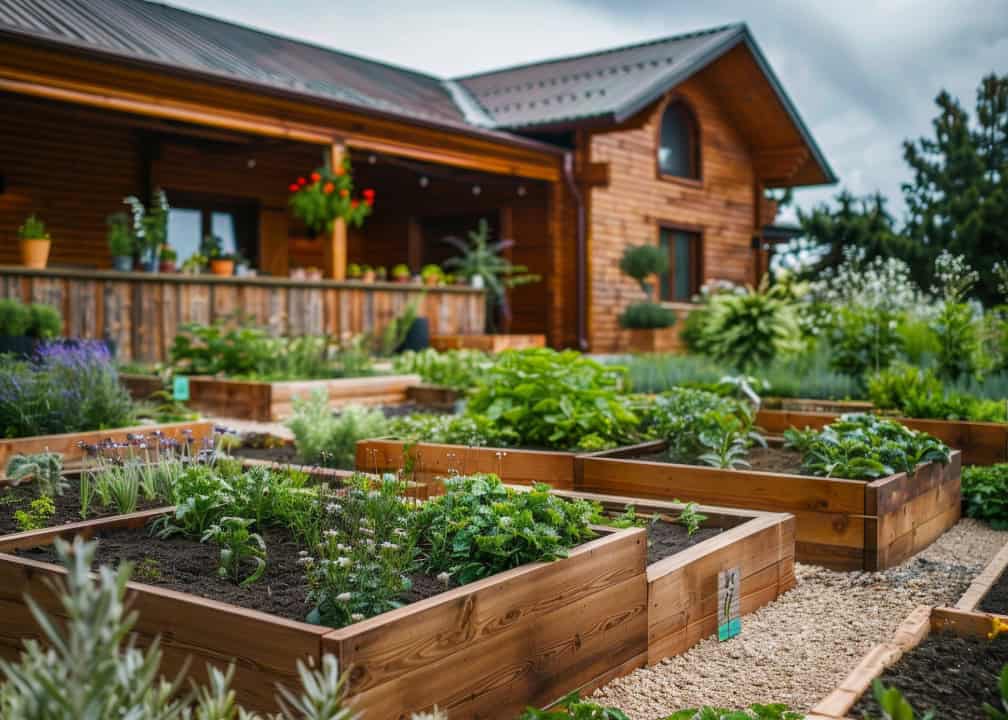
Post: December 6, 2025

Subscribe to the Blog >

Hoe! Hoe! Hoe! Gifts for gardeners

Choose tools, gadgets, and technology for gardeners based on their interests

By Kari Ranten, Skagit County WSU Extension Master Gardener

 
Kari Ranten

The holidays provide a great opportunity to give your favorite gardener something to serve as a helping hand to support their hobby.

While the ideas ranging from old school to high tech are endless, think about what the gardener in your life enjoys most and hone in on the tools of the trade that will help them in their growing endeavor. Do they want to start seeds indoors? Are they interested in propagating plants? Do they want to learn about pruning? Are they left-handed? What about tools for maintaining the garden? How about garments for the garden? Do they like to use technology?

To assist in your search for the perfect gift, here are a few ideas for tools, gadgets, and technology that can be procured at a local garden center or nursery, hardware store, or online.

hand writing in a log book
A logbook or calendar can be a handy way to plan for the coming season, record when and where planting took place, what seeds or starts were used, and track progress and success to aid growing seasons to come. Photo ©: Adobe Stock
packets of seeds in airtight envelopes
An air-tight seed-saving system to help organize seeds by type, planting season, color, location, and other factors is another handy gift idea. Photo ©: Adobe Stock
water timer stuck in soil under a plant
Rather than guessing, moisture meters are inexpensive and handy for keeping plants properly watered in the greenhouse or garden. © Adobe Stock

The gardener interested in starting seeds or propagating plants ahead of the spring season can always use a few supplies:

  • A log book or calendar can be a handy way to plan for the coming season and then record when and where planting took place, what seeds or starts were used, and track the progress and success to aid in growing seasons to come.
  • Seeds, of course. Winter is a fun time to explore seed options and look forward to the possibilities presented by the coming growing season. To provide your gardener with options to peruse and dream over, order up a few seed catalogs from purveyors specializing in the Northwest growing environment.
  • An air-tight seed saving system to help organize seeds by type, planting season, color, location, and other functions is another handy gift idea. Throw in some plant markers or tags to identify what’s sprouting and, ultimately, transplanted to the garden.
  • A seed starting operation will benefit from a few basics, including trays for planting, proper seed-starting soil, and, of course, seeds. Several companies offer kits with everything a gardener needs to use soil blocking or other seed starting techniques, including some with self-watering options.
  • For the seed starting trays, include humidity domes with space to keep the seedlings warm and moist and allow them to grow a bit after sprouting. A succession of small pot sizes will also support the plant growth progression.
  • Depending on the space available – from a corner shelf in the garage to a full-on greenhouse setup – heat mats and lights come in all sizes with timers and programming options. Again, some companies offer small-scale seed starting kits, including LED lights, suitable for a shelf or tabletop in the house.
  • A fan, such as a small battery-operated or electrical device, is helpful for air circulation for starting seeds and cuttings.
  • For those who want to propagate plants from cuttings, such as geraniums, fuchsias, houseplants, and more, include the items for seed starting, plus some small, sharp clippers for trimming stems for planting.
  • A soil thermometer and/or moisture meter can be handy too.
serrated two-edged garden knife with wood handle
An overwhelming choice among Skagit County Extension Master Gardeners for a must-have garden tool is a hori hori knife. Photo ©: Skagit County Master Gardeners
hand holding 8-inch battery operated chain saw next to thick branch
Hand-held battery-operated chainsaws are available in a variety of models and weights for cutting and pruning tree and shrub limbs. Photo ©: Ginny Bode
v-shape shovel blade on a red handled tool
The V-shaped “Root Slayer” shovel is a great help when dividing, moving, or removing plants. Photo ©: Hallie Kitner

What will be helpful for pruning?

  • To trim back grasses or cut small tree or shrub limbs, lightweight handsaws, and hand-held battery-operated chainsaws are available in a variety of models. Be sure to evaluate whether the blade is suitable for the intended use and the size of the limbs that will require trimming.
  • On a smaller scale, a nice set of small, straight-blade, hand-held pruners make a great stocking stuffer. The more sets of pruners a gardener has, the merrier!
  • If your favorite gardener is left-handed, manufacturers offer pruners and other hand tools tailored to their needs.

What’s most helpful to maintain the established garden? There are a variety of ways to look at garden maintenance, which can be aided by the right tools.

  • An overwhelming choice among Skagit County Extension Master Gardeners for a must-have garden tool is a hori hori knife. This tool can be handy for weeding, planting bulbs, dividing perennials, cutting roots, and more. Be sure to include a sheath for safe transport in the garden and storage.
  • For weeding, a stirrup hoe aids in the task, separating roots and leaves with a scrubbing action, allowing the gardener to remain standing for the job.
  • For dividing, moving, or removing plants, the “Root Slayer” gets high marks from Skagit County Extension Master Gardeners and others. The tool is a V-shaped shovel with serrated edges that helps cut through roots and soil.
  • A garden cart or wagon always comes in handy for moving plants, pots, soil, or delivering garden debris to the compost pile.
  • Watering is an important job for the gardener, and a variety of tools:
    • Watering cans in the appropriate sizes for doing the job manually. The gardener should have at least one with a long, extended spout to reach into small spaces and make sure everything gets moisture.
    • Hoses in the required length to reach plants that will routinely need watering are helpful, along with the proper attachment or wand to reach pots, hanging plants, and beds.
    • If a gardener is interested in an automated watering system, do some research into potential DIY options or consider hiring a professional to install a system.
  • Combination garden kneeler and stools have become popular to improve accessibility and comfort when weeding and planting.
padded kneeling bench in garden with weed bucket and tools
Kneeler benches or stools improve accessibility and comfort when weeding and planting. Photo ©: Ginny Bode
two smiling gardeners standing side by side wearing overalls
Overalls are a popular choice for the busy, bending-over, hard-working gardener. Photo ©: Nancy Crowell | Crowellphotography.com
person wearing apron with gardening tools in pocket
Garden aprons or tool belts provide easy access to tools for lighter garden chores. Photo ©: Adobe Stock

What are the best garden garments?

  • Garden gloves are always welcome, and preferred materials can vary by the season. From waterproof models for fall and winter to lighter-weight options for summer, a gardener can always use another pair.
  • It may seem cliché, however, overalls are a popular choice for the busy, bending-over, hard-working gardener. Bib overalls offer comfort, flexibility, and breathability along with a plentiful number of pockets for tools, tough, soil-resistant fabrics in plain colors and fun patterns, and reinforcement at the knees.
  • For overalls or shirts that go with them, many gardening garments offer UPF sun protection, which is a nice feature to prevent sunburn.
  • An apron with pockets for lighter duty gardening chores is also useful.
  • On the sun-protection front, a wide-brimmed hat for the garden is a must, to keep the rays off the neck and face.
  • If you don’t have your gardener’s size, remember that a gift card is a one-size-fits-all solution.

For the gardener who enjoys technology:

  • A wide variety of small weather stations for the home are available for those who want to know about rainfall, humidity, barometric pressure, wind speed and direction, and temperatures in their garden that include a real-time wireless feed to deliver data to your phone and indoor console.
  • Monitors for the greenhouse can provide information on temperature, humidity, and more. Similar systems are available for watering systems.
  • Compact countertop seed starting and herb growing units can bring the gardening to the kitchen all year round.
  • Apps for the phone include a wide range of options from alerting gardeners to an impending frost, reminders to water, and a fertilizer calculator.

As you can see, there is no shortage of gift ideas to support your favorite gardener. Happy holidays!

hand holding phone with plant app on screen
Apps for the phone help the gardener with everything from identifying plants and diagnosing diseases to receiving alerts about an impending frost and a fertilizer calculator. Photo ©: Adobe Stock

Resources for more information:

Compagnucci, S. (2025) This $28 Garden Tool Cut My Weeding Time in Half. The New York Times Wirecutter.

Kumar, G. (2016) Propagating Shrubs, Vines, and Trees from Stem Cuttings. Oregon State University Extension. PNW 152.

Kumar, G., Larsen, F. and Shekel, K. (2009) Propagating Plants from Seed. Oregon State University Extension. PNW 1i70.

Murgel, J. (2025) Simple Plant Propagation: How to divide plants and conquer hearts. Colorado State University Extension.

Rennie, A. (2023) The Best Pruning Saws to Keep Your Trees and Shrubbery Neat and Tidy. Popular Mechanics.

ABOUT THE AUTHOR:
Kari Ranten is a retired journalist and health care communicator who became a certified Skagit County WSU Extension Master Gardener in 2024.


Questions about home gardening or becoming a master gardener may be directed to Skagit County WSU Extension Office, 11768 Westar Lane, Suite A, Burlington, WA 98233; by phone: 360-428-4270; or via the Skagit County WSU Extension website.

Washington State University Extension helps people develop leadership skills and use research-based knowledge to improve economic status and quality of life. Cooperating agencies: Washington State University, US Department of Agriculture, and Skagit County. Extension programs and policies are available to all without discrimination. To request disability accommodations contact us at least ten days in advance.
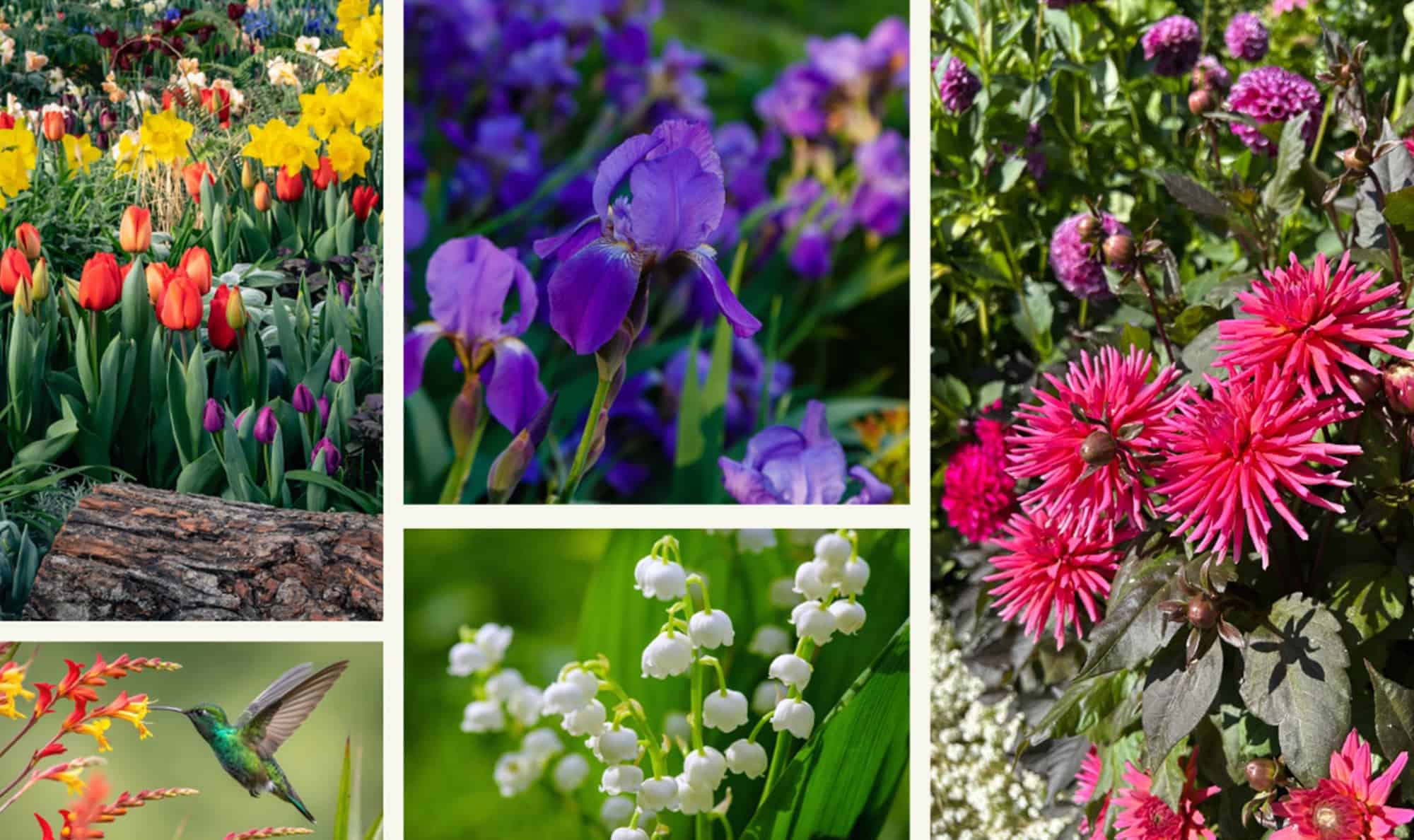


Post: November 21, 2025

Subscribe to the Blog >

Dreaming and decision-making for a greenhouse

Questions and options to consider if a greenhouse is right for you

By Kari Ranten, Skagit County WSU Extension Master Gardener


Kari Ranten

The short days of the coming winter have gardeners missing the abundant growth, harvest, and busy days of the summer just past. Many are already dreaming about the potential of the upcoming growing season.

At this time of year, characterized by shortened days and gray skies in the Northwest, the opportunities for spring seem endless: What to grow? What seeds to buy? What were the favorites from seasons past that could be wintered over? Is there something new to try? More vegetables? More flowers? Something tropical?

With all of this potential, it makes sense that many gardeners’ thoughts turn to ways to fill the gardening void of winter. The likely answer may be to add a greenhouse to extend the growing season or make gardening a more year-round enterprise.

“When people make something by hand – with their own hands – it takes on a different level of value. So, it is with the food and flowers that we grow with our own hands. Having a greenhouse enables you to enjoy this therapy on a daily basis in any season,” writes Shane Smith, author of Greenhouse Gardener’s Companion, Growing Food & Flowers in Your Greenhouse or Sunspace (2000). Smith’s book is considered by many to be a must-have for those who desire or use a greenhouse. The Chicago Review Press notes Smith’s book is “The most comprehensive book on greenhouse gardening available today.”

The extension of the joy of gardening throughout the year is certainly a big draw. However, adding a “hobby” greenhouse requires considerable planning, decision-making, and resources. Winter may be just the season to spend time researching the idea of a greenhouse and to learn more about a potential project for the coming year. It takes some time to evaluate the right option for your specific goals, location, and budget, as well as address the myriad of questions that will come up. This column will pose some of the key questions you will want to ponder before moving forward with a greenhouse or other structure, such as a lean-to, cold frame, or tunnels. (Beddes, et al. 2022)

The most fundamental questions to start with are: What do you want to grow? How do you plan to use a greenhouse? Answers to these questions will help you get started as you dig into the details of location, space, materials, size, power, and lighting needs for a growing space.

A greenhouse can be used in a variety of ways. Before making a decision, know that each option presents a decision-making path to get to the ultimate plan for a structure that is right for you.

person using tools to assemble a greenhouse frame
Many considerations go into planning for a greenhouse. What will you grow? How big will it be? What materials will you use? These considerations and more will help you make the best decision for your wants and needs. Photo: © Adobe Stock

Here are a few considerations:

Want to start seeds? The first use that naturally comes to mind when thinking about adding a greenhouse is its use as a venue to get a head start on seeding flowers and vegetables, including tomatoes, squash, beans, and others, in early spring. Here, you will need to consider whether you want a heated or unheated space, based on the plants you plan to start.

“Because seeds like warm temperatures to germinate (often in the 65 to 75°F range), you will have to provide heat and light to help get your seeds to germinate. This can be done with LED grow lights and a heat mat, but that also means that you will need electricity in your greenhouse.” (Marshall, 2022).

quonset hut style greenhouse with poly wrap material
Greenhouses come in all shapes, sizes, and materials. Know what you want to grow and plan a structure that meets your budget and needs. Photo: © Adobe Stock
greenhouse positioned in the distance beyond raised beds in sunshine
Ideally, the location of your greenhouse will afford a south or southwest exposure to meet the daily sunlight needs of a greenhouse, which acts as a collector of solar heat. Photo: © Adobe Stock
greenhouse with cold frame units beside it
The cold frames located beside this greenhouse are a type of season extender that protects plants on chilly nights in spring and late fall, extending the growing season at both ends. Photo: © Adobe Stock

Extending the season? A greenhouse can also be used as a season extender beyond summer, with fall planting of vegetables such as lettuce, spinach, and other greens, for harvest and enjoyment throughout the winter months. Heat and light requirements will also apply in this case. (Beddes, et al. 2022).

Protecting fragile plants? Suppose you want a protected place for delicate plants to spend the winter out of the cold, including cuttings of favorite perennials such as fuchsias, clematis, or herbs. In that case, a greenhouse can be a handy solution. Additional candidates may include geraniums and other annuals you want to hold over for another season. Some may not require a greenhouse; instead, they may need a garage or basement (Howard, 2025).


Tropical plants require a different environment than growing vegetables. Knowing which types of plants you want to grow helps you make decisions. Photo:© Adobe Stock


Tropical ideas? A greenhouse can be a year-round place for plants that may need a slightly warmer environment than our Zone 8b provides (https://planthardiness.ars.usda.gov/), such as citrus trees and orchids. “For example, it is said that George Washington grew lemon, limes, pineapples, and other tropical fruit in a greenhouse in 1787 at Mount Vernon. Glasshouses, as they were originally called, became the rage in England and later in America. They eventually came to be called greenhouses because the plants inside stayed green all winter long.” (Marshall, 2022)

Free-standing or lean-to? Designs and materials? Take advantage of resources on design options and materials to build with, including fiberglass, plastic, polycarbonate, and glass. Floor materials can also vary, including a slab, pavers, or gravel. Many do-it-yourself kits are available on the market, offering a wide range of sizes and amenity options. Design plans are also available online, offering options for building with recycled materials, including windows, doors, shelving, and other reusable building supplies.

plants growing outside of the greenhouse wall
Master Gardener Anita Johnson located a raised bed growing area adjacent to the side of the greenhouse. Photo: © Anita Johnson
greenhouse with door open and electrical box on post outside
Anita used a long extension cord to operate a fan in the greenhouse until a couple of years ago, when she hired an electrician to trench and put in a remote electrical outlet near the greenhouse. Photo: © Anita Johnson
close up of electrical box on post with cords running to greenhouse
Access to power and water is helpful when locating a greenhouse. Photo: © Anita Johnson

Power? Heat? Lights? Ventilation? Research the climate and weather patterns where you live and match them with the desired use for the space to determine if you need access to power for heating, lighting, fans, or ventilation. An extension cord from the house may be enough. Otherwise, running power to the facility may be the right choice. Options can include space heaters, heat mats, and grow lights, which can be set to timers and scaled as needed. Technology also enables in-home, real-time monitoring linked to your cell phone, allowing you to view 24/7 conditions in the greenhouse, including humidity and temperature. Thermally activated automatic vents can also be installed and adjusted for temperature control. A drip watering system on a timer is also an option, or you can rely on rain barrels and watering cans.

Where will you put the greenhouse? How big should it be? A greenhouse requires a level area (or space that can be leveled) and meets the size and light needs. Many greenhouse owners caution gardeners to be honest about the space they need, based on their goals for use, to avoid an undersized project. Also, consider whether storage for gardening items, as well as plants, is needed.

What is the correct exposure? Ideally, the space will afford a south or southwest exposure to meet the daily sunlight needs of a greenhouse, which acts as a collector of solar heat. (Smith, 2000).

What about shelving or spaces to hang baskets? Plants, including seed starts and succulents, require more shelf space compared to plants in large pots. Pay attention to the materials used in greenhouse construction or the kit to make sure additional shelving or a bar for hanging plants is included or can be easily added. Gardeners recommend allowing for maximum flexibility to move plants, lights, and heat mats around as needed, while avoiding overcrowding.

Have a budget based on your decisions: With all these considerations in mind, they must match up with the project budget. “Before spending time and money, it is best to define your crop production goals, budget, and local climate challenges.” (Beddes, et al. 2022).

It takes work! Remember, once in place, the greenhouse requires ongoing maintenance, cleaning, watching for evidence of pests (like aphids, scale, etc.), disease (fungal and bacterial) and over- or under-watering (like edema or damping off), as well as regular time and attention – even with timers and automation.

For now, enjoy the dreaming and promise of spring.

Resources for more information:

Extending the Garden Season from Utah State University Yard and Garden Extension. 

The Hobby Greenhouse by Oklahoma Cooperative Extension Service.

References:

Beddes, T., Caron, M., Hansen, S., and Gunnell, J. (2022) Extending the Garden Season. Utah State University Yard and Garden Extension.

Chicago Review Press. (2025)The Greenhouse Gardener’s Companion 

Howard, D. (2025). How to Overwinter Plants: Protect Geraniums, Roses, Herbs & Tropicals From Frost. The Old Farmer’s Almanac. 

Marshall, R. (2022) A Greenhouse for Everyone. Massachusetts Horticultural Society. 

Schnelle, M., Dobbs, S., Needham, D., and Dole J. (2017) The Hobby Greenhouse. Oklahoma State University Extension Fact Sheet HLA-6705. 

Smith, S. (2000) Greenhouse Gardener’s Companion: Growing Food & Flowers in Your Greenhouse or Sunspace. Fulcrum Publishing. Golden, CO.

ABOUT THE AUTHOR:
Kari Ranten is a retired journalist and health care communicator who became a certified Skagit County WSU Extension Master Gardener in 2024.


Questions about home gardening or becoming a master gardener may be directed to Skagit County WSU Extension Office, 11768 Westar Lane, Suite A, Burlington, WA 98233; by phone: 360-428-4270; or via the Skagit County WSU Extension website.

Washington State University Extension helps people develop leadership skills and use research-based knowledge to improve economic status and quality of life. Cooperating agencies: Washington State University, US Department of Agriculture, and Skagit County. Extension programs and policies are available to all without discrimination. To request disability accommodations contact us at least ten days in advance.
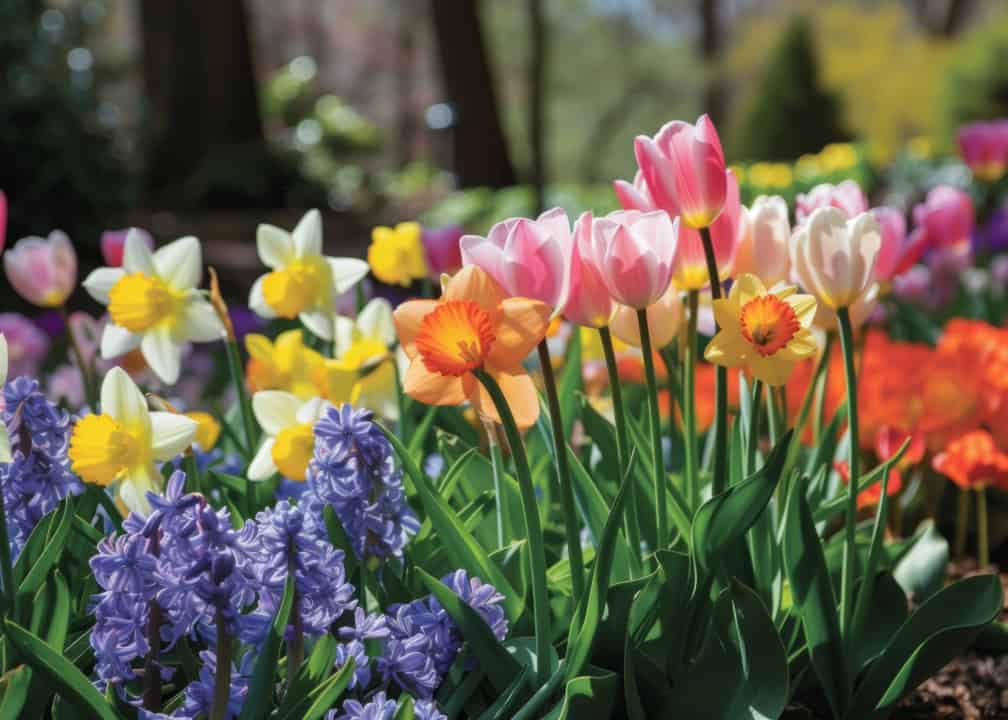


colorful flowers in garden with sun setting on the water in background

Post: September 19, 2025

Subscribe to the Blog >

The Joys of a Cut Flower Garden

How to plan, grow, and protect a wide variety of beautiful blooms

Editor’s Note: Author Karen Bruce is passionate about growing a cut flower garden. Over the past ten years, she has honed her skills and enlarged her Camano Island garden to be able to cut 100 – 150 blooms each week for events and giving to others. Like so many cut flower gardeners, she is grateful for the beauty of the flowers blooming and the joy she finds in sharing the results of her passion with others.


By Karen Bruce, Skagit County WSU Extension Master Gardener


Karen Bruce

A cut flower garden brings not only colorful flowers throughout the growing season, but also bees, butterflies, hummingbirds and other beneficial visitors that come to enjoy the blooms. Gardening in general can teach us lessons if we pay attention. A cut flower garden’s lessons are vibrant in color and design. Planning a cutting garden begins in the fall with an assessment of this year’s garden and gathering seeds for next season.

The cut flower garden can consist of both annuals and perennials. Annuals grow and bloom for one year (occasionally they can overwinter but typically do not). Annuals can be planted from seed (most economical) or with starts or plugs from your local nursery, online sources, or the Master Gardener Plant Fair! Examples of annuals are sunflowers, zinnias, lisianthus, snapdragons, statice, Queen Anne’s lace, stock, and amaranthus.

Chantilly Bronze and Madame Butterfly Bronze snapdragons © Photo: Karen Bruce

‘Chantilly Bronze’ and ‘Madame Butterfly Bronze’ snapdragons © Photo: Karen Bruce

burgundy and green amaranth stalks

‘Love-lies-bleeding’ Amaranth and ‘Green Tails’ Amaranth © Photo: Karen Bruce

Perennials come back year after year; their initial investment is higher, but they will produce flowers that can be cut for many years. Examples of perennials that grow each year are alstroemerias, hydrangeas, hypericum berries, peonies, weigela, and astilbe.

Bulbs, tubers, and corms, if properly cared for, will come back each year. Examples of these are daffodils, tulips, anemones, ranunculus, lilies, gladiolas, and dahlias.

dahlias blooming in garden

‘Bracken Sarah’ dahlia © Photo: Karen Bruce

bouquet of dahlias, hypericum, and lilies in white vase on table

Floral arrangement with lilies, dahlias, peach hypericum berries, apricot alstroemeria, ‘Spring Bouquet’ viburnum greenery © Photo: Karen Bruce
So you want to start a cutting garden of your own.
Things to consider when deciding what and how much to purchase:

  • Why are you growing cut flowers? Is it for personal enjoyment? Are you creating bouquets and arrangements for special events such as weddings or memorial services? Are you growing to sell your flower bouquets at a farmer’s market or other venue?
  • Are you are growing flowers for a special event next year? What colors, varieties and how many stems do you need? Consider the event date and which flowers will be in bloom at that time.
  • What is your budget? Seeds can be purchased for as low as $4 to $6 per packet. Established plants will cost more but may be more predictable.
  • How much space do you have? Will you incorporate the plantings into an existing garden? Are you going to create raised beds to grow your plants? Do you have a fenced area to protect your plants from deer or other critters?
  • Do you have a greenhouse or area to start seeds, or do you need to purchase seeds that can be directly sown into your garden space?
  • How much time and energy will you have to devote to your cutting garden?
    • Do you have the several months of time it takes to tend the growing seedlings?
    • Will you be around to take care of your plants, or do you have extensive travel plans?
    • Do you have adequate watering available?

Answers to these questions and your goals for your flower garden will help you plan for the season ahead.

bright green flower stalks in garden.

Bells of Ireland © Photo: Karen Bruce

green leaves with light pink berries

Peach Hypericum berry bush © Photo: Karen Bruce

green bush with hops-like blooms

Hops plant growing in garden. © Photo: Karen Bruce

There are many books available that can provide you with information about flowers you can grow to create beautiful cut bouquets. It is a good idea to look for an author who lives in your general growing area who will have an idea of what grows well in your gardening zone. A local favorite is Floret Farm’s Cut Flower Garden: Grow, Harvest, and Arrange Stunning Seasonal Blooms by Erin Benzakein, a well-known flower farmer and writer. Benzakein’s flower farm is located right here in Skagit Valley, and her New York Times best-selling book provides information on all types of flowers, along with photos of each flower. She also covers topics such as soil, tools, and techniques for seed starting and caring for your flowers once they have been harvested.

Floral arrangement with hops, Procut Plum sunflower, lisianthus, astrantia, dahlia, and salal greenery. 
© Photo: Karen Bruce
Floral arrangement with hops, Procut Plum sunflower, lisianthus, astrantia, dahlia, and salal greenery.
© Photo: Karen Bruce

This Month in Your Garden

– September –

  • Prune bamboo culms to thin your bamboo. Prune older (without sheaths), leaning, or damaged culms and cut them close to the ground. Prune any culms encroaching into an undesired area, and don’t forget root pruning to contain your grove.
  • Stop dead-heading your roses and allow them to begin developing rose hips. The shortening hours of sunlight, along with allowing the rose hips to develop, lets the rose bush know it has done its job of making seed and can now prepare for dormancy. Remove wilted petals and any leaves with black spot, rust or mildew to keep any developing fungus away from plant.
  • Deadhead perennials that self-seed, such as calla lilies, Shasta daisy, and crocosmia to prevent propagation.

Planning for next year’s cutting garden begins in the fall with the process of journaling and collecting pictures of what was successful, then making lists and ordering seeds, bulbs, tubers, corms, and plant starts and plugs.

In looking back at May/June, some favorite flowers were:

  • Sweet peas
  • Peonies – all colors
  • Lilies
  • Ranunculus – ‘Champagne’ and ‘Chamallow’

In assessing the July/August flower gardens, some current standouts this year are:

  • Dahlias – Peach/coral and blush colors such as ‘Café au Lait’, ‘Sweet Nathalie’, ‘Castle Drive’, ‘Clearview Peachy’, ‘Nicholas’, ‘Ferncliff Copper’, and ‘Breakout’ are beautiful for event bouquets
  • Snapdragons – This year, favorites are the ‘Madame Butterfly’ bronze/white and the ‘Chantilly’ pink snapdragons.
  • Bells of Ireland
  • Zinnias – The ‘Queeny’ series and ‘Benary’s Giant Mix’ provide big blooms in a variety of beautiful colors.
  • Lisianthus – Because lisianthus can be challenging to start from seed, ordering plugs helps make growing them less anxiety producing. Farmer Bailey  is an online brokerage for starter plants and plugs for cut flower varieties suited to the United States. Here, lisianthus begin blooming in late August. If you want to try your hand at growing lisianthus from seed, check out our blog post Growing Lisianthus
  • Alstroemerias
  • Veronica
  • Hypericum Berries – The peach hypericum (Hypericum inodorum ‘Kolmades’) or Magical® Desire St. John’s wort works well with other flowers from a cutting garden.

And don’t forget to have an ample supply of greenery to add to the look, color, and texture of an arrangement. These can include:

  • Eucalyptus
  • Viburnum ‘Spring Bouquet’
  • Salal

October/November blooms will include chrysanthemums that are starting to form buds now. One of the first to bloom is a golden decorative chrysanthemum called ‘Honeyglow’.

light pink rose-like blooms of lisianthus

Light pink lisianthus (or prairie gentian) © Photo: Karen Bruce

floral arrangement on table

Floral arrangement with pink dogwood and mock orange © Photo: Karen Bruce
Every gardener benefits from reviewing and documenting successes and challenges.
To have continual blooms from June to October requires planning. Flower gardeners, such as myself, who grow flowers for events and sharing require 100 – 150 blooms per week. How is this possible you ask? Many flowers are cut-and-come-again. This means that you can cut from the plant, and new growth will provide additional flowers. For cut-and-come-again flowers to be successful, you must continually cut blooms from the plant and/or deadhead the ones that you do not use. Examples of cut-and-come-again flowers are dahlias, zinnias, cosmos, scabiosa, sweet peas, strawflower and statice.

Most cut flowers need to be planted in a sunny location with six to eight hours of sun per day. They also need to be watered on a consistent basis. A drip watering system saves time and avoids the need for much hand-watering. The consistency and deeper watering that comes from a drip system is helpful. Cut flowers also need regular fertilizing. Some years, annuals like snapdragons can survive our temperate winters. This past winter, many snapdragons survived, so that was an added success, providing many beautiful blooms earlier than usual in early May. As the snapdragons that overwintered finished blooming, the snapdragon seedlings started in the greenhouse provided new blooms later in the season.

Staking and plant supports are critical to protect flower stems from unexpected wind and rain storms.

Save the seeds of the flowers you like, this will increase your seed stock for next year at no additional cost. Some of the easiest seeds to save are sweet peas. After sweet peas are finished blooming, they form a pod that looks like a pea pod. When this pod turns brown and the outside feels like sandpaper, pick the pods and store them in a paper bag. If you open the pod, there will be several dark brown seeds per pod. Save these seeds to plant early next year. Other easy seeds to save are scabiosa, Bells of Ireland, Queen Anne’s lace, and zinnias. Be aware, some flowers, like zinnias are cross-pollinated and the seeds may result in a mix of colors and traits in the new plants. Learn more about seed saving at: Seed Saving 101

The greatest challenges to a cut flower garden tend to be deer, bunnies and slugs

If your property is situated next to the woods, you may have many resident deer. Gardeners protect their beloved flowers in various ways. The surest preventive measure is to build a fence around the areas devoted to flowers (and edibles.) For this gardener, a seven-foot-high fence was a good first start. Some gardeners even erect two parallel fences to thwart the most athletic deer. After discovering that the local deer do not seem to eat my dahlias, my dahlia beds are outside of the fence. Often, not all plants can be planted inside a fence, and scent-based repellents like Liquid Fence may also be helpful. Learn what deer like to eat and spray repellent around those plants about once a week (and after a rain) during the growing season. For more information see Washington State University fact sheet > Deer Damage

conifers in rock landscape

Know & Grow: Conifers in the Home Landscape

Free, no registration required
Listen to Master Gardener Alison Hitchcock speak on caring for conifers in the home garden. Alison Hitchcock has been a Skagit County WSU Extension Master Gardener since 2001. Prior to retirement, she worked for the Department of Natural Resources as the Northwest Regional Silviculturist.
Tuesday, October 21, 2025
1 pm – 2:30 pm
Sakuma Auditorium – NWREC WSU
16650 WA-536, Mount Vernon, WA 98273


Rabbits can also be a problem and some years can be worse than others. Fencing can work, but only if the fencing material is buried 6-12 inches deep and stands at least 2 to 3 feet high. Chicken wire cages around plants are helpful but also must be buried like fencing. Applying a pet- and child-safe rabbit repellent, such as Liquid Fence, is helpful, though it may take several weeks of attention. It also helps to have a dog or cat roaming the property to chase them away. WSU’s Hortsense website offers more tips and methods for protecting plants from rabbits> Rabbits

Healthy slug and snail populations are ever-present in western Washington gardens. Sluggo and Sluggo Plus are organic iron phosphate products that can be your best friend. Neither is harmful to animals or children and have been the effective way to deal with slugs and snails when applied according to their label directions. Some gardeners manage slugs and snails with early morning or late evening garden checks, manually picking and disposing of them. For more information check out:

As summer is winding down and fall approaches, I am thankful for the flower season and the joy it has provided, as the giver and to those receiving flowers this season. Start small if you have never grown flowers before. See what you like and keep track of what grows well in your space and microclimate. Flowers provide joy to many and you will not be disappointed!

RESOURCES AND REFERENCES :

Benzakein, E. (2017) Floret Farm’s Cut Flower Garden: Grow, Harvest, and Arrange Stunning Seasonal Blooms. Chronicle Books, San Francisco, CA.

Managing Slugs and Snails. Oregon State University Extension Service. 10-Minute University™. (2025). Oregon Master Gardener™ Association – Clackamas County Chapter in Cooperation with Oregon State University Extension Service University. 

Vertebrate: Deer Damage. Washington State University (WSU) College of Agricultural, Human, and Natural Resource Sciences (CAHNRS). (2025). WSU Extension Hortsense Fact Sheet. 

Vertebrate: Rabbits. WSU. CAHNRS. (2025). WSU Extension Hortsense Fact Sheet.

ABOUT THE AUTHOR:
Karen Bruce has been a Skagit County WSU Extension Master Gardener since 2019. She is co-manager of the Cottage Garden at the Discovery Garden on SR 536, west of Mount Vernon.


Questions about home gardening or becoming a master gardener may be directed to Skagit County WSU Extension Office, 11768 Westar Lane, Suite A, Burlington, WA 98233; by phone: 360-428-4270; or via the website: www.skagit.wsu.edu/mg

Washington State University Extension helps people develop leadership skills and use research-based knowledge to improve economic status and quality of life. Cooperating agencies: Washington State University, US Department of Agriculture, and Skagit County. Extension programs and policies are available to all without discrimination. To request disability accommodations contact us at least ten days in advance.
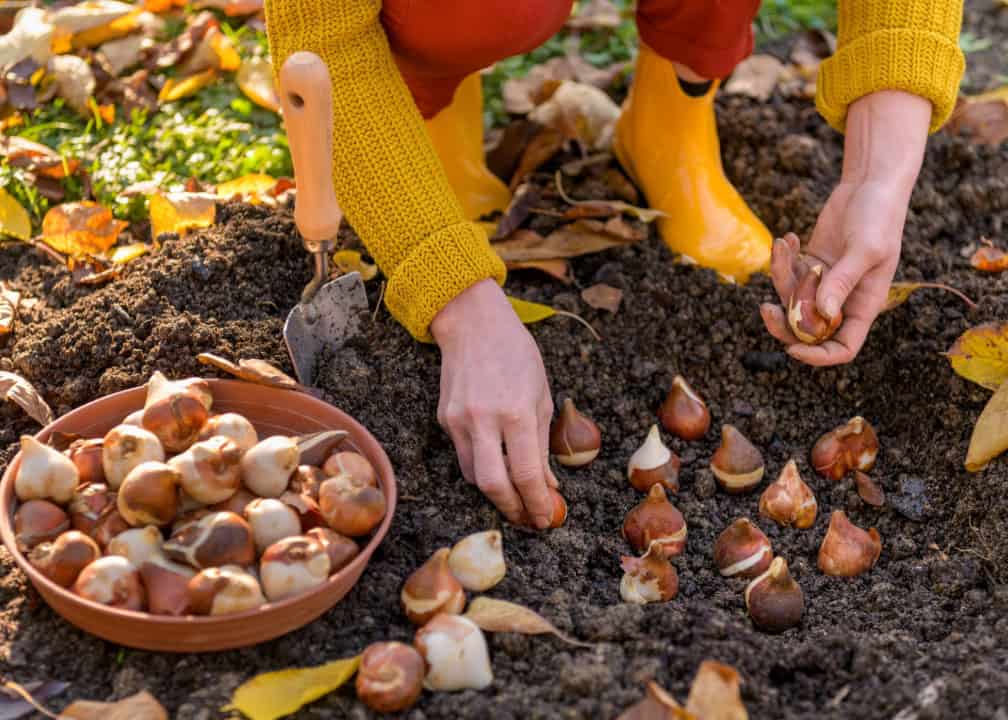


summer garden with colorful flowers and birdbath

Attracting Pollinators to the Home Garden

Making the right plant selections will help draw pollinators to the home garden

Posted July 18, 2025

Subscribe to the Blog >


By Kari Ranten, Skagit County WSU Extension Master Gardener

Kari Ranten

Pollinators are the heroes in our landscape and food chain. The small but mighty bees, hummingbirds, butterflies, and other birds and beneficial insects are key to crop production and creating a diverse environment. The home gardener often sets out to create a pollinator-friendly landscape and quickly discovers how enjoyable it is to watch these pollinators in the garden.

Proper plant selection and placement is key to luring vital pollinators to the home garden.

Scientific research emphasizes the importance of pollinators, crediting them with the reproduction of 90 percent of flowering plants and one-third of human food crops. “Each of us depends on these industrious pollinators in a practical way to provide us with the wide range of foods we eat. In addition, pollinators are part of the intricate web that supports the biological diversity in natural ecosystems that helps sustain our quality of life,” say the authors of Selecting Plants for Pollinators.

“Without bees, there would be no apples, pumpkins, strawberries or many other fruits and vegetables . . . Approximately one in three mouthfuls of food and drink require the presence of a pollinator.” – Xerces Society

Research shows that pollinator populations, including bees and butterflies, are declining in Washington state and the United States. “Unfortunately, the numbers of both native pollinators and domesticated bee populations are declining. They are threatened by habitat loss, disease, and the excessive and inappropriate use of pesticides.” 2 In March of 2025 Washington State University staff published a study showing that butterfly numbers have decreased by more than 20 percent from 2000 to 2020, with some species declining by more than 90 percent.7

Selecting the right plants is foundational to drawing pollinators to your garden. The two Pollinator Gardens in the Skagit County WSU Extension Master Gardener Discovery Garden, west of Mount Vernon, provide examples of plants that attract pollinators throughout the seasons. Master Gardener Alix Foster oversees the Pollinator Gardens and several years ago wrote an article describing the basics about the pollination process and why pollinators are so important, along with what each gardener can do to support pollinators. Read the article here >

pink flowers on bush with bright green leaves

Spiraea japonica Golden Princess attracts pollinators in the Pollinator Garden in the Discovery Garden.
© Skagit County Master Gardeners

blue purple flowers blooming in the garden

Jacob’s Ladder (Polemonium reptans) and foxglove attract various pollinators, especially bees. Other pollinators like butterflies, moths, and flies are also attracted to the flowers. © Skagit County Master Gardeners

Foster recently led a tour of one of the compact Pollinator Gardens to showcase the selection and placement of plants that maximize the number and variety of bugs and birds visiting the garden. Efforts are underway to add more native plants and enhance the number of plants that bloom in sequence over the months along with a variety of colors, shapes, and sizes to span the seasons. During daytime hours, 365 days a year, enjoy a self-guided tour of the Discovery Garden where signs list the plant names, what pollinators they draw, and the bloom time for the specimens on display. To see the complete list of plants in the Pollinator Gardens at the Discovery Garden, go to https://skagitmg.org/home/discovery-garden/pollinator-garden/.

Fortunately, there is an abundance of options for pollinator-friendly plants. The Pollinator Partnership, a global non-profit dedicated to the protection and promotion of pollinators and their ecosystems, offers a tool on their website to generate a list based on zip code at https://www.pollinator.org/find-your-roots-tool. A search using Mount Vernon, WA 98273, yields a list of 1,172 perennial flowers, shrubs, and trees to consider for a pollinator landscape.

Several fundamentals apply when choosing plants to draw pollinators:

Use native plants: Natives, including wildflowers, shrubs, and trees, are naturally adapted to the region’s climate and soil. Research by Gordon Frankies 3 shows native plants are four times more likely than non-native plants to attract bees and significantly increase the abundance of butterflies and moths. The Salal Native Plant Garden, adjacent to the Discovery Garden, introduces home gardeners to many varieties native to northwest Washington. According to the Pollinator Partnership, “Non-native plants such as cultivar and hybrid plant species are, in most cases, not good for pollinators as they can result in double flowers, changes in flower color, and sterile flowers with no pollen.”

Select plants that bloom across the seasons: Flowering plants, including annuals and perennials, serve as a draw for pollinators. When shopping for plants, nursery tags often list the pollinators that are attracted to the specific plant. As an example, a tag on Monarda fistulosa, a perennial commonly called bee balm, lists that the deep pink blooms attract bees, hummingbirds, and butterflies.

Pollinators love flowers – keep blooms going throughout the seasons: Pollinators are drawn by a variety of plant qualities, colorful blooms, and the availability of pollen and/or nectar.

Interested in Becoming a Master Gardener?

Application period is now open through August 15, 2025.

WSU has recently launched a new training platform called Washington Green School, designed to provide comprehensive research-based horticulture and environmental stewardship education. The Washington Green School offers two distinct tracks:

  • Washington Gardener Certificate Track
    This option is ideal for individuals seeking to enhance their gardening skills without the commitment of volunteering. This self-paced, online-only course provides a certificate upon successful completion.
  • Extension Master Gardener Volunteer Track
    This track is for those interested in becoming certified WSU Extension Master Gardener volunteers and includes the Green School online coursework, in-person, local volunteer training, and a commitment to volunteer service hours.

For more information, go to https://skagitmg.org/home/green-school/

To apply for the Skagit County WSU Extension Master Gardener Program, go to https://extension.wsu.edu/skagit/mg/apply/


In the search for food resources, each type of pollinator has preferences for the color, nectar, odor, pollen, and flower shape. The Pollinator Partnership has compiled the Pollinator Syndromes chart below describing characteristics which draw eight different pollinator groups. For example, butterflies prefer flowers shaped like a narrow tube with a spur and a wide landing pad, often in bright red and purple colors. Bats pollinate plants which emit strong musty scents and open at night.


In addition to referring to the plant lists for the two local Pollinator Gardens, consider regular visits to the Discovery Garden or local nurseries to check what is blooming each month, or seek out another pollinator garden, such as Pollinator Pathway Northwest at 21 Acres in Woodinville (https://21acres.org/).

Plant several similar plants in close proximity: Create several extensive, round plantings of each plant to minimize the distance pollinators need to travel to obtain their nutrition and transport pollen. Additionally, experts recommend planting at least three different pollinator plants within each of the three blooming seasons: spring, summer, and fall 3 for maximum benefit.

Consider a bee lawn: Adding flowers in with turfgrass can provide a draw for pollinators seeking nectar and/or pollen. The bee lawn is available for human recreation and as an attraction for dozens of species of native bees 4.

Use care with chemicals: For details about chemical use to protect pollinators, see Washington State University Extension bulletin “Pollination and Pollinator Protection” in the references below.

In addition to flowers and plants, home gardeners should be aware of the basic needs of pollinators:

  • Appropriate nesting areas Off-season hibernation sites
  • Good sun exposure
  • Adequate source(s) of water
  • And lastly, allow leaves to gather [and self-mulch] on the ground as a haven for insects, birds, and others through winter.
swallowtail butterfly on purple stalks of lavender bush
In the warmth of summer, the tiger swallowtail butterfly is attracted to lavender. Photo © Shelly Hanks, WSU Photo Services
Yellow Welsh poppies blooming in garden
Yellow Welsh poppies bloom from June – August, providing nectar and pollen for bees and butterflies. Photo © Skagit County Master Gardeners

REFERENCES AND RESOURCES:

  1. Lawrence, T. (2015) WSU Extension bulletin FS174E. Pollination and Pollinator Protection (Home Garden Series). 
  2. Ley, E., Buchmann, S., and Holmes, K. (2025) Selecting Plants for Pollinators Including the states of: Oregon and Washington a Regional Guide for Farmers, Land Managers, and Gardeners in the Pacific Lowland Mixed Forest Province. The Pollinator Partnership™/North American Pollinator Protection Campaign.
  3. Mader, E., Shepherd, Matthew, Vaughan, M., Hoffman, S., LeBuhn, G. (2011) Xerces Society Guide: Attracting Native Pollinators. Storey Publishing. North Adams, MA.
  4. Moncada, K., Reiter, M., and Wolfin, J. (2023) Planting and maintaining a bee lawn. University of Minnesota Extension.
  5. Pollinator Partnership. (2025)
  6. Pollinator Threats. (2025) Pollinator Partnership.
  7. U.S. Butterfly Populations are Severely Declining. (2025) Washington State University Office of Research. (2025)
  8. Wollaeger, H., Getter, K. and Behe, B. (2015). Consumer Preferences for Traditional, Neonicotinoid-free, Bee-friendly, or Biological Control Pest Management Practices on Floriculture Crops. Michigan State University Department of Horticulture. HortScience 50(5):721-732.

ABOUT THE AUTHOR:

Kari Ranten is a retired journalist and health care communicator who became a certified Skagit County WSU Extension Master Gardener in 2024. 


Questions about home gardening or becoming a master gardener may be directed to Skagit County WSU Extension Office, 11768 Westar Lane, Suite A, Burlington, WA 98233; by phone: 360-428-4270; or via the website: www.skagit.wsu.edu/mg

Washington State University Extension helps people develop leadership skills and use research-based knowledge to improve economic status and quality of life. Cooperating agencies: Washington State University, US Department of Agriculture, and Skagit County. Extension programs and policies are available to all without discrimination. To request disability accommodations contact us at least ten days in advance.
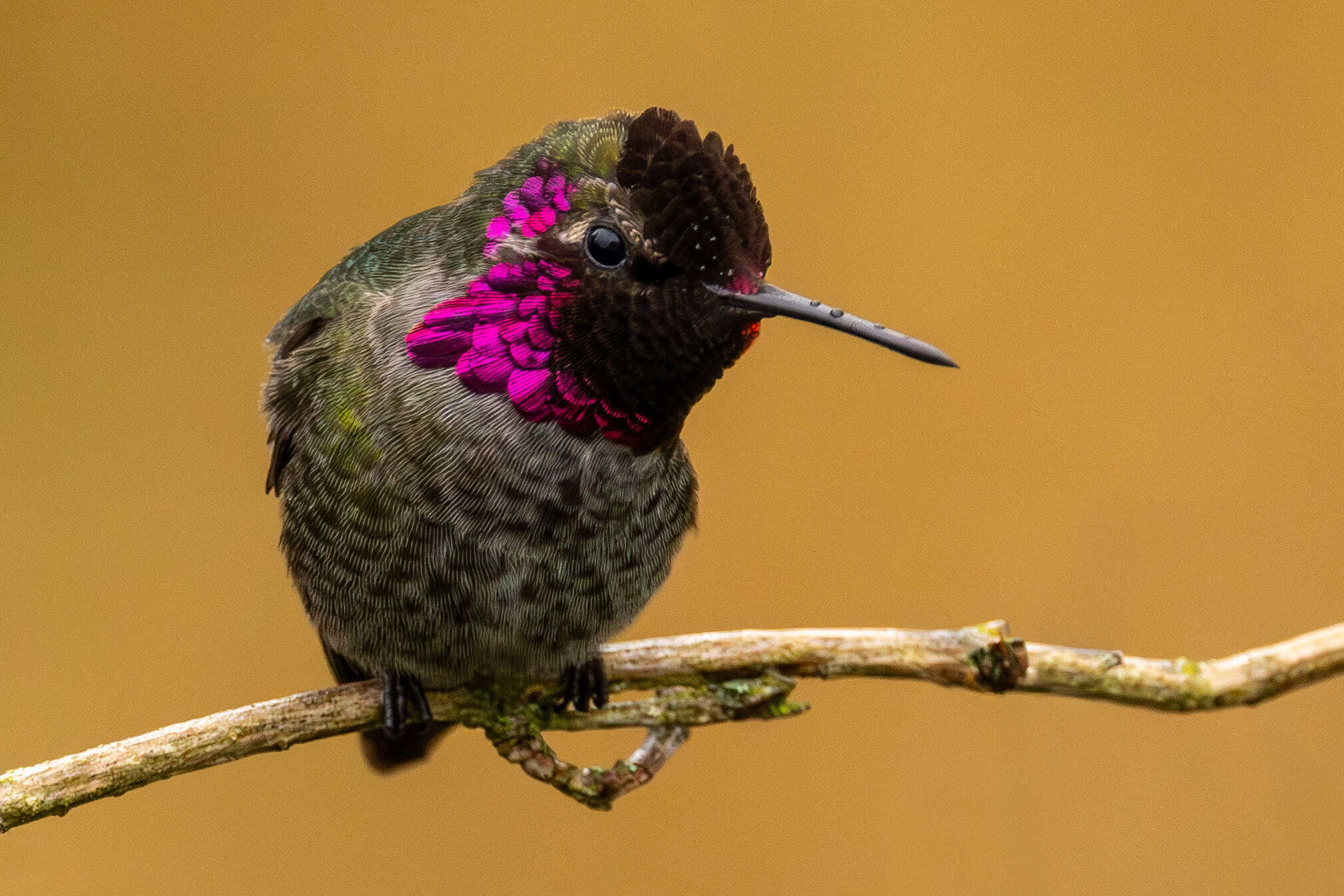


retriever in yard
graphic for Ask a Master Gardener masthead with flower

Pets and Home Gardens

Protecting your pets from the plants and your plants from your pets!

Subscribe to the Blog >

By Deborah Leitner, Skagit County WSU Extension Master Gardener


Deborah Leitner

Several years ago, when we adopted our beloved black lab Shadow from the Seattle Humane Society, I had visions of my new best friend spending hours with me in the garden, frolicking by my side, as I weeded, puttered, planted, pondered, and pruned my way through my fenced-in urban backyard oasis. Shortly after we got him home, it became clear that Shadow had a different plan.

Shadow’s propensity for joyful exuberance posed specific gardening challenges, as he loved to dig, eat strawberries and vegetables, and generally disturb any carefully laid out plans. Some plants were lost, but I found a new focus in creating an environment where he could frolic and play, and we could enjoy him while not stressing too much if any plant or shrub got injured in the process. Both pets and gardening require planning, patience, and a healthy dose of reality.

What to Avoid
The ASPCA (American Society for the Prevention of Cruelty to Animals) offers a comprehensive list of toxic plants for dogs, cats, and horses on their website. (See reference below.) This website also provides a complete list of safe and non-toxic plants for pets.

Examples of toxic plants that are common in Pacific Northwest backyards include:

Daffodils: The flowers, leaves, and bulbs can cause abdominal pain, vomiting, and diarrhea. In severe cases, cardiac arrhythmias and respiratory problems may occur.

Lily of the Valley: Dogs who eat lily of the valley may experience cardiac arrhythmias, decreased heart rates, and seizures.

Tulips and hyacinths: The bulbs are toxic. Mild cases show drooling and some vomiting. If dogs eat too many, they may show an increase in heart rate.

Azaleas: These can be fatal if your dog even chews on leaves.

The above list is not meant to be all-inclusive but rather a sampling of the most commonly encountered toxic plants in urban backyards. For more detailed lists, check out the WSU and ASPCA references below.

Also, many houseplants are toxic to both cats and dogs. Be sure to keep your indoor plants well out of reach of pets. A few of the most toxic plants include aloe, philodendron, pothos, jade plant, and asparagus fern. If you need help identifying your houseplants, the master gardeners at the WSU Extension Plant Clinics in Burlington or Anacortes or the Farmer’s Market booths in Mount Vernon or Sedro Wooley are excellent resources for identification of plants.

According to the ASPCA, it is a myth that dogs and cats instinctively avoid toxic plants. If you see your dog or cat eating a plant and are unsure if it is harmful, it is best to contact your vet as soon as possible. The ASPCA Animal Poison Control Center is also available 24 hours a day, 365 days a year, at (888) 426-4435 to answer any questions in an emergency.

terrier dog with fence in background
Dogs love running the fence line and saying hi to neighbors. Save your plants from being trampled by leaving a space between plants and the fence line. Photo © Adobe Stock
cat sitting on window seat beside plants
If your pets live indoors, it is important to identify your plants and know which are toxic to pets. Photo © Adobe Stock

What to Plant
There are many plants that both do well in the Pacific Northwest and are safe for dogs. The following list highlights some of the safe plants that are commonly found in PNW backyards:

Shrubs: Abelia is a hardy shrub that can tolerate many challenges, including being sprayed with dog urine. Green Mountain boxwoods, cypresses, and Rocky Mountain Juniper are good hedge options. Mature shrubs are more resistant to dog damage.

Trees: Camellias, magnolias, and Japanese maples are all good choices

Perennials: False goat’s beard (Astilbe,) ornamental grasses, red hot pokers (Kniphophia,) goat’s beard, echinacea, and rudbeckia all seem to tolerate the paw traffic.

Annuals: Sunflowers, fuchsia, pansy, and petunia are all safe for dogs. 

Herbs: Organically grown edible herbs are a good option. 

Native plants: Salal, evergreen huckleberry, Oregon grape, and western sword ferns are all hardy natives that are safe for dogs. 

Other plants: Japanese aralia, hardy geranium, coreopsis, and nasturtiums are all dog-friendly plants

If you have a fence, try leaving a few feet between the fence and your plants. Dogs love running the fence line, chasing squirrels, saying hi to neighbors, and protecting their humans. You are saving your plants from being trampled by giving them space to do so.

dog sitting by red hot poker plants

Perennials such as red hot pokers (Kniphophia), goat’s beard, echinacea, and rudbeckia all seem to tolerate paw traffic.  Photo © Adobe Stock

white flowers of poison hemlock plant

If your pets have room to roam outside, it is critically important to identify the plants growing where they roam. Poison-hemlock is highly toxic to humans and animals and should be removed following Washington State Noxious Weed Control guidelines. Photo © Adobe Stock

Fertilizing and Mulching
Commercially prepared, organic compost on garden beds is a safe choice for dog owners. A risk is involved if using homemade compost, as mold and fungi may be present in the decomposing material containing neurotoxins. Arborist wood chips are an excellent option for mulching, but some dogs (like mine) love to eat the chips, posing other risks.

Two mulches to avoid are cocoa mulch and pine needle mulch. Cocoa mulch contains theobromine, a toxin that is dangerous to dogs. Pine needle mulch can damage your pet’s stomach lining.

If you fertilize your lawn, be sure to read the label carefully. Many products say they are safe for use around pets, but they still recommend that you keep pets off the recently fertilized grass for up to 48 hours. Consider using a mulching lawn mower, leaving the cut grass in a place where it will break down and add nitrogen back to the lawn. Another option is to let your lawn go dormant in the summer, knowing it will return to life in the fall.

Got Slugs?
If you garden in the PNW, you are likely familiar with slugs. Our most famous native slug, the banana slug, is mainly seen in the forest, eating away at decaying matter. Slugs, specifically native slugs, have their place in the greater scheme of things; they are vital to the decomposition of organic matter and provide food for birds, snakes, frogs, and other animals. However, most slugs the home gardener encounters are not native, having been introduced from Europe. Once introduced, they made themselves right at home and drive the home gardener crazy.

Commercial slug products containing metaldehyde are highly toxic to pets, birds, wildlife, and humans, and should be used with a tamper-proof bait station, if used at all. Poisoning occurs even if a small amount is ingested. Products containing iron phosphate are considered safer for people and pets, but should be used cautiously, as poisoning can still occur if your pet ingests large amounts. If you choose to use the products containing iron phosphate, read the instructions carefully, and consider putting a barricade such as a small fence or wire basket around the plant in question to prevent your dog or cat from getting near the product.

Some gardeners use broken shells, lava rock, or other rough materials to deter slugs from the area without using chemicals. Placing copper bands around plants or planting lavender, mint, or rosemary may discourage slugs and snails from entering the garden.

A safer alternative is to trap the slugs using bait. Bury a container such as a margarine tub containing yeast mixed in water (beer works well for this method), so the slug will fall into the trap and drown. You will need to monitor the trap and replace the bait regularly. Baited traps don’t discriminate by species, however. Other small wildlife can meet their end by falling into the trap. It’s a good idea to remove the trap during the day so that Fido isn’t tempted to indulge, and then set the trap out again in the evening.

Many gardeners prefer controlling slugs manually. It is time-consuming, but tried and true. Fill a jar with soapy or salty water, pick the slugs from the plants, deposit them in the jar, seal them, and wait a few days. Then flush the contents down the toilet. Over time, your slug population will substantially diminish, and your pets and other wildlife will be safe from chemical (and alcohol) poisoning. Learn more about managing slugs

Overall, the toxicity of slug bait is a significant concern for pet owners. Prompt intervention is crucial if poisoning is suspected, and preventive measures can help ensure the safety of your pet.

black dog on grass

Shadow living the good life. Photo © Deborah Leitner

Shadow never lost his youthful exuberance and propensity for mischief in the garden. He lived a joyful life, but sadly, at age 13, it was time to say goodbye. It took a while to be ready for a new canine companion, but Shadow’s successor, Teddy, was found at the Skagit Valley Humane Society. Or you might say Teddy found us because we certainly didn’t expect to come home with a 10-year-old black lab mix. But discovering the joy of living with a mature senior dog, Teddy is a good match. Teddy is not interested in gardening but loves being a backyard companion.

Companion Planting

Know & Grow
The Science Behind 
Companion Planting
Tuesday, May 20, 2025
1 pm – 2:30 pm
NWREC Sakuma Auditorium
16650 State Highway 536, Mount Vernon

Based on research by horticultural scientists such as Dr. Linda Chalker-Scott and Dr Jeff Gillman, you will learn natural ways to prevent or lessen pest and disease problems in your garden. Use plant combinations, polyculture, and other science-based practices for a healthier garden. Master Gardener Rae Barto will share these findings and advice.

graphic showing three gardens in open house

Mark Your Calendar:
Annual Three Garden Open House

Saturday, June 28, 2025
10 am – 2 pm
Discovery Garden
16602 State Route 536 (Memorial Highway)
Mount Vernon, WA 98273
Fun Activities for Kids  ~  Plant Sale
Water Conservation Experts  ~  Noxious Weed Information
30+ Garden Rooms  ~  Plant Clinic and Gardening Help
Native Plants  ~  Pollinators
Talk to Fruit Tree Experts

Interested in becoming a Master Gardener?

WSU is introducing a new program called Washington Green School which will include WSU Extension Master Gardener training. Beginning this fall, Green School will offer two distinct tracks in its online course: one for individuals looking to enhance their gardening skills through research-based horticultural and environmental stewardship, the Washington Gardener course, and another for those who wish to take it further by becoming a WSU Extension Master Gardener Program volunteer.

Learn more about Washington Green School training.

Applications to become a Skagit County WSU Extension Master Gardener are due by August 15, 2025 to be in the Class of 2026. Apply to be a WSU Extension Master Gardener.

REFERENCES AND RESOURCES:

Chaulker-Scott, L. (2007) Wood chip mulch: Landscape boon or bane? Retrieved at Hedgerow: Mulches

Animal Poison Control. American Society for the Prevention of Cruelty to Animals. 

Toxic and Non-Toxic Plant List – Dogs. American Society for the Prevention of Cruelty to Animals. 

Toxic and Non-Toxic Plant List – Cats. American Society for the Prevention of Cruelty to Animals. 

Plants Toxic to Dogs. Cornell University College of Veterinary Medicine.

Plant Toxicity and Pets. Texas A & M University Extension.

ABOUT THE AUTHOR:
Deborah Leitner is a WSU Extension Skagit County Master Gardener class of 2007. Along with caring for the Discovery Garden, she can often be found helping answer questions at the Plant Clinic in Burlington.


Questions about home gardening or becoming a master gardener may be directed to Skagit County WSU Extension Office, 11768 Westar Lane, Suite A, Burlington, WA 98233; by phone: 360-428-4270; or via the Extension website.

Washington State University Extension helps people develop leadership skills and use research-based knowledge to improve economic status and quality of life. Cooperating agencies: Washington State University, US Department of Agriculture, and Skagit County. Extension programs and policies are available to all without discrimination. To request disability accommodations contact us at least ten days in advance.
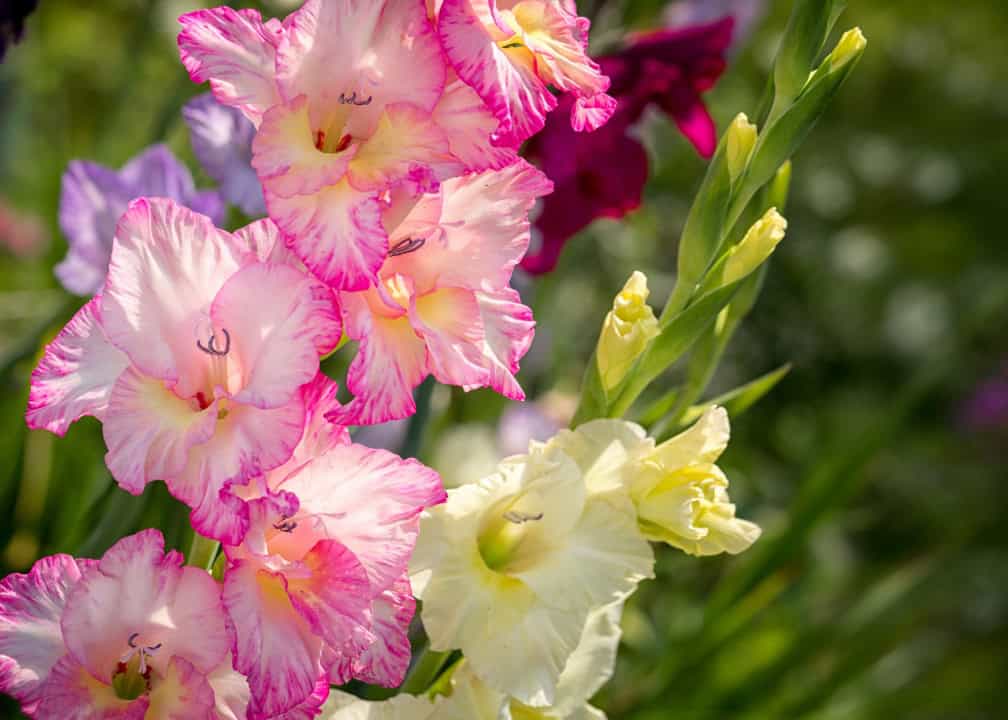


25-0417_Header2b
AMGPost_header5

Mark Your Calendar!

Skagit County Master Gardener Plant Fair is Saturday, May 10

Anticipation is Building for the Annual Event on Mother’s Day Weekend

              Subscribe to the Blog >

By Kari Ranten, Skagit County WSU Extension Master Gardener

Kari Ranten

Featuring thousands of plants for sale, the Skagit County Master Gardener Plant Fair is a local celebration of spring and gardening.

Gardeners across the region count on the plant fair as a place to purchase quality plants and look forward to gathering inspiration for the coming growing season. Did you know that all of the tomatoes – more than 3,600 plants – available at the plant fair are grown from seed by volunteer WSU Extension Master Gardeners? Not only that, the varieties grown are chosen because they are ideal for our climate.

The 31st annual Plant Fair is set for 8 a.m. to 2 p.m. on Saturday, May 10, 2025, at the Skagit County Fairgrounds. The event and parking are free, enter through the south gate of the fairgrounds. Attendees are encouraged to bring a wagon or wheelbarrow to help transport their selections. Boxes are available at the site and customers can leave purchased plants at a free plant parking area monitored by volunteers as they continue to shop and enjoy the plant fair. An ATM will be available on site.

3,600 Tomato Plants – 2,000 Flowering Annuals
2,000 Vegetable and Herb Starts
Hundreds of Perennials and Native Plants
Small Fruits: Grapes, Figs, Currants, Berries

“As an organization and a community of people who live and love all things gardening, we are looking forward to this amazing annual event,” said Master Gardener Claire Cotnoir, who, along with her husband and fellow Master Gardener Hank Davies, co-chairs the plant fair. “This is our way to inspire all gardeners by offering quality plants suited to growing successfully in our region. We enjoy the opportunity to share information and enthusiasm for gardening, along with educating the public about how to embrace gardening as a way to care for and protect the environment.”

The plant fair will offer thousands of plants for sale, including vegetables, tomatoes, herbs, perennials and native plant varieties. Most of the plants are grown or propagated by master gardener volunteers.

The plant fair is truly a highly anticipated event, as illustrated by those who waited in line at the gates last year. Some called their annual visit to the event a “Mother’s Day weekend tradition” for their family. One smiling woman, with a wheelbarrow in tow, proclaimed “It’s the only holiday I celebrate – Plant Fair Day!”

Need Tips on Growing Tomatoes?

Master Gardener Denny Organ, an expert in growing tomatoes in the region, will provide short workshop-style presentations with tips on planting, pruning and general care for tomatoes between 9 a.m. to noon on Saturday, May 10 at the Master Gardener Demonstration Booth. Between presentations, Denny will be available to answer one-on-one questions about growing tomatoes. Check at the master gardener information booth at the Plant Fair for specific times of the presentations.

Free 'parking' for your plant purchases while you shop and learn.
Free ‘parking’ for your plant purchases while you shop and learn.
Master gardeners will be available to answer all of your plant and gardening questions at the Plant Clinic inside the Pavilion entrance.
Thousands of flowering annuals, perennials, edible vines and bushes, and native plants will be on sale in the Pavilion.
50+ vendors will be selling plants, garden art, jewelry, fibers, woodwork, food etc.
Over 2,000 vegetables and herbs grown by master gardeners and selected for success in this area will be on sale.
Learn how to control water runoff from the people at the Water Conservation District booth.

In addition to plant sales, the Plant Fair will feature:

  • More than 50 vendors will offer garden accessories, gifts, plants, garden art and hand-crafted items. Several food vendors will also be on site.
  • Skagit County Master Gardeners will host an educational booth and display, with a focus on pollinators, firewise gardening and growing tomatoes.
  • Master gardeners will staff a Plant Clinic at the fair to help address plant questions or concerns.
  • Master gardeners will offer free tool sharpening, with a limit of one tool per customer.

The annual Skagit County Master Gardener Plant Fair is the primary fund-raising event run by the Skagit County Master Gardener Foundation (SCMGF). Proceeds enable the foundation to support master gardener outreach, events, education and activities. Beyond fundraising, the plant fair builds community awareness of the master gardener program, encourages community participation in gardening and growing local food, and inspires people to become master gardener volunteers.

Master gardener volunteers also maintain the Discovery Garden just west of Mount Vernon on Memorial Highway, which is open to the public daily as a showcase for the variety of plants that grow in the region.

women with tomatoes

Cherry, slicers, salad, paste, and dwarf are among the fifty tomato varieties available at the Plant Fair. Download the list and make your selections.

25-0417_Pic-18

Now you own a lovely tomato plant. Read on to help your plant grow and thrive, producing delicious tomatoes throughout the season.

Soon to be a proud owner of a tomato plant? What’s next?

Many Skagit County Master Gardener Plant Fair customers are laser focused on one thing: Buying tomato plants. As they check out, with plants in hand, the question many have is what to do next with these amazing plants?

Past customers, many who have purchased tomatoes at the plant fair for several years running, express satisfaction with the product. Of course, each growing season is unique and 2024 presented some challenges with rain and cooler temperatures. Between the May plant fair and the end of the 2024 growing season, customers describe the tomato plants produced by master gardeners as healthy, hardy and offering a “really great yield.”

In the fall, master gardeners taste test 30+ varieties of tomatoes to select the varieties to grow for the Plant Fair.

Master gardeners grow all of the tomato plants from seed. The process begins in February to have them ready for the plant fair. Lights, heat mats and tender loving care help nurture the seeds to germination and on to developing into fledgling plants. As they grow, the tomatoes are transplanted into six-pack plugs, then four-inch pots and ultimately to the one-gallon pots available for sale.

Going into the plant fair, customers may check out the list of varieties available on the Skagit County Master Gardener website (skagitmg.org/) and make selections based on a desire for snacking, sauces, slicing and other tomato uses. All varieties are carefully chosen by master gardeners and tested for growing conditions in Skagit County. In addition, for a comprehensive A-Z listing of tomato varieties featuring details on each one, check out the Skagit County Master Gardener Tomato Variety Selection Tool: https://skagitmg.org/home/food/tomato-varieties/.

At the end of each season, master gardeners gather for a taste-test session of fruit from their plants to help inform future variety selection. Some of the varieties available for purchase at the plant fair will be marked as “Winner of Our MG Tomato Tasting Event.”

Tomatoes: What do I do next?
So, once you take home tomato plants at the mid-May plant fair, what should you do next to have success? Here are a few tips on how to plant and care for these fledgling tomatoes from master gardeners who head up the “Tomato Team” and other resources:

Hardening off: The tomato plants, in one-gallon pots, will have spent more than a month in an unheated greenhouse leading up to the plant sale. As temperatures warm, they will need gradual introduction to sunlight and the outdoors. Place the plants in a sheltered location near the house or other structure and expose the plants to indirect sunlight gradually. Start with one hour on the first day and add one hour each day, building up to a full day. Plants can tolerate direct sunlight after three to five days.

According to the Washington State University Extension Fact Sheet FS145E titled Growing Tomatoes in Home Gardens,“After a week, leave plants outside overnight. If temperatures drop below 50°F, keep them indoors . . . Do not plant them before the frost-free date for your area because spring frost can kill young tomato plants.” Plants should not be transplanted unprotected until nighttime temperatures stay above 45 to 50 degrees, which may not be until June, according to Vegetable Gardening in the Pacific Northwest by Seattle author Lorene Edwards Forkner.

25-0417_Pic-16
Kari Ranten and Jeremy Stevens

If the people in the fun, creative hats (master gardeners) look a little giddy, it is because they have crossed the finish line, successfully raising nearly 10,000 healthy, happy plants for you to bring home and enjoy this summer.

Planting: Whether using a container or transplanting into the ground, plant in well-drained soil in a sunny location. Plant in a deep hole and cover the stem up to the bottom leaves with soil to inspire root growth and plant development.

Trench planting is also an option. Trench planting involves digging a trench about six inches deep, adding a tablespoon of super phosphate to the soil (well mixed), and laying the whole plant in the ground with only the very top of the plant exposed to the sunlight. For more information about trench planting, go to North Carolina State University Extension Publications, Growing Tomatoes in the Home Garden, https://content.ces.ncsu.edu/growing-tomatoes-in-the-home-garden.

Growing in pots: Tomatoes do not like to be confined to small pots for too long. The master gardener tomatoes are sold in one-gallon pots, which will work for a while, however, be sure to have 10-gallon grow bags, pots, or buckets with holes drilled in the bottom at the ready when overnight temperatures are appropriate to transplant outdoors for the season. Remember, tomato plant roots can go more than six inches deep into the soil so the more room you give them in a pot the happier they will be. Also, consider growing determinate plants in pots and indeterminate in the ground if possible. Determinate plants top off at around five feet tall and are easier to grow in pots than indeterminate which are vining and will grow until fall frost. Another wonderful option available for pots or patio growing this year are dwarf varieties, also available at the plant fair.

Watering: Tomatoes will perform better if they are a little dry rather than soggy. For plants in pots, providing a plastic roof or clear plastic cloche to keep the rain off is helpful, but not required. “Water regularly and deeply since tomatoes are deep-rooted plants, but avoid overhead irrigation, which can encourage disease,” according to “Sunset Western Garden Book of Edibles.” Author Forkner suggests reducing watering near the end of the season to encourage fruit ripening.

Support: Indeterminate tomatoes, those that grow like vines, benefit from supports such as cages, trellises or pole supports. Determinate varieties are more compact and bushier, reaching a fixed height.

Light and exposure: In the Pacific Northwest, placing pots along a south-facing wall is best for tomato success. A garden space with full sun for at least six hours per day, according to the Washington State University Extension Fact Sheet FS145E.

Potential problems: Tomatoes can be impacted by a variety of diseases and pests. Research and select cultivars that are disease resistant. Washington State University Extension Fact Sheet FS145E lists a variety of potential problems, including:

  • Late blight: The fungal disease appears as gray-green coloration on leaves, stems and fruit, turning to dark blotches on the fruit. The fact sheet suggests avoiding over watering, removing infected plants or plant parts when symptoms are noticed, but do not compost them. Give plants ample space to support air circulation.
  • Slugs: Common in Western Washington, slugs can completely consume younger plants, damage foliage of more mature plants and cause “hollowing damage” on fruit. To protect plants, remove weeds and debris, encourage predators; hand-pick and kill slugs that feed at night and use chemical-based baits with caution.
  • Blossom End Rot: According to the University of Wisconsin, Wisconsin Division of Horticulture Extension, this condition often occurs on the first fruits formed on plants. Initially, water-soaked spots (resembling small bruises) appear, most often on the bottoms of fruits and include dark, leathery, sunken areas on the blossom end of the tomato. This is caused by a lack of calcium uptake and conditions where there is too much or too little water. Water evenly and mulch the soil to retain moisture during dry periods. Avoid practices that would damage roots, such as cultivating too near plants thereby cutting roots, use a good Cal-Mag fertilizer and do not “wash” out soil nutrient with heavy over watering.
  • An additional resource regarding pests and diseases with tomatoes is the University of Maryland Extension’s Key to Common Problems of Tomatoes (https://extension.umd.edu/resource/key-common-problems-tomatoes/) and Washington State University CAHNRS and WSU Extension Hortsense website (https://hortsense.cahnrs.wsu.edu/).

Harvest and use: Harvest when the fruit reaches mature color. Tomatoes can be used in a wide range of preparations from fresh to frozen or dried to canned. For more information, check out the National Center for Home Food Preservation (http://www.uga.edu/nchfp/) or Oregon State University Extension Service’s site focused on canning tomatoes and tomato products (https://extension.oregonstate.edu/catalog/pub/pnw300-s).

REFERENCES:
Fredericks, G., Cowan, J. and Daniels, C. (2014) Vegetables: Growing Tomatoes in Home Gardens. Washington State University Extension Fact Sheet #FS145E. https://s3.wp.wsu.edu/uploads/sites/2070/2019/09/FS145E.pdf

Forkner, L. (2012) Vegetable Gardening in the Pacific Northwest. Portland, OR. Timber Press.

North Carolina State University Extension Publications, Growing Tomatoes in the Home Garden. https://content.ces.ncsu.edu/growing-tomatoes-in-the-home-garden

Skagit County Master Gardener Tomato Variety Selection Tool: https://skagitmg.org/home/food/tomato-varieties/

Sunset. (2010) Sunset Western Garden Book of Edibles: The Complete A to Z Guide to Growing Your Own Vegetables, Herbs, and Fruits.” Menlo Park, California. Sunset Publishing Corporation.

University of Maryland Extension. https://extension.umd.edu/resource/key-common-problems-tomatoes/

University of Wisconsin-Madison, Wisconsin Horticulture Division of Extension. https://hort.extension.wisc.edu/articles/blossom-end-rot/

Washington State University CAHNRS and WSU Extension Hortsense. https://hortsense.cahnrs.wsu.edu/


Looking Ahead to Summer-
Join us for a Free Open House
Saturday, June 28 – 10 am – 2 pm

Explore the three gardens in one location: the WSU Extension Master Gardener Discovery Garden, the NW Fruit Garden, and the Salal Native Plant Garden at the Discovery Day Open House. Talk to the volunteers that manage each of the gardens. Subscribe here for more information. >

ABOUT THE AUTHOR:
Kari Ranten is a retired journalist and health care communicator who became a certified Skagit County WSU Extension Master Gardener in 2024.


Questions about home gardening or becoming a master gardener may be directed to Skagit County WSU Extension Office, 11768 Westar Lane, Suite A, Burlington, WA 98233; by phone: 360-428-4270; or via the website: www.skagit.wsu.edu/mg

Washington State University Extension helps people develop leadership skills and use research-based knowledge to improve economic status and quality of life. Cooperating agencies: Washington State University, US Department of Agriculture, and Skagit County. Extension programs and policies are available to all without discrimination. To request disability accommodations contact us at least ten days in advance.
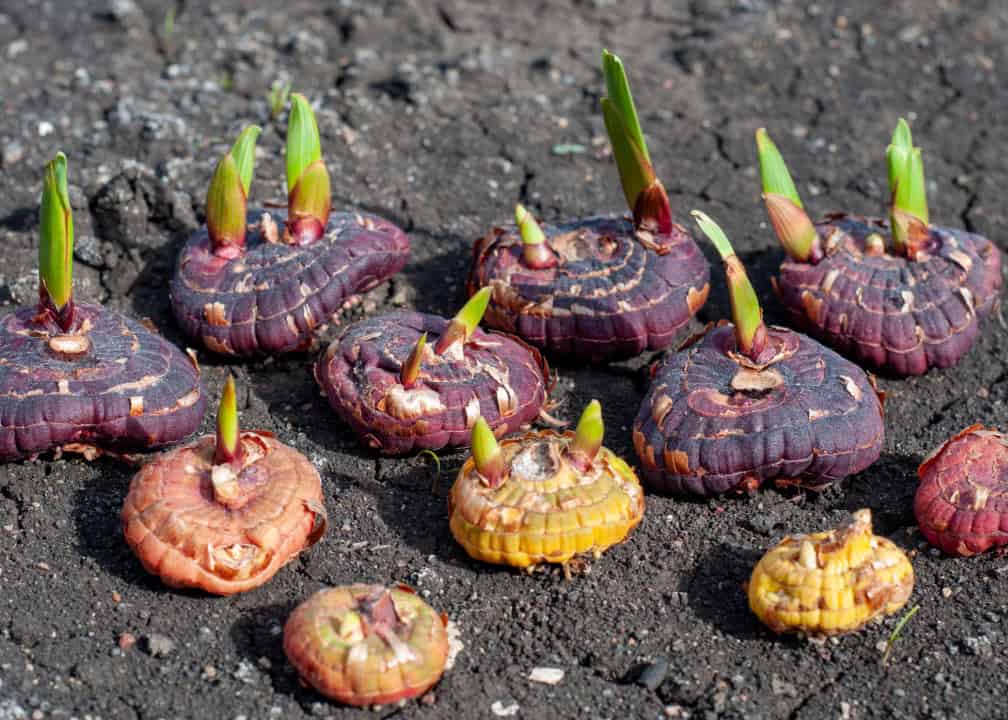


pink and blue hydrangeas blooming in garden with bird house
AMGPost_header5

Hooray for Hydrangeas

Gardeners are quick to show you their favorite hydrangeas, but many question how and when to prune them

              Subscribe to the Blog >

By Diana Wisen and Janine Wentworth, Skagit County WSU Extension Master Gardeners

photos of two women

Authors Diana Wisen and Janine Wentworth

Hydrangeas, with their stunning blooms, have been captivating flower enthusiasts for centuries. The ability of some varieties to change color based on soil pH adds an element of magic. They can be big and bold or lacey and layered. All varieties grow well in sunny locations, perhaps with some afternoon shade-all varieties like acidic, moist, humus-rich soil that drains well. While hydrangeas can tolerate neglect, they do better if watered in the high heat of summer. Additionally, a layer of arborist chip mulch spread well beyond the outer drip line of the branches will help retain moisture.

How to Prune Hydrangeas
Hydrangeas do well in the Pacific Northwest, thriving in our climate and native soil. They do not need to be pruned to do well, but many homeowners like a more tidy look, which requires pruning. Others prune to keep their hydrangea varieties smaller than their normal growth habit. Sometimes, severe winter cold causes damage to the current season’s buds, and you may want to remove the damage. The best time to do all of this is in the spring before they leaf out.
Older stems often look dead, but they are not. You can cut the dead wood on any hydrangea back to the ground. Dead stems and those that are too crowded can be pruned close to the base of the plant. © Skagit County Master Gardeners
Many hydrangeas require no pruning, but if you choose to prune them, you need to know if it is a variety that blooms on last year's shoots (old wood) or the coming season's shoots (new wood.) © Skagit County Master Gardeners
Many hydrangeas require no pruning, but if you choose to prune them, you need to know if it is a variety that blooms on last year’s shoots (old wood) or the coming season’s shoots (new wood.) © Skagit County Master Gardeners

The first step to pruning any hydrangea is to know what kind it is. Different kinds are pruned differently, and if you don’t know what kind you are pruning, you may be cutting off all the potential flowers by pruning at the wrong time. Save the plant tag and learn to recognize the variety you have. That is the key to a successful start.

Hydrangeas start blooming in mid-summer and bloom for a long time. There is no need to prune in winter. In fact, leaving on the dead flower heads can protect emerging buds from freezing. Hydrangeas are deciduous, but their leaves hang on well into fall. Leave them where they fall on the soil.

Learning to recognize dead wood can be tricky with hydrangeas. Older stems often look dead, but they are not. Dead stems are usually three or more years old. On some specimens, the dead stems may even be ten years old. To identify dead wood, look for stems with no buds or leaves. These can be cut back to the base of the plant. If you are unsure, start cutting from the tip of the branch and look for a greenish interior on the stem, or scrape the bark with your fingernail. If it’s brown, crisp, and very dry, it’s dead. You can cut the dead wood on any hydrangea back to the ground. You can also prune out wayward-looking stems or those that are too crowded.

large blue purple flower

The most common kind of hydrangea is H. macrophylla or bigleaf hydrangea, of which there are two types: mophead and lacecap. © Crowell Photography

A lacecap hydrangea has flatter inflorescences or flower clusters with small sterile flowers around the edges and tiny fertile flowers in the center, giving it a delicate lacy appearance© Pexels.com | Dayong Tein

A lacecap hydrangea has flatter inflorescences or flower clusters with small sterile flowers around the edges and tiny fertile flowers in the center, giving it a delicate lacy appearance© Pexels.com | Dayong Tein

Now for the Differences
The most common kind of hydrangea is H. macrophylla, or bigleaf hydrangea, of which there are two types: mophead and lacecap. All bigleaf hydrangeas bloom on wood formed the previous year and on buds set last summer. When all danger of a hard frost is past in late spring, remove the dead flower heads by cutting back to a pair of healthy fat buds, which will be your flowers. Slender buds are the leaves. Even if you choose not to remove or prune the dead flower heads from last season, H. macrophylla will still bloom just fine.

The standard bigleaf hydrangea wants to be big and tall genetically. It is difficult to reduce the size of a mature hydrangea. If pruned hard, it will grow back to its original height but have weak stems and no flowers that year. It is better to cut select older stems to the ground to reduce the size of the plant. Doing this will shorten your plant and will necessarily sacrifice flowers. Some newer cultivars have been bred to stay small. These may be a better choice for your landscape than constantly pruning to reduce the size of a large hydrangea.

A popular mophead type is ‘Nikko Blue’. The flowers are big, rounded heads consisting of all sterile flowers. If the blossoms begin to turn pink and you prefer blue, make the soil more acidic by adding aluminum sulfate to the soil in the early spring. It may take more than one year and additional servings of aluminum sulfate to achieve blue blossoms. Note: Concrete sidewalks or foundations can leach lime into the soil resulting in pink hydrangea blossoms. However, some hydrangea varieties are naturally pink and will not turn blue in acid soils.

A popular lacecap hydrangea is ‘Mariesii’, with flatter inflorescences, or flower clusters, with small sterile flowers around the edges and tiny fertile flowers in the center, giving it a delicate lacy appearance. Lacecaps do not typically grow as tall as their mophead cousins.

Panicle hydrangea flowers are large, cone-shaped, up to 12 inches, blooming on sturdy stems, sometimes up to 10 feet tall. Panicle hydrangeas are best pruned in early spring to promote new flowering wood. © Ginny Bode, Photographer

Panicle hydrangea flowers are large, cone-shaped, up to 12 inches, blooming on sturdy stems, sometimes up to 10 feet tall. Panicle hydrangeas are best pruned in early spring to promote new flowering wood. © Ginny Bode, Photographer

Smooth hydrangeas (H. arborescens) like this cultivar 'Annabelle' have large snowball-like clusters and bloom on new growth of the current season so it can be pruned to the ground in early spring, leaving 2-4 inches. © Crowell Photography

Smooth hydrangeas (H. arborescens) like this cultivar ‘Annabelle’ have large snowball-like clusters and bloom on new growth of the current season so it can be pruned to the ground in early spring, leaving 2-4 inches. © Crowell Photography

Another popular hydrangea is H. paniculata. ‘Limelight’ and Grandiflora ‘PeeGee’ are popular panicle cultivars with many more on the market. Panicle hydrangea flowers are large, cone-shaped, up to 12 inches in length, and bloom on sturdy stems, sometimes to 10 feet tall. Flower color varies from creamy white to pale green, transitioning to pink hues as they mature later in the summer.

Panicle hydrangeas bloom on new wood, meaning the flower buds form on stems growing this season. Thus, you should prune all the previous season’s stems to two or three pairs of buds in the spring, which will bloom in the coming summer, giving you a low structure. You can also do selective pruning and cut some older stems way back while leaving some a little longer. If you don’t prune it all, the flowers will be so high up that you will not be able to enjoy them after a few years. Panicle hydrangeas are best pruned in early spring to promote new flowering wood.

Another kind of hydrangea is H. arborescens, or smooth hydrangea. An old and still popular cultivar is ‘Annabelle’. It has large snowball-like clusters of white flowers, which are white regardless of soil acidity. The flowers may fade to a soft pink near the end of the season.

Smooth hydrangeas flower on new growth of the current season, so stems can be pruned to 2-4 inches from the ground in early spring. Most have a rounded growth habit to 5 feet in height and width. There are newer cultivars on the market that are bred to stay smaller.

oak leaf hydrangea bush with pink and white flowers
The flowers and leaves of the oakleaf hydrangea put on a spectacular display throughout summer and fall, and they are easy to care for. © Adobe Stock
garden scene with hydrangeas climbing on arbor
Climbing hydrangeas can take a bit to begin blooming, but once established, they need very little pruning.© Adobe Stock

A hydrangea gaining popularity in the Pacific Northwest is H. quercifolia, commonly known as oakleaf hydrangea. Though native to the Southeastern United States, oakleaf hydrangeas do exceptionally well in the PNW and are known for spectacular fall color. The flowers and the leaves turn rich shades of red, orange, and purple in the fall and can last several months for additional seasonal interest. Its leaves look like large oak leaves and stay on the plant well into fall.

Oakleaf hydrangeas are one of the easiest hydrangeas to care for. They do not need to be pruned except to keep them out of a walkway. Plant them where they can have plenty of space to look their magnificent best, because over-pruning makes for weak, floppy stems. Plant them in full sun for good color.

H. anomala petiolaris
, commonly called climbing hydrangea or hydrangea vine, needs support such as a tree trunk or fence to cling to; otherwise, it will spread among neighboring plants and be challenging to care for. Be patient; climbing hydrangeas are slow to begin blooming, sometimes waiting 3 to 5 years to begin flowering. They need very little pruning, and once established, climbing hydrangeas bloom on new shoots. You can deadhead the spent flowers if you wish. However, this variety can grow to 50 feet tall or more, so plan accordingly. And be forewarned-deer love to eat this kind of hydrangea

There are other kinds of hydrangeas: H. serrata and H. aspera, commonly known as mountain hydrangeas, are native to Japan and Korea. These are not widely planted in the Pacific Northwest. Mountain hydrangeas bloom on the previous year’s wood.

New cultivars are constantly being developed. A little over 20 years ago, a remontant (reblooming in same season) hydrangea was discovered in Minnesota. Years of intensive breeding trials resulted in a new, reblooming bigleaf hydrangea cultivar branded Endless Summer®. The world of hydrangeas changed dramatically with this cold hardy hydrangea that would reliably bloom on both old wood and new wood the same summer, offering an extended season of fresh blooms. Since then many cultivars of repeat blooming hydrangeas have been released. These reblooming hydrangeas should be pruned only after the first blooming period.

Hydrangeas are a beautiful, easy-care additions to your landscape, providing cut or dried flowers and color to the landscape throughout their long bloom season. The stunning varieties require minimal pruning if planted in the correct location for size and growth habits. Always read and save the plant tag. Study your plant and learn its growth habit by observation throughout the season. Using these basic tips, your hydrangeas should bloom successfully year after year.

Listed below you will find a number of excellent resources for learning more about hydrangeas, including a book by Dr. Michael Dirr who identified the first reblooming hydrangea and worked with it to develop the cultivars branded under the name Endless Summer®.


Mark Your Calendar: Always the Saturday Before Mother’s Day

We’re growing 3,500 tomato plants, and over 3,000 flower and vegetable starts along with edible and ornamental perennials for you to bring home and plant your garden this season.

RESOURCES:
Crosbie, C. (2007) Easy Pruning: Simple Steps to Success. Royal Horticultural Society and DK Publishing

Turnball, C. (2021) Guide to Pruning. (3rd Edition) Sasquatch Books

Kourik, R. (1987) Hands on Gardener – Pruning. Workman Publishing, New York, New York.

Joyce, D. (1999) Pruning & Training. Eyewitness Garden Handbooks. DK Publishing.

Bird, R. (2006) Pruning Trees, Shrubs, and Climbers. Anness Publishing.

Reich, L. (2010) The Pruning Book. The Taunton Press.

Dirr, M. (2024) “Hydrangeas for American Gardens.” Timber Press.

ABOUT THE AUTHOR:

Diana Wisen has been a Skagit County WSU Extension Master Gardener since 1991 and is the coordinator of the Hardy Fuchsia Garden at the Discovery Garden.

Janine Wentworth is a Skagit County WSU Extension Master Gardener, Class of 2018. She is the coordinator of the Front Door Garden, the most recent addition to the Discovery Garden on SR 536 west of Mount Vernon.


Questions about home gardening or becoming a master gardener may be directed to Skagit County WSU Extension Office, 11768 Westar Lane, Suite A, Burlington, WA 98233; by phone: 360-428-4270; or via the website: www.skagit.wsu.edu/mg

Washington State University Extension helps people develop leadership skills and use research-based knowledge to improve economic status and quality of life. Cooperating agencies: Washington State University, US Department of Agriculture, and Skagit County. Extension programs and policies are available to all without discrimination. To request disability accommodations contact us at least ten days in advance.
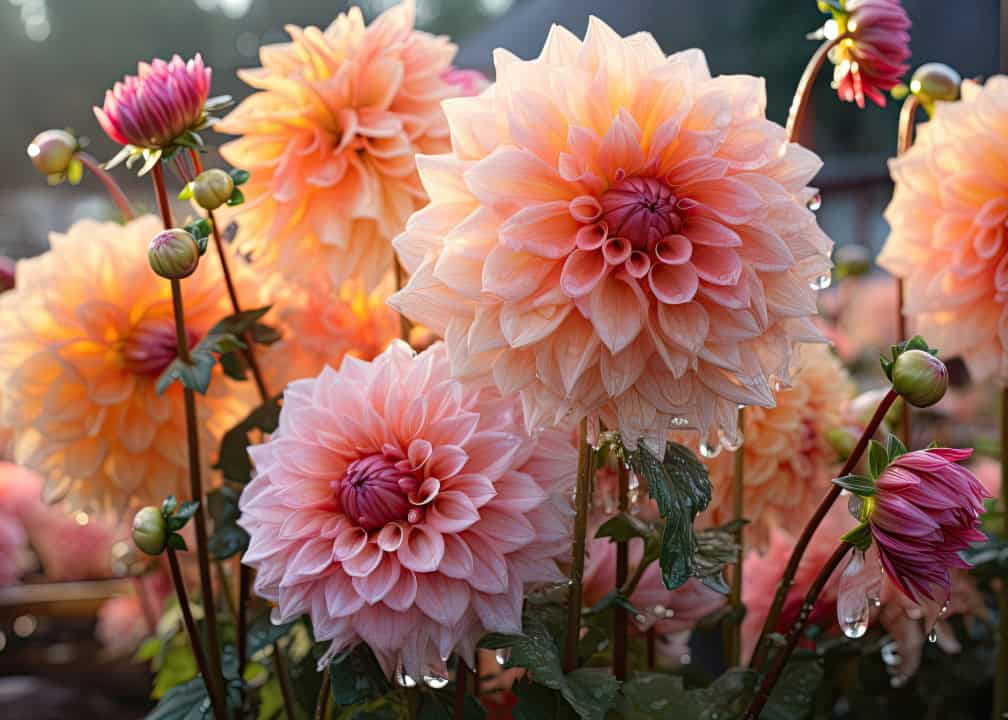


© Sonja Nelson
AMGPost_header5

Warmer Summers Impact Local Rhododendrons

From sun scorch to lace bug, local gardeners protect their beloved rhododendrons with these conscientious tips.

              Subscribe to the Blog >

By Sonja Nelson, Skagit County WSU Extension Master Gardener

Author Sonja Nelson

Rhododendrons in our gardens, along with the native state flower Rhododendron macrophyllum, the Western or Pacific rhododendron in our woodlands, are facing the vagaries of climate change here in the Pacific Northwest as well as worldwide. Gardeners in our moderate climate can no longer assume our benevolent climate will continue its unstinting support for the genus Rhododendron. According to the World Meteorological Organization, the average global temperature in 2024 was the warmest year on record at about 2.7° F or 1.55° C above preindustrial levels. Higher temperatures do not bode well for rhododendrons. They like moderation!

Rhododendrons have a long history in the Pacific Northwest. Native Americans used the flowers of rhododendrons in their dance rituals long before western plant hunter Archibald Menzies identified the R. macrophyllum. Menzies was the surgeon-botanist for Captain George Vancouver on board the British ship ‘Discovery’ in 1792. The R. macrophyllum, or Western rhododendron, was sent to King George III and introduced to the Kew Gardens in London. The discovery brought together the British and American plant people who eventually produced a creative milieus communities of rhododendron enthusiasts that made the rhododendron the “King of Shrubs” on both sides of the Atlantic.
References to the Western rhododendron (Rhododendron macrophyllum) date back to native Americans using rhododendron flowers in their dance rituals long before the late 1700s. © Photo: Sonja Nelson

References to the Western rhododendron (Rhododendron macrophyllum) date back to native Americans using rhododendron flowers in their dance rituals long before the late 1700s. © Photo: Sonja Nelson

One hundred years after Menzies documented finding the Western rhododendron, the state of Washington sought a representative flower to display in the 1893 Chicago World Fair exhibit. The Washington State Fair Commission asked the state’s women to decide. A letter-writing campaign began, pitting the native rhododendron against, among others, the clover. (The vote was Western rhododendron 7,704 and clover 5,729.) It was officially designated the Washington State flower in 1959.

However, between the time the Western rhododendron was presented at the Chicago World Fair, rhododendron species from Asia, particularly the Himalayas, had been discovered by dedicated British plant hunters and sent back to Britain to adorn gardens there with their vibrant colors and to hybridize. Many Asian species and hybrids were also brought to America, where nurseries introduced them to the Pacific Northwest. Gardeners welcomed them with enthusiasm and love. And the rhodies loved them back with their stunning performance!

Meanwhile, Washington state’s native Western rhododendron grew in its native woodlands as the quietly attractive relative of the more flamboyant Himalayan species. In the 1970s the Western rhododendrons regained popularity as gardening with native plants became popular with the backing of  WSU Extension and the Washington Native Plant Society. In 1979, the First World Climate Conference declared climate change a global issue, and rhododendron gardeners’ concern turned to the native Western rhododendron and its environment, along with concern for their rhododendron species and hybrids from afar. The natural environment of the Pacific Northwest, so well suited for much of the genus Rhododendron, was becoming jeopardized by temperature increases and other disturbances to its blissful climate.

The Western or Pacific rhododendron is native to the woodlands of the Pacific Northwest. Image © Oregon State University
One of the most sun-hardy of all rhododendrons, the Jean Marie Rhododendron is noted for its large trusses of deep red, trumpet shaped flowers. © WSU Clark County

The complexity of a warming climate makes it difficult to predict precisely how rhododendrons will be impacted by our specific climate and what to do if it does. For instance, if temperatures increased enough to leave visible sun spots on the leaves of rhododendrons, the rhododendrons could simply be moved to a site with partial shade. However, the effect of a warming climate on plants is not always straightforward.

One solution to protect rhododendron gardens from climate change damage is to find varieties-both species and hybrids-that are tolerant of temperature increase and ensuing weather extremes.

A member of the American Rhododendron Society, C.J. Patterson of Massachusetts, has focused his interest in rhododendrons on finding drought-tolerant rhododendrons for East Coast gardens. He writes that “rhododendrons, in general, are mostly very resistant to dry conditions once they are established,” citing R. carolinianum, R. maximum, and R. catawbiense as drought tolerant. He says one of the most drought-tolerant rhododendron hybrids is the hybrid ‘PJM’ (R. minus var. Carolinian Group x R. dauricum) and other hybrids of the same cross.

The director of the German Rhododendron Society, Hartwig Schepker, supports the idea that the genus Rhododendron is diverse enough to cope with the challenges posed by extreme climate conditions, saying we find them or create new hybrids that will be up to the job.

Another rhododendron expert is Glen Jamieson, the editor of the Journal American Rhododendron Society, who often writes about the impact of climate change on rhododendrons, which, he says, has been relatively minor annually. In coming publications, he plans to summarize the weather impacts on his garden in British Columbia over the past 40 years, where there have been extreme cold, heat, precipitation, and wind events-all of which can be attributed to a changing climate.

Since it is difficult, if not impossible, to predict precisely the effects of climate change on rhododendrons in the future, conscientious basic care is the best way to help them survive hard times in the future. Washington State University lists watering, fertilizing, and mulching as basic care.

Basic Care for Rhododendrons
Washington State University Extension recommends this regimen of basic care:

Watering

  • Water rhododendrons at least once a week, or when the top inch of soil feels dry.
  • Avoid waterlogged soil, which can damage rhododendrons.
  • Water well in the fall to prepare for winter

Fertilizing

  • Use a fertilizer made for acid-loving plants.
  • Fertilize in the spring when buds swell and in the fall after flowering.
  • Follow the product label recommendations.


Mulching

  • Use coarse organic mulch, like wood chips, to cover the root zone.
  • Keep mulch at least 4 inches deep, but don’t let it touch the base of the plant.
  • Mulch helps conserve water, reduce weeds, and moderate soil temperatures

Other Tips

  • Plant rhododendrons in well-drained acidic soil
  • Avoid dense or compacted soil
  • Provide shade or semi-shade
  • Prune out dead flowers
  • Avoid overhead watering
  • Maintain good air circulation
  • Prevent injury to reduce the chance of infection
  • Clean up and destroy fallen leaves

A Unique Opportunity to Observe Local Climate Change Impact
The coordinators of the various gardens within the WSU Extension Master Gardener Discovery Garden west of Mount Vernon were questioned about possible damage in their gardens due to recent summers with high temperatures. Five coordinators reported no change, and four coordinators reported slight changes. Ironically, six coordinators reported damage from unusual cold spells. The Rhododendron Garden coordinator, however, reported extensive damage to a large planting of small-leaved rhododendrons due to warming temperatures.

Lace bug symptoms on rhododendron leaves © WSU Hortsense Photo by: C.R. Foss
Photo © Sonja Nelson

Rhododendrons are divided into two natural divisions: the lepidotes and the elepidotes. Small-leaved rhododendrons belong to the lepidote division based on the tiny scales on the undersides of their leaves. Elepidotes do not have scales and tend to be large-leaved.

Sun scorch on the leaves of rhododendrons has long been an occasional problem for gardeners, but the warming caused by climate change has introduced a new, insidious avenue for damage–the rhododendron lace bug (Stephanitis rhododendri). Believed to have migrated from California, lace bugs have taken advantage of the longer growing season in the Pacific Northwest and can complete their life cycle, where, in 2023, in the Rhododendron Garden, it laid eggs and, as a result, destroyed a planting of rhododendrons.

Rhododendron lace bug (Stephanitis rhododendri Horvath) © Insect Images Photographers: Seastone, L. and B. Parks

Rhododendron lace bug (Stephanitis rhododendri Horvath) © Insect Images Photographers: Seastone, L. and B. Parks

Azalea lace bug (Stephanitis pyrioides) © Photo: Jim Baker, North Carolina State University, Bugwood.org

Azalea lace bug (Stephanitis pyrioides) © Photo: Jim Baker, North Carolina State University, Bugwood.org

The lace bug affected rhododendrons with small leaves, mainly in the island meadow section of the Rhododendron Garden, namely hybrids ‘Ramapo,’ ‘Ginny Gee,’ and ‘Patty Bee.’

The rhododendron lace bug has one generation per year. It overwinters as eggs laid on the underside of leaves. Nymphs are about 1/8 inch long and are spiny. Adults are about 1/8 inch long and whitish tan with lacy-looking wings. Damage is usually apparent by early to mid-July. The lace bug sucks on the undersides of leaves and causes stippling on the upper surface of the leaves and tar-like deposits of excrement on the lower surface. Repeated infestations may result in yellowed, sickly plants. Spraying the undersides of the plants to remove the lace bugs was considered impossible because the leaves grow so densely and so close to the ground; thus the affected plants were removed. New planting will take place in 2025.

The related azalea lace bug (Stephanitis pyrioides) has four to five life cycles annually. It infects rhododendrons also but has not been found in the Rhododendron Garden section of the Discovery Garden. Both types of lace bug overwinter.

Lacewing insect © Insect Images: Photographer: Johnny N. Dell

The lace bug is not to be confused with lacewing insects (Chrysoperla species) which are native to the Pacific Northwest and important natural predators providing biological control of aphids.

Treatment for Lace Bug
For non-chemical treatment, Washington State University recommends hand removal of adults and nymphs regularly to limit the amount of visible damage. This can be done with a strong spray of water.

If you choose to use a chemical treatment, two recommended pesticides that are legal in Washington are:     

  • Safer Brand BioNEEM Multi-Purpose Insecticide and Repellent Concentrate [Organic] Active ingredient: azadirachtin [EPA registration number: 70051-6-42697]
  • Safer Brand Garden Defense Multi-Purpose Spray Concentrate [Organic]
    Active ingredient: clarified hydrophobic extract of neem oil [EPA registration number: 70051-2-42697]

The best time to treat is May and June. For more information, download the WSU fact sheet on rhododendrons and lace bugs @ (https://hortsense.cahnrs.wsu.edu/fact-sheet/rhododendron-rhododendron-lace-bug/).

The Rhododendron Garden in the Discovery Garden allows the public to view plants as they grow in our specific climate. The damage to some of the small-leaved rhododendrons is sad to see, but it gives gardeners the knowledge to make necessary changes in their gardens to keep them beautiful.

Soon, spring will once again bring forth the eye-catching, luscious blooms on the rhododendron hybrids planted in our gardens and the quietly elegant blooms of our native Western rhododendron at the edges of our woodlands.

REFERENCES AND RESOURCES:
Dale-Crunk, B. (2024) Personal communication.

NASA https://climate.nasa.gov/vital-signs/global-temperature/?intent=121

Skagit Climate Science. Air Temperature and Precipitation Retieved at: (http://www.skagitclimatescience.org/skagit-impacts/temperature-and-precipitation-and-ecosystems/#nw-is-warmer).

Washington State University. (2024) Rhododendron: Rhododendron and Lace Bug Retrieved at: (https://hortsense.cahnrs.wsu.edu/fact-sheet/rhododendron-rhododendron-lace-bug/).

Pojar, J. and MacKinnon, A. (1994) Plants of the Pacific Northwest, B.C. Ministry of Forests and Lone Pine Publishing

Nelson, S. (Compiler) (2001) The Pacific Coast Rhododendron Story American Rhododendron Society. Binford & Mort Publishing, Portland, Oregon.

University of Washington: Pruning and Caring for Rhododendrons. https://depts.washington.edu/hortlib/pal/pruning-and-caring-for-rhododendrons/

Washington Native Plant Society (2022) Coast Rhododendron: Washington’s State Flower Retrieved at:https://www.wnps.org/blog/coast-rhododendron-washington-state-flower?highlight=WyJyaG9kb2RlbmRyb24iXQ==

World Meteorological Organization (2025) January 2025 sees record global temperatures despite La Niña Retrieved at: https://wmo.int/media/news/january-2025-sees-record-global-temperatures-despite-la-nina


ABOUT THE AUTHOR:
Sonja Nelson is a Skagit County WSU Extension Master Gardener, Class of 2009.

Questions about home gardening or becoming a master gardener may be directed to Skagit County WSU Extension Office, 11768 Westar Lane, Suite A, Burlington, WA 98233; by phone: 360-428-4270; or via the website: www.skagit.wsu.edu/mg

Washington State University Extension helps people develop leadership skills and use research-based knowledge to improve economic status and quality of life. Cooperating agencies: Washington State University, US Department of Agriculture, and Skagit County. Extension programs and policies are available to all without discrimination. To request disability accommodations contact us at least ten days in advance.
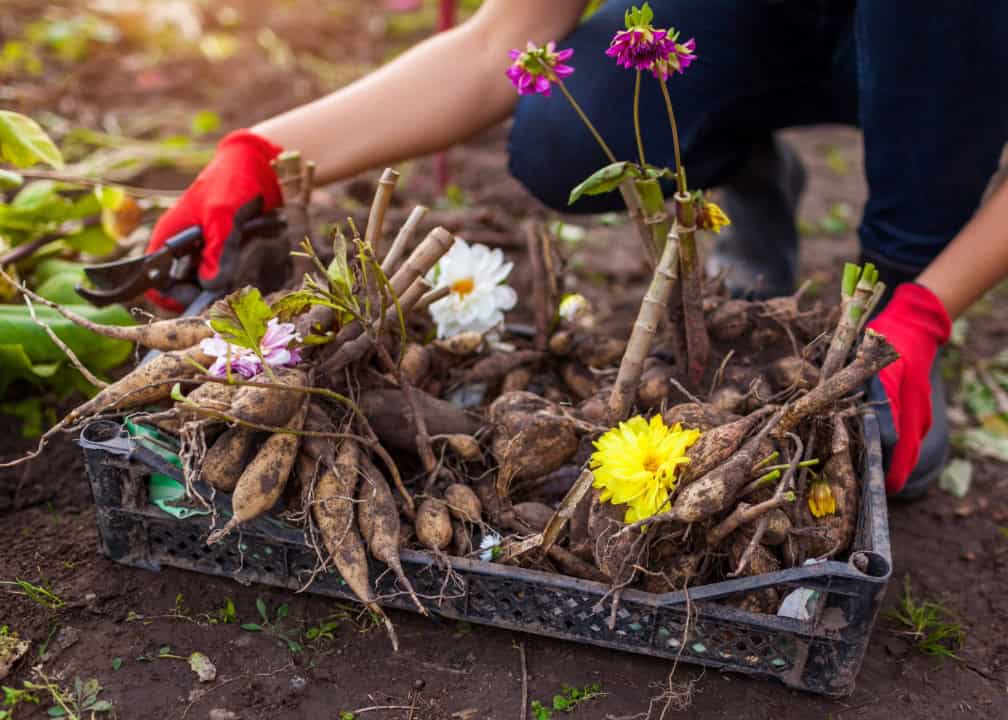


AMGPost_header5
090224_Header2

Useful Tips for Harvesting and Preserving Herbs in the Pacific Northwest

Preserving herbs can be a bit of trial and error, but the process is worth the fresh flavor and satisfaction.

              Subscribe to the Blog >

By: Laura Kuhn, Skagit County WSU Extension Master Gardener

Because of their useful nature, herbs are a common addition to home gardens. The use of the term herb is often used interchangeably with spice. However, the terms herbs and spices technically refer to two different things. “Herbs” are defined as the leafy parts of plants, such as oregano, rosemary, thyme, sage, basil, and others. “Spices” typically involve the use of other plant parts such as roots, fruits, flowers, seeds, or bark. Spices include cinnamon, ginger, lavender, coriander, cumin, and many others. Both herbs and spices are used for their savory, aromatic, or medicinal qualities. This article will focus primarily on herb preservation, although many methods mentioned here can also apply to spices.

Gardeners who grow vegetables may also grow herbs for pairing in recipes later. However, some of the best pairings cannot be harvested at the same time. For example, basil can look tired by the time the tomatoes are ready to be harvested. And it is difficult to find an easy, cost-effective way to have bunches of fresh cilantro available at the same time tomatoes and peppers ripen for salsa. Preserving herbs can help to bridge these gaps.

In 2002, when faced with a huge abundance of herbs that could not all be used fresh, I bought one of the popular “As Seen On TV” food dehydrators and dried herbs to make gifts for the following holiday season. The color and flavor of home-dried herbs are superior to store-bought herbs. Since then, I have also started to grow herbs and spices to make tea.

An often-asked question is: What is the best way to preserve herbs? The answer depends on how you plan to use them. The goal is to capture the essential oils in the trichomes (fine outgrowth like hairs) on the surface or epidermal layer of the leaves. These oils have the flavor and aroma we want.

What gardeners choose to grow and preserve is most influenced by the amount of time, budget, and available space. The good news is that with a small investment in time, space, and equipment, home gardeners can achieve excellent results that rival the expensive options available.

Oregano ripe for harvest.  © Photographer: Laura Kuhn
Oregano ripe for harvest. © Photographer: Laura Kuhn
Stevia and ornamental oregano in a vertical container with annuals.  © Photographer: Laura Kuhn
Stevia and ornamental oregano in a vertical container with annuals. © Photographer: Laura Kuhn
Growing Herbs-
Herbs can grow in most garden conditions and be planted directly in the ground, in raised beds, or in containers. Vertical garden systems are a terrific way to get a lot of variety in a small space. Gardeners who are just starting herb growing should start slowly and do their research. Purchasing herb starts at a local garden center is an easy and inexpensive way to begin. However, a far greater selection of herbs are available as seeds. Once gardeners have experience, they can grow their favorites from seed and make space for annual and perennial varieties.
Harvesting Herbs-
The harvesting process is as simple as removing the right part of the plant for the intended use. For most culinary uses, the target is tender fresh leaves (i.e., oregano, thyme, and basil). In some cases, the goal is to preserve flowers for making tea (i.e., chamomile, calendula, or anise hyssop) or to harvest the plant’s mature seeds (i.e., dill or coriander). Yet other plants are used for their roots (i.e., ginger or horseradish). If growing for flowers, it is important to pick the flowers often to encourage the production of more blooms.

For leafy herbs such as basil and oregano, the best flavor comes from young leaves on stems cut before the plant goes into flower production. However, the growing season can be extended by cutting back flowering stem tops to encourage more leaf growth. When doing so, leave four to six leaves on the plant stems for re-growth. If growing for seed, keep the flowers on the plants and wait until the seeds are fully mature. Root harvests take a longer time commitment and can require waiting for several growing seasons to achieve a decent harvest.

Organization is important during the harvesting process. It is best to harvest all of one specific plant at a time, making the cleaning and preservation process easier by avoiding the time-consuming task of separating during the cleaning process. For harvesting, no special tools are needed. Most herbs are tender enough to harvest by hand pinching or using scissors. Small clippers with short-tipped blades are best for harvesting small leaves or stems. Digging roots is a careful process. It is important to provide wide enough margins to avoid shovel damage to the roots.

Mammolo and Lettuce Leaf basils ready for drying in the dehydrator. © Photographer: Laura Kuhn
Preserving Herbs –
After harvesting, the herbs require cleaning before preserving. Most herbs can be immersed in cool water to clean off the leaves (stem and all). Use paper towels, a drying rack on a work surface, or a salad spinner to get as much moisture off as possible. Avoid crushing the leaves unless the herbs are chopped before preserving them. Chives can be washed and cut into small pieces with scissors by holding a bunch of stems and cutting them as a group before preserving them.

The preservation method should strive to achieve the best quality for the intended use. Scientific research has been conducted on various methods of preservation. The winning method for drying herbs is freeze drying because it preserves essential oils, aroma, and color best. However, the cost of such a system for most home gardeners is not reasonable. Therefore, the most common methods involve dehydration (using heat) or drying (using air), which results in a shelf-stable product that can be used year-round, or by freezing.

Bunching and cutting chives to cut and freeze or dry. © Photographer: Laura Kuhn
Echinacea (foreground) and lavender at a local nursery. © Photographer: Laura Kuhn
Chamomile ready to harvest in the Herb Garden at the Discovery Garden. © Photographer: Laura Kuhn
Calendula and various herbs in the Discovery Garden.  © Photographer: Laura Kuhn
Calendula and various herbs in the Discovery Garden. © Photographer: Laura Kuhn

Humidity levels in the Pacific Northwest, particularly western Washington, are a challenge to herb preservation and storage. Humidity levels should be 45-55 percent for proper drying and to avoid mold. Even during our drier summer months, average outdoor humidity levels are more than 60 percent. The water content in the herbs being dried is also a consideration. The more tender herbs, such as basil, tarragon, oregano, lemon balm, and mints, tend to have a higher water content. On the other hand, sage, thyme, parsley, and rosemary tend to be more “woody” and have a lower water content. Taking this into account before picking a preservation method increases the chances of success.

Drying with Air
Drying with air is by far the easiest method of preserving herbs but difficult to master successfully given Pacific Northwest humidity levels. Mold can form on plants, or the dried product will be limp and discolored. Make small bunches of plant stems, wrap with butcher’s twine, and hang the bunches up. The drying area will need to have good ventilation (an oscillating fan works great). Avoid exposure to light during drying as it will affect the color. A barometer or humidity gauge helps decide if drying is possible. Woody plants such as rosemary and sage are best for this process due to humidity levels. The amount of time needed to dry the plants and crush the leaves will vary based on weather and drying conditions. Checking plants often is the best way to gauge if they are ready.
Bunches of herbs ready for hang drying. © Photographer: Laura Kuhn
Failed attempt at airdrying parsley and lemon balm. Conditions were too humid for effective drying. Note loss of color in parsley to the left. © Photographer: Laura Kuhn
Dehydrating with Heat
The National Center for Home Food Preservation recommends drying herbs at 95 to 115 degrees Fahrenheit. Lower temperatures are best for tender plants. Since most home ovens cannot achieve the recommended temperatures for herb drying, food dehydrators have become popular. Many dehydrators come with wire racks so air can flow through the leaves. Arrange the leaves/stems across the rack so they are not touching. Overcrowding during the drying process can result in longer dry times. You can use a mesh-style rack for small leaves to provide air circulation. A tip for selecting a decent food dehydrator is to make sure that it can adjust the drying temperature and time. Select a unit that can dry at as low a temperature as possible to provide the most control over the drying process and quality. Increased heat levels might be needed to compensate for humidity levels. Using heated air to dry herbs can result in a higher loss of essential oils than using air-dried herbs. The amount of time needed to achieve a crisp, dry product that can be easily crushed is variable. Humidity, plant water content, and temperature are all factors to consider. For this reason, I recommend checking on the plants often during the drying process.

For either drying method mentioned above, it is important to note that any moisture left in the plants after drying can lead to spoilage. If your drying space seems to be “too moist” meaning you cannot achieve a crisp dry texture, increase the temperature, and air circulation. A process of trial and error may be needed as the time of year and the water content of plants can vary.

To prepare the dried herbs for storage, the leaves are removed from stems and crushed to the desired size. A tip for this step is to place the dried herbs into a bag and push the leaves off the stems. Set aside stems as you push the leaves into the bag. When the biggest stems are removed, crush the leaves inside of the bag to the desired size. Sift through the dried product to remove smaller stems to achieve the best consistency for cooking. Rougher dried herbs can be used for teas. It really is up to personal preference as to how “clean” the final product will be. Some choose sifters or screens to further improve the visual appeal of the end product.

Dehydrator full of racks of calendula and anise hyssop. © Photographer: Laura Kuhn
Fresh chopped basil freezes well when packed in ice cube trays then filled with water or oil. Once frozen, the basil cubes can be stored in a large freezer bag and used as needed. © Photographer: Laura Kuhn
Freezing
A quick and straightforward way to preserve herbs for later use in cooking is by freezing. Individual leaves can be placed in single layers on cookie sheets and then flash frozen. Cut chives work well this way. Once frozen, place the herbs into storage containers to reduce exposure to air. Another freezing method is to chop the herbs and load them into ice cube trays, then fill with water. Once frozen, put the cubes into storage containers and add them to recipes when needed. Alliums (onions and garlic) can be easily processed this way, also. The biggest downside to freezing is the required storage space in your freezer and a shorter shelf life.

Other methods include layering whole leaves in salt or oil. Herb essential oils can be transferred to other liquids for use in cooking. For example, herbs can be steeped to create herb-infused vinegars or oils. These methods take more time and care than can be covered here, so more research and preparation should be taken before trying these options. Microwaving takes a bit of trial and error to get the right cooking time for the type of herb used and varies with different types of machines.

Most herbs can be processed successfully in a variety of ways for different uses. A good tip is to experiment and see which techniques work best. Gardeners who experiment, find the methods that work best for their intended use.

Air tight containers and light blocking storage bin for dried herbs. © Photographer: Laura Kuhn
Storing Herbs –
Dried or dehydrated herbs do not like exposure to light and air, especially moist air. A simple and effortless way to store extra dried herbs is to put them into marked zip lock bags or a vacuumed sealed mason jar. Once each herb is in its container, they will need to be placed in a dark area like inside of a canister or storage container. Keep your herbs in a cool dry area because exposure to heat during storage can affect essential oil content. Storage time will vary on the herb, but if stored properly, they can last for months or longer.

The two most important tips of all are to grow what you will use and grow from seed for the best plant selection.

REFERENCES AND RESOURCES:

Rodale’s Encyclopedia of Herbs, May 2000, Rodale Press

Drying: Herbs, National Center for Home Food Preservation, University of Georgia, no date cited. https://nchfp.uga.edu/how/dry/recipes/herbs/

Thamkaew, G., Sjöholm, I., & Galindo, F. G. (2020). A review of drying methods for improving the quality of dried herbs. Critical Reviews in Food Science and Nutrition61(11), 1763-1786. https://doi.org/10.1080/10408398.2020.1765309

Author: Laura Kuhn

ABOUT THE AUTHOR:
Laura is new to the Skagit Valley but has more than 30 years of experience growing in coastal, inland valley, and desert climates. She had fun trying to grow herbs while traveling full-time in an RV. Laura is a 2023 graduate of the Skagit County WSU Extension Master Gardener program.

Questions about home gardening or becoming a Master Gardener, may be directed to: Skagit County WSU Extension Office, 11768 Westar Lane, Suite A, Burlington, WA 98233; by phone: 360-428-4270; or via the website: https://extension.wsu.edu/skagit/mg/


A Second Act for Your Square 1-Gallon Pots at the Discovery Garden!

Bring your leftover square 1-gallon pots to the Discovery Garden (16650 State Route 536, Mount Vernon). The bin for recycling the square 1-gal pots is located in the parking lot, just north (to the right) of the main entrance.
We only need square 1-gallon pots like the ones pictured below (bottom right). The recycling bin will be available now through fall. Simply put your pots into the bin, and we take care of the rest!


pot recycling


AMGPost_header5
102023_Header

Plant Bulbs Now For Spring Color

Take the time in the fall to plant bulbs and enjoy the first signs of spring in late January.


              Subscribe to the Blog >

By Jessamyn Tuttle, Skagit County WSU Extension Master Gardener

Bulbs are an important part of the spring garden. They provide color and interest when it’s most appreciated, as well as food for early pollinators. After putting on a spectacular show throughout spring, bulbs then fade into dormancy and let the summer garden do its thing.

To make that happen, however, the work of planting bulbs needs to happen in the fall. It’s strangely satisfying to put dry, dormant bulbs into the garden on a blustery October day, knowing that in just a few short months they will be shooting up new growth and flowers.

Crocus tommasinianus © Jessamyn Tuttle

Crocus tommasinianus © Jessamyn Tuttle

Iris histrioides 'Katharine Hodgkin' © Jessamyn Tuttle

Iris histrioidesKatharine Hodgkin’ © Jessamyn Tuttle

Early Bloomers
The first bulbs to bloom here in Western Washington are typically snowdrops (Galanthus spp.), often emerging in January but coming into their full bloom in late February. Whether planted in clumps or a massive drift, snowdrops are a sure sign that spring is on the horizon. Snowdrops are always white with green or yellow markings, the double-flowered varieties are particularly charming.

Winter aconite (Eranthis hyemalis) is a tuberous member of the buttercup family, providing a vivid spot of yellow surrounded by a frill of greenery. It blooms around the same time as snowdrops with a bonus in that it’s resistant to deer and rabbits.

Iris reticulata 'Harmony', Discovery Garden © Jessamyn Tuttle

Iris reticulata ‘Harmony’ © Jessamyn Tuttle

Muscari © Jessamyn Tuttle

Miniature iris, also called rock garden iris or bulbous iris, begin blooming in February. Unlike bearded irises, which grow from rhizomes, these come from small bulbs and are easy to slip into the garden wherever you have a bit of space between plants, especially those that go dormant in the winter. The miniature iris flowers are only a few inches across and sit on short stems. They are unfortunately wildly popular with slugs, so you may need to get out in the garden with slug bait earlier than usual to protect them. The most commonly available species, Iris reticulata, comes in white, blue, and purple. You can also find bright yellow I. danfordiae, or look for the fancy veining of I. histrioides (‘Katharine Hodgkin’ is a particular favorite.)

Crocuses pop up on the heels of snowdrops. Their grassy foliage comes up from the corm in February or March, followed quickly by delicate flowers in brilliant colors including white, yellow, lavender, and deep purple. They only open on sunny days, protecting their fragile petals from rain. The earliest varieties, commonly called snow crocus, include smaller-flowered species like Crocus chrysanthus and Crocus tommasinianus, which come in a lovely range of colors and patterns. The larger cultivars, sometimes called Dutch crocus, like C. vernus ‘Pickwick’ and ‘Jeanne d’Arc’ appear a few weeks later. Crocuses are deer-resistant, although not slug-resistant. Crocuses can be planted in swathes in lawns if you’re able to hold off on mowing until the foliage has ripened, otherwise, they fit nicely anywhere in the garden where they will get some sun.

Muscari armeniacum, also known as grape hyacinth, is a wonderful addition to the spring garden thanks to its pure blue color (they also come in white, purple, and pink). Muscari spreads with enthusiasm by both seed and bulb offset, so be aware of the commitment you’re making when planting it. Blooming in March and April, it makes a perfect companion for daffodils. A slightly earlier option for blue flowers is Chionodoxa or Glory-of-the-Snow. These deceptively fragile little blossoms pop out of seemingly nowhere and look their best when planted en masse. Species include C. luciliae and C. forbesii, among others, and also come in pink and white.

Snowdrops in the Discovery Garden © Jessamyn Tuttle

Tete a tete miniature Narcissus © Jessamyn Tuttle


Snowdrops in the Discovery Garden © Jessamyn Tuttle

Snowdrops © Jessamyn Tuttle


The Narcissus Family is Wide and Diverse
While the most commonly seen type of narcissus is the large yellow trumpet daffodil like ‘King Alfred’ or ‘Dutch Master,’ there are hundreds of varieties to choose from, including early blooming miniatures like ‘Tete a Tete,’ a tiny yellow trumpet narcissus, which is often available in pots very early in the season, but does just as well planted out in the garden, often coming up through a layer of snow. ‘February Gold’ is a slightly taller yellow miniature, while ‘Jack Snipe’ is a handsome dwarf Narcissus featuring a yellow trumpet surrounded by white, swept-back petals.

For a real punch, the distinctive Narcissus ‘Jetfire’ offers bright yellow and red-orange blooms. One of the very earliest daffodils, however, is ‘Rijnveld’s Early Sensation’ which produces a full-size trumpet daffodil flower a full month before other daffodils, an impressive show that sometimes gets cut abruptly short by a late winter snowfall or windstorm.

Later blooming varieties include the big trumpet daffodils but also the small cup, doubles, and large cup, like the classic ‘Ice Follies’ with its white petals and flat yellow cup, and the pretty, fragrant tazetta daffodils like the delightful white and orange cultivar ‘Geranium.’ Late season brings the delicate, backswept flowers of Narcissus poeticus var. recurvus, also known as ‘Pheasant Eye’ daffodil.

'Spring Green' tulip © Jessamyn Tuttle

Spring Green’ tulip © Jessamyn Tuttle

Tulipa saxatilis © Jessamyn Tuttle

Tulipa saxatilis © Jessamyn Tuttle

The Pinnacle of Spring
For many people, especially here in Skagit Valley, the pinnacle of spring is when the tulips bloom. There are many, many varieties of tulips, including single early, single late, doubles, parrots, triumph, Darwin hybrids, emperor, and fringed, each with its own bloom time and flower type. They come in every color except blue, from ‘Spring Green’, a white tulip with pale green stripes to the nearly black ‘Queen of Night.’

There are also species of tulips which are less showy than the big hybrids but very hardy and great for naturalizing in the garden. Tulipa saxatilis is a vigorous spreader that carpets the ground with showy lavender-pink flowers with brilliant yellow centers, while T. batalinii ‘Bright Gem’ has blue-green foliage topped with yellow or apricot flowers streaked with pink.

Chionodoxa, or Glory-of-the-Snow  © Jessamyn Tuttle

Chionodoxa, or glory-of-the-snow © Jessamyn Tuttle

Tulipa batalini 'Bright Gem' © Jessamyn Tuttle

Tulipa batalini ‘Bright Gem’ © Jessamyn Tuttle

Planting Spring Bulbs
The rule for most bulbs is to plant in late fall or early winter, setting them at a depth 2-3 times the size of the bulb. Not planting bulbs deep enough is often what causes them, especially tulips, to vanish instead of coming back year after year. Pick a spot with full or at least part sun, and well-draining soil. Bulbs do not do well in damp spots. You can add some bulb fertilizer to the soil while planting if you like. Small, early-blooming bulbs can be tucked in throughout a garden bed, but all bulbs look beautiful planted together in a group to make swathes of color in the spring.

Bulbs should be well watered at the time of planting and while actively growing and flowering but do best when allowed to stay mostly dry through their summer dormancy. And if you want your bulbs to come back next year, don’t cut the foliage down until it has ripened, since the leaves are what provide the bulb with food for the next season.

If you plant every bulb listed here, you should have a succession of colors starting in January until the rest of the garden fills out in May. Enjoy!


REFERENCES:

https://www.missouribotanicalgarden.org/Portals/0/Gardening/Gardening%20Help/Factsheets/Flowering%20%20Bulbs17.pdf

Botts, B. Early spring bulbs. Chicago Botanic Garden https://www.chicagobotanic.org/plantinfo/smart_gardener/early_spring_bulbs

Slade, N (2014). The plant lover’s guide to snowdrops. Timber Press.

Austin, C (2005). Irises: A gardener’s encyclopedia. Timber Press.


ABOUT THE AUTHOR:

Jessamyn Tuttle is a Skagit County WSU Extension Master Gardener, Class of 2017. She is co-manager of the Plant House and also coordinates the Iris Garden room in the Discovery Garden on Hwy 536 west of Mount Vernon.

_________

Questions about home gardening or becoming a Master Gardener, may be directed to: Skagit County WSU Extension Office, 11768 Westar Lane, Suite A, Burlington, WA 98233; by phone: 360-428-4270; or via the website: https://extension.wsu.edu/skagit/mg/


AMGPost_header5
100823_Header2

Seed Saving and Sharing

Open the door to learning about plants in a whole new way.

              Subscribe to the Blog >

By Sheri Rylaarsdam, Skagit County WSU Extension Master Gardener

Want to see an adult in an eight-foot-tall sunflower costume? Let your vegetables grow into monsters? Save some cold hard cash? Save an heirloom plant or design a new one?

These are all possibilities once one starts down the road of seed saving. You can begin almost accidentally by not pulling all the radishes in the garden. Several weeks later you’ll notice they have grown six feet tall with multiple branches and hundreds of seedpods. The original radish is an unrecognizable nob at the bottom of the magnificent plant.

vegetable garden with plants gone to seed
Radish plants gone to seed in the author’s garden. © Photo by Sheri Rylaarsdam
Radish seed pods can be collected when they turn brown and look dried out. Interestingly, they are also edible. © Photo by Sheri Rylaarsdam

Now you know getting started is easy enough. So next you may be asking “What other vegetables produce harvestable seeds when left to grow?”

First, always save seeds from open-pollinated plants, not hybrids. Open-pollinated seeds are plants pollinated openly by wind, rain, or flying critters. Heirloom seeds are included in this category, named so because the saved seeds have produced ‘true to type’ plants for fifty years or more. The seeds collected from hybrid plants are sterile because they are a manually-produced cross between two varieties and will not grow true to form.

It is easiest to save inbred or self-pollinated seeds. These are seeds of plants whose pollen is transferred within the same flower or from one flower to the other within the same plant. Peas, beans, lettuce, and most tomatoes are examples of plants with inbred or self-pollinating seeds.

Beet plants grow tall when left to seed. © Photo by Sheri Rylaarsdam
Cobra green pole beans going to seed. © Photo by Sheri Rylaarsdam

Grown from saved open-pollinated seed, this Hungarian Heart tomato is the largest the author has grown. © Photo by Sheri Rylaarsdam

Harvesting Self-Pollinating Seeds
Let beans and peas dry on the plant, then pick the pods to shell. Thresh the pods by hand. The chaff can be winnowed by tossing the pods in the wind and catching the seeds in a basin.

Lettuce seeds send up a seed stalk, ripening two to three weeks after flowering. Harvest daily by shaking the seeds into a paper bag. The lettuce feathers and chaff can then be separated from the seeds using a fine mesh screen.

To save seeds from tomatoes, choose fully ripe tomatoes. Cut across the equator of the tomato and scrape out the gel and seeds. Let the seeds ferment for a couple of days until a black or white mold forms on top. This helps remove any pathogens on the seed surface and also removes the natural germination inhibitor that coats the seed. Strain off the mold and rinse the seeds slowly and carefully. Drain in a fine mesh strainer and dry thoroughly on a saucer. Be sure to label the saved seeds with the name of the variety and the date they were saved. Since the viability of seeds is most affected by fluctuating temperature and moisture levels, it is important to store them in a cool, dry place-ideally in a tightly closed glass jar in the refrigerator.

Harvesting Wind-Pollinated Seeds
Varieties of wind-pollinated plants need to be separated by distance or mature at different times in order not to cross. Wind-pollinated plants include beets, chard, spinach, and corn. Corn pollen is light and can be carried long distances by the wind. A distance of two miles is the recommended isolation distance. A minimum of two hundred plants is needed to have enough genetic diversity.
Harvesting Seeds Pollinated by Bees
Bee-pollinated plants include many ornamental flowers and these vegetable families: Apiaceae (carrots, dill, parsley, cilantro, parsnip, chervil, caraway), Amaryllidaceae (onion, garlic, shallots, scallions, chives, leeks), Brassicaceae (cabbage, broccoli, cauliflower, Brussels sprouts, turnips, kale) and Cucurbitaceae (squash, pumpkins, gourds). If vegetables have the same Latin name they can cross. Avoid cross-pollination by allowing just one type of vegetable from each family to go to seed. For example, if one lets leeks go to seed, do not let onions, garlic, shallots, scallions, or chives go to seed at the same time. The seed-producing vegetable also needs to be isolated from other seed-producing vegetables in its family by one-half mile. Cucurbitaceae are often hand-pollinated. Professional seed savers often use a system of cages to avoid cross-pollination.

Carrots, cabbages, beets, and onions are examples of biennials. These should be left in the ground or stored over the winter and replanted in spring to produce seed in the second year.

Master Gardener Dixie Mitchell repurposes the silca gel packets that come with shipments to keep her seed collection dry until use. © Photo by Ginny Bode

Start with something easy. Choose a variety of beans, peas, lettuce, or tomato that is delicious, grows vigorously, is a good producer, and is resistant to pests and diseases. Once you’ve started saving seeds, collect all the seeds you can. Then you’ll have plenty to plant next year, some to share, some to donate to a seed library or take to a seed swap.

Sharing seeds by donating to a seed library can make it easy for new gardeners to get started. Supplying seeds and information encourages gardeners to be out in nature, eat healthy food, and save money. Seed swaps are an excellent way to get seeds for the garden for the whole next year. Seed swap events usually have music, food, classes, and sometimes adults dressed up like sunflowers!

One can support biodiversity by supporting seed banks, buying from seed companies that increase biodiversity, and contributing to seed libraries and local seed guilds. The U.S. has lost a large percentage of its food plant biodiversity in the last 100 years. By saving seeds, you are doing your part to preserve the genetic diversity which is vital for the future of our food supply.

Seed stewards work to increase, not decrease, biodiversity. By saving and growing open-pollinated varieties of vegetables in the same area for many years and selecting for taste, disease resistance, and productivity, one can develop an improved vegetable. The selected variety will have the characteristics necessary to withstand unfavorable local conditions such as drought or heavy soil.

Seed saving is a gateway to learning about vegetables and flowers in a whole new way, witnessing their whole life cycle and how they interact with other plants. It has led to a new appreciation for nature’s abundance. Through seed sharing, I’ve contributed to altruistic causes that make a difference in the daily lives of people in our community. And I’ve met interesting people that make me smile-such as the fellow seed sharer wearing an eight-foot-tall sunflower costume.


REFERENCES:

Ashworth, Suzanne, 2002, Seed to Seed, Seed Savers Exchange

Gardening for Everyone: Seed Saving/WSU Lewis County Extension/ s3.wp.wsu.edu/uploads/sites/2057/2022/02/Seed-Saving-Handout.pdf

Op-ed: Saving Heirloom Seeds Can Protect Crop Diversity/civil eats/civileats.com/2022/01/27

Community Horticultural Fact Sheet #17/ WSU Jefferson County Extension/ extension.wsu.edu/jefferson/master-gardener-seed-library

Hubbard, Kristina K. January 11, 2019
https://civileats.com/2019/01/11/the-sobering-details-behind-the-latest-seed-monopoly-chart/


Sheri Rylaarsdam

ABOUT THE AUTHOR:

Sheri Rylaarsdam is a Skagit County WSU Extension Master Gardener, Class of 2019. She is an avid seed saver and vegetable grower.

_________

Questions about home gardening or becoming a Master Gardener, may be directed to: Skagit County WSU Extension Office, 11768 Westar Lane, Suite A, Burlington, WA 98233; by phone: 360-428-4270; or via the website: https://extension.wsu.edu/skagit/mg/


AMGPost_header5
picture of Discovery Garden entrance apples, Salal Native Garden sign


Discover the Skagit Valley Display Gardens Open House

Discover the Discovery Garden, NW Fruit Garden, and the Salal Native Plant Garden

              Subscribe to the Blog >

By Janine Wentworth, Skagit County WSU Extension Master Gardener

June is the beginning of summer blooming, fruit and vegetable growth and early harvests.

Enjoy the summer gardens of Skagit Valley at the Discover the Display Gardens Open House. Skagit Valley is home to 8 acres of display gardens operated by volunteers as a learning resource for the public.

Discover the Display Gardens
Open House

June 24, 2023 · 10 am – 2 pm

Free Admission

  • Skagit County WSU Extension Master Gardener Discovery Garden
  • Western Washington Fruit Research Foundation
  • Salal Native Plant Garden

All three are nestled together in the green fields of the WSU Northwestern Washington Research and Extension Center west of Mount Vernon on HWY 536 (Memorial Hwy.)

While all three of these gardens are open to the public daily, the Annual Open House is focused on educating and inspiring visitors interested in many specific areas of interest, including pollination, water-wise gardening, native plants and raising fruits and vegetables in the Skagit area.

The Discovery Garden
Designed to support Skagit home gardeners by promoting science-based gardening practices, Skagit area WSU Extension Master Gardeners have created 30 garden rooms within the garden, featuring hundreds of plants chosen to flourish in Skagit Valley. Come and spend time with the volunteers who maintain the gardens and learn more about what they grow.

In addition to tours of the garden rooms, Master Gardeners will be on hand offering activities for all ages including:

  • Free garden tool sharpening
  • Solutions to plant problems
  • Plant identification– to help you know what you have
  • Expert advice on weed identification and management

While at the Discovery Garden, visit the small fruits garden and learn more about food you can grow in your own back yard. Photo © Nancy Crowell Photography
Visit the learning station near the pond in the Naturescape Garden. There you will see Koi fish and learn about pond maintenance and construction as well as drip irrigation.
Bring a blanket and picnic lunch and enjoy the day at the Discovery Garden. Photo © Nancy Crowell Photography

Learn about effective gardening at the 8 education stations located throughout the garden area. Master Gardeners will offer instruction on topics such as:

  • Developing healthy soil
  • Composting
  • Pollinator support
  • Fruit tree pruning and thinning
  • Gardening with native plants
  • Weed identification: Match examples of common weeds with their names so you can learn how to identify them and control them
  • Clean water and water conservation: Visit the learning station near the pond in the Naturescape Garden. There you will see Koi fish and learn about pond maintenance and construction as well as drip irrigation

Pollinators: Learn about plants that support pollinators from Master Gardeners who plant and care for the pollinator gardens and the pollinators that live in the garden. The pollinator station at the Open House will teach ways to help native bees and other pollinators thrive in home and community landscapes because pollination is an essential survival function.

Local Food: The Skagit County WSU Extension Master Gardeners offer extensive resources for local gardeners. During the Open House, Master Gardeners will be giving talks on drawing of food baskethealthy soils, growing your own vegetables, and weed identification and eradication. The Grow Your Own Food page at https://skagitmg.org/home/resources/food/ is also an excellent resource for gardeners getting started.

While at the Discovery Garden, visit the Vegetable, Small Fruits, and Doc’s Arbor garden rooms for ideas and examples of food-producing plants that grow well in the Skagit County area.

Educators from the Xerex Society will be at the Open House demonstrating techniques for making your garden pollinator friendly
Learn smarter vegetable gardening tips from the Master Gardeners who have research and tested a variety techniques that face gardeners in the North Puget Sound area.
Throughout the growing season, garden waste is sorted, chopped, and chipped-- the browns and greens are com­bined and turned, giving us nutrient-rich compost in a few months.
Throughout the growing season, garden waste is sorted, chopped, and chipped– the browns and greens are com­bined and turned, giving us nutrient-rich compost in a few months.

Composting: Curious about how to get started composting? Composting reduces waste and provides an inexpensive treatment for home gardens and landscapes. Healthy soil is essential to have healthy plants. Come talk to our soil experts and learn about your soil and what you can do to improve it.

Growing the Discovery Gardens since 1996
In 1994, the Skagit County WSU Extension Master Gardeners had a vision for a garden that would demonstrate best practices for gardening in the Skagit area. After two years of planning, the garden’s first structure of trees and fences was placed in the fall of 1996. Over the following two years, many committed WSU Extension Master Gardeners, along with the help of the community, planted the gardens.

The WSU Master Gardener Program addresses important sociologic and environmental issues by teaching research-based horticulture information. We want people to have important skills and abilities that help mitigate challenges and to understand that everyone has a role to play in creating and sustaining healthy and resilient communities.

Salal Native Plant Garden
The second garden participating in the Tri-Garden Open House is the Salal Native Plant Garden. Bordering the Discovery Garden to the south, the Salal Native Plant Garden is entered by walking through the Discovery Garden following the paths to the south. This labor of love and concern for native plants is manifested in an extensive and charming display garden.

Created twenty-five years ago as a collaborative effort between volunteers of the Salal Chapter of the Washington Native Plant Society and the Washington State University Agriculture Extension Agency at Mount Vernon (WSU), the Native Plant Garden is now a half-acre oasis that holds the seeds for the future of native plants in the lower Skagit Valley. The garden is a terrific resource for homeowners who want to learn how to incorporate more native plants into their landscaping.

Western Washington Fruit Research Foundation (NW Fruit)
The third garden on display is the fruit garden known as the Western Washington Fruit Research Foundation (or NWFruit.org). Here volunteers will answer questions about fruit trees. The 6-acre garden was designed and constructed by volunteers of the foundation and contains large informational signs and handouts based on the research conducted by Washington State University.

During the Open House volunteers will be on hand to explain examples of netting for bird control, a Tatura trellis, and answer questions about the expansive espalier display.

The fruit garden contains a large collection of fruiting plants with many unique varieties, including a collection of 17 variations of Gravenstein apples, a collection of antique apples from all over the world, and unusual fruits such as medlar and blue honeyberry. Located on the west side of the Discovery Garden the fruit garden is open to the public seven days a week from dawn to dusk.

Please join us for the Open House festivities on June 24, 2023 from 10 am – 2 pm. You are welcome to bring a blanket and picnic lunch and enjoy the day with family and friends.

The gardens are open and free to the public throughout the year, 7 days a week from dawn to dusk. Visit the gardens throughout the seasons to view the seasonal changes. Signage in each garden identifies plants and makes for interesting and educational self-guided tours.


RESOURCES:

ABOUT THE AUTHOR:

Janine Wentworth became a master gardener in 2018. She and Kay Torrance are co-chairs of the Discovery Garden Open House.


Questions about home gardening or becoming a master gardener may be directed to: Skagit County WSU Extension Office, 11768 Westar Lane, Suite A, Burlington, WA 98233; by phone: 360-428-4270; or via the website: www.skagit.wsu.edu/mg


AMGPost_header5
041923-header

2023 Skagit Master Gardener Plant Fair

Enjoy fun for the whole family – Saturday, May 13, 2023

              Subscribe to the Blog >

By Claire Cotnoir and Hank Davies, Skagit County WSU Extension Master Gardeners and Co-Chairs of the 2023 Plant Fair

Photo © Jessimine Tuttle

This exciting annual event kicks off the Skagit Valley gardener’s summer with thousands of quality garden plants for sale, all locally grown or selected by Master Gardeners and chosen for success in our Skagit Valley environment. The Annual Skagit County WSU Extension Master Gardener Plant Fair is set for Saturday, May 13, 8 AM – 2 PM at the Skagit County Fairgrounds located at 501 Taylor Street in Mount Vernon. Parking is free – admission is free and the fun and knowledge you will gain is free. Follow the signs to the County Fairgrounds South entrance on Taylor Street. Be sure to tell your friends and neighbors about this exciting annual event.

This year’s Plant Fair perennial flowers and annual starts feature some spectacular varieties. You will find starts for exciting plants such as the fabulous Lisianthus – which is very difficult to germinate (we have done the hard part for you!) and we are excited to offer these other exciting varieties at this year’s Plant Fair.

  • Lisianthus – a rare and beautiful rose-like plant! A wide variety of colors will be available including, Apricot, Beige Neo, Mint Green, Rouge, Gold, and Metallic Blue
  • Coleus in a rainbow of colors–great for containers and accent colors
  • Unusual and unique palette of Snapdragon flowers
  • Canterbury Bells
  • A beautiful collection of new Cosmos, including cupcake white, double click cranberry, and apricot lemonade
  • Amaranth, Zinnia varieties, and of course, Sunflowers
  • Bells of Ireland and Pumpkin on a Stick!

A wide variety of herbs and vegetables will be on sale including basil, dill, egg plant, Swiss chard, cabbage and leaf lettuces. Photo © Nancy Crowell
We're excited to offer Lisianthus, a beautiful cut flower in a variety of unusual colors including Apricot, Beige Neo, Mint Green, Rouge, Gold, and Metallic Blue Photo © My Thanh Kim
We’re excited to offer Lisianthus, a beautiful cut flower in a variety of unusual colors including Apricot, Beige Neo, Mint Green, Rouge, Gold, and Metallic Blue Photo © My Thanh Kim
Find unusual shade plants like these Hookers Fairy Bells. Photo © Jessimine Tuttle

In the vegetable section, the Master Gardener Greenhouse team’s goal was to select varieties for uniqueness, plants that are award-winning, and have growing and producing habits that match our location and climate. We are offering plants that do not need a greenhouse to be successful, and that are as disease resistant as possible given our wet weather and short season. A few examples of the vegetable starts you will find include:

  • A wide variety of Basil including Dolce Fresca Genovese, an award-winning Basil that is compact, disease resistant, and reluctant to flower and bolt. Other Basils include Prospero Genovese, Deep Purple, and Thai.
  • A vast assortment of hearty and tender herbs including a Dill Leaf variety.
  • Many leaf lettuce varieties including arugula, Swiss chard, and a slow-to-bolt spinach variety that is also disease resistant.
  • Some fun Brassica – or you might know them as members of the cabbage family, and a wide variety of eggplant including early, high-yielding varieties of Italian, Asian, and white.
  • 7 varieties of peppers including many that are easy to grow and eager to produce including Bastan, an early ancho as well as Arapaho Cayenne. We are also offering this year Aji Rico, a medium hot award-winning conical pepper variety.

This year’s Plant Fair vendors will be selling bulbs, blooms, potted plants, locally sourced food, and drink in addition to the handcrafted items. Photo © Nancy Crowell

And finally, an array of early melon starts chosen for their flavor and hardiness. Please remember to make a list and bring your boxes as you are sure to leave with many more plants than you ever knew you wanted.

The 2023 Plant Fair covers the entire fairgrounds, both inside all the display buildings and outside. One entire building, Building D will be devoted just to tomatoes. Last year’s Skagit County WSU Extension Master Gardener Plant Fair featured over three thousand tomato plants. The tomato starts are very popular and have sold out in previous years. For a complete list of the tomato varieties with descriptions, please go to: https://skagitmg.org/home/events/plant-fair/plantfairtomatoes/

Building D, aka the “tomato house”, is staffed with veteran tomato experts to help you pick out the right plants for your garden based on your preferences and garden conditions. And they love to answer tomato questions.

In addition to the plants available for sale and the expertise available from knowledgeable veteran local Master Gardeners, Plant Fair visitors will enjoy a variety of vendors selling handcrafted wares like jewelry, glass/metal art, wood sculptures, and even more plants. This year’s vendors will be selling bulbs, blooms, potted plants, locally sourced food, and drink in addition to the handcrafted items.

And, we are pleased to announce, based on your suggestions, this year we will have a spot set up where you can park your purchases while you peruse the other garden sections for possibly additional goods you can’t live without.

The Plant Fair offers a huge selection of locally grown plant starts, selected by Master Gardeners and chosen for success in our Skagit Valley environment. Photo © Nancy Crowell
Ferns and shade loving native plants Photo © Nancy Crowell
Iris varieties and many other flowering perennials will be for sale. Photo © Jessimine Tuttle

You should also try to make time to attend one of the short gardening presentations offered each half hour from 9 AM to 1 PM. They will be presented in Building B. We are excited to announce the inclusion of a Spanish language presentation on bees. Other topics that will be showcased and presented by our own Skagit County WSU Extension Master Gardeners include tomatoes, questions, and advice. Master Gardeners will also be available on-site including some of our Plant Clinic experts to help you with plant questions and problems. A full list of presentations during the Plant Fair can be found on our website at https://skagitmg.org/home/events/plant-fair/

The Master Gardener mission is to support home gardeners by promoting science-based gardening practices and education in a partnership with WSU extension. The proceeds generated from the Plant Fair allow Skagit County WSU Extension Master Gardeners to continue to support that mission.

Plant Clinics are held throughout the summer months and into the fall. You are encouraged to bring your plants and your questions to the Plant Clinics. Information on the dates and places for Plant Clinics will be available at the Plant Fair for reliable, science-based advice and help. For 50 years our WSU Extension Master Gardeners have been helping Washington communities with its gardening needs – providing science-based answers to plant production and plant problems and questions. Skagit County has had an active WSU Extension Master Gardener Program since 1977. For more information please go to our website here: https://extension.wsu.edu/skagit/mg/

Claire Cotnoir and Hank Davies,
SCMG Plant Fair Co-Chairs

ABOUT THE AUTHORS:
Claire Cotnoir and Hank Davies are the Co-Chairs of the Skagit County WSU Extension Master Gardener Plant Fair and are also co-cordinators of the Japanese Garden in the Discovery Garden on SR 536, west of Mount Vernon.

Questions about home gardening or becoming a Master Gardener, may be directed to: Skagit County WSU Extension Office, 11768 Westar Lane, Suite A, Burlington, WA 98233; by phone: 360-428-4270; or via the website: www.skagit.wsu.edu/mg


AMGPost_header5
031723-header2

Midnight Marauders

Managing Those Pesky Slugs and Snails


              Subscribe to the Blog >

By Diana Wisen, Skagit County WSU Extension Master Gardener

Pacific Northwest gardeners probably spend more time discussing slug damage than almost any other garden problem. Slugs require moisture in the soil and vegetation, both of which are abundant in our area.
During cold or dry weather, they can move down into the soil. Adult slugs and snails live through the winter in this region, seeking shelter underground. In dry or hot weather, they can borrow down as much as 6 feet to find cool dampness. They can seal themselves off with a parchment-like membrane for protection from the elements. They are Gastropods from the Greek meaning “belly foot”.

Most of the slugs and snails you see in your yard are non-native, invasive varieties. The native Banana slug, a good guy, is found mostly in wooded areas, not suburban landscapes, and tends to eat only decaying matter. There are many species of non-native slugs that attack your plants.

Diana Wisen

Two of the most destructive are the common gray field slug, genus Arion (several colors of these large slugs), and the brown snail that is becoming more common as it can survive drier conditions easier than slugs.

Slugs eat young vegetables starts, strawberries, daffodils and tulips, and many other things, with new dahlia shoots and marigolds being among their favorites. You have to start early and be vigilant in your efforts to manage the slug and snail population in your yard. There is no such thing as just one slug. Slugs can lay anywhere between 30 to 100 eggs at a time, several times a year, mostly in late summer. Slugs are hermaphrodites: adults have both female and male organs, so all can lay eggs. Sometimes the eggs hatch right away and other times they hatch the following spring. Look for clusters of tiny, pearl-like eggs beneath leaf debris, boards, garden pots, and other damp places and crush them immediately.

Those little eggs will soon turn into ravenous baby slugs which eat 30-40 times their body weight every day! Their teeth are like a rasp that shreds the vegetation as they glide along. Slugs tend to come out at night or on cloudy days when it is cool and damp. This is your clue as to when to head out to hand-pick. However, only about 5% of the slugs are above ground at any given time, thus making control efforts difficult and ongoing.

There are five main types of control and for best results, you may have to utilize all of them, though you will never be able to eliminate slugs completely.

Biological:
Some predators eat slugs. Toads, frogs, snakes, and beetles will eat small slugs, so encourage them in your yard. Sometimes chickens and wild birds will eat baby slugs, but gag on large slugs. Ducks and geese eat slugs, but this poultry solution is not for everyone.
Cultural:
Change the conditions so the area is not conducive to slugs. Keep the soil dry. Mow nearby meadows or grassy areas. Keep a 6-foot-wide strip of dry, bare ground around your vegetable garden, use arborist chips for pathways, till your soil in early spring to expose the slug eggs, and plant things that slugs tend not to eat. Crushed eggs shells, ashes, and diatomaceous earth do not work. The slug’s mucus thickens to protect it from sharp surfaces.
Mechanical:
People love to talk about their favorite tools for slug control.
– A sharp shovel or weeding tool, a Hori-Hori knife, an old kitchen knife or scissors, or a hoe. Keep them all handy. Many people regularly go out at night or early morning with a bucket of soapy water on a search and destroy mission. The frequency is up to you, but the more often the better the results. Be sure to wear disposable gloves as slugs carry diseases such as Salmonella. Be sure to keep a lid
on the container.
– A wide band (3″) of copper tape firmly attached around the base of containers and raised beds will prevent slugs from climbing up. They will not cross copper. But make sure there are no slug eggs in the soil already in the pot!
This large red slug (Arion rufus) is one of the larger slug varieties, with an appetite to
match. This photo shows the slug's round pneumostome (nose and breathing hole) and
the black optical tentacles protruding from its head. © Photo by Jason Miller.
This large red slug (Arion rufus) is one of the larger slug varieties, with an appetite to
match. This photo shows the slug’s round pneumostome (nose and breathing hole) and
the black optical tentacles protruding from its head. © Photo by Jason Miller.
Large red slugs descend on a pile of discarded raspberry canes. With voracious appetites,
these slugs can devastate many small plants overnight, skeletonizing the leaves and
diminishing the plants' chances at survival. © Photo by Jason Miller.
Large red slugs descend on a pile of discarded raspberry canes. With voracious appetites,
these slugs can devastate many small plants overnight, skeletonizing the leaves and
diminishing the plants’ chances at survival. © Photo by Jason Miller.
Chemical:
There are many products on the market to kill slugs and snails. Read the label before purchasing and using it at home. Follow the directions exactly. The newer products are distributed differently than was done with the products of a few years back. Newer products use ferrous (iron) phosphate as the active ingredient and require only sprinkling sparsely over an area. Slugs are attracted to the bait, they eat it, and it makes them stop eating and slither away to die. You won’t see the dead bodies, but after a few days, you will notice the damage has stopped. These newer products remain active for up to 2 weeks, even if it rains. They are safe to use around children, pets, and wildlife.

There are some products available that use metaldehyde as the active ingredient and it works very well, but they can be poisonous to children, pets, and wildlife.

Home Remedies:
Do not use salt. Slugs rehydrate and salt damages your soil and plants. Fermenting yeast attracts slugs, so some people use beer. You provide the party, and the slugs show up, drink their fill and drown. It has its advantage. The slugs come to you; you don’t have to go out looking for them. You can use a cottage cheese carton, cut a couple of openings in the side, set it in the ground up to those holes, fill it with beer or your homemade brew, and put the lid on. Check and empty it every couple of days. Slugs are also attracted by the smell of dead slugs and show up to join the party. Keep your dog away since dogs are known to slurp up the whole thing, dead slugs, and all. You can use old beer, but not wine or stale beer. Apple vinegar sometimes works. You can also make your own fermenting recipe: 1 Tbsp brewer’s yeast or baking yeast, 1 Tbsp sugar, 2 Tbsp flour, and 2 cups tepid water. Mix and allowed to stand for an hour or so. It will last for 2 or 3 days.

Remember it takes regular attention and vigilance to manage slug and snail populations. Keep at it and over the years you will see a decline in the numbers you have in your yard.

About the Author:
Diana Wisen is a Skagit County WSU Extension Master Gardener and is the Coordinator of the Fuchsia Garden at the Discovery Garden on SR 536 in Mount Vernon.
References:
Gordon, David George. 2010. The Secret Life of Slugs and Snails-Life in the Slow Lane Sasquatch Books, Seattle, WA

“Managing Slugs and Snails” State University- 10-Minute University OSU Master Gardener Program and OSU Extension Service

Those Pesky Slugs” Article by Mary Robson King County Area Extension Agent (now retired) May 2000

Schenk, George. 2002. The Complete Shade Garden. Timber Press, Portland, OR

Questions about home gardening or becoming a master gardener, may be directed to:  WSU Skagit County Extension Office, 11768 Westar Lane, Suite A, Burlington, WA 98233; by phone: 360-428-4270; or via the website: www.skagit.wsu.edu/mg

Washington State University Extension helps people develop leadership skills and use research-based knowledge to improve economic status and quality of life. Cooperating agencies: Washington State University, U.S. Department of Agriculture, and Skagit County. Extension programs and policies are available to all without discrimination.  To request disability accommodations contact us at least ten days in advance.
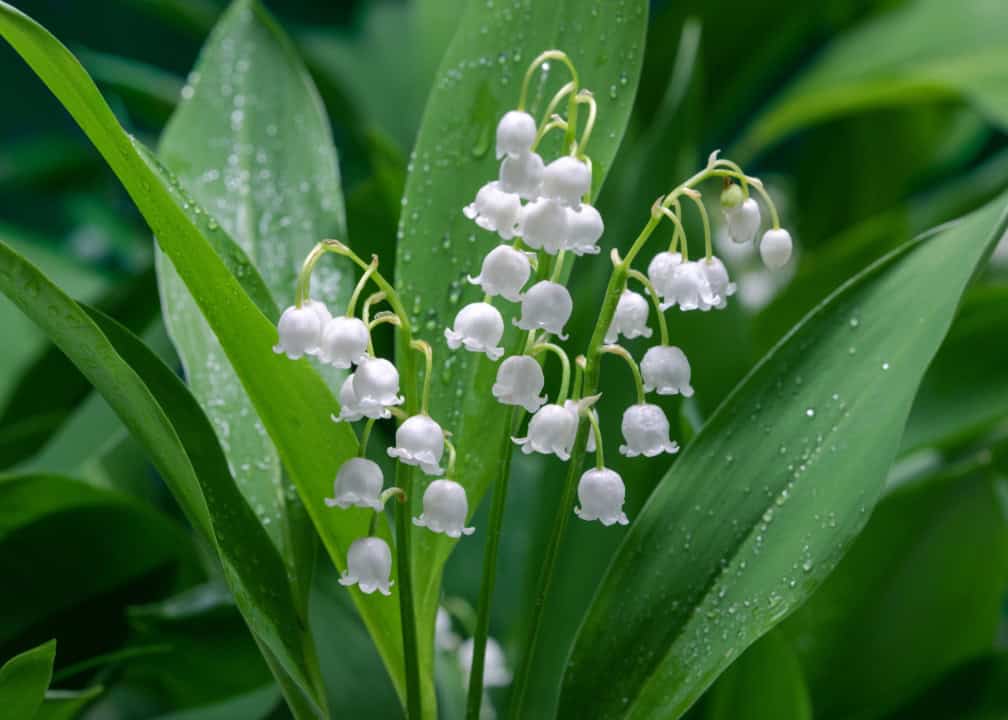


AMGPost_header5
Web_headerLisianthus

How to Grow Lisianthus

A rose by any other name…

[sibwp_form id=]

By My Thanh Kim, Skagit County WSU Extension Master Gardener

Call it love at first sight. Four years ago, I fell hard for some mysterious flowers in a lobby of a hotel. They looked like roses except more striking with an abundance of green buds surrounding luxurious blooms. This was the beginning of an obsession.  I checked nurseries for plants but had no luck.  Over the next several years I saw them again, and then, while watching the 2020 (2021) Tokyo Summer Olympics, I saw my beauties, lisianthus flowers prominently displayed and my love affair with them started all over again.

While hard to find in flower nurseries it is possible to start lisianthus from seeds. Mastering the seed-starting techniques was a months-long process, but well worth it. In the end, I had nearly 2,000 plants and gave away buckets of beautiful blooms all summer long. These are the best flowers ever, and I want everyone to enjoy them.

Lisianthus, Eustoma grandiflorum, (commonly called prairie gentian, bluebell gentian) are valued for many reasons including their resemblance to roses, their long vase life as cut flowers, and their unique beauty. They come in many vibrant colors, romantic soft tones, and mysterious bicolor flowers.  In addition to their colors and shape, they are sought after by florists for their strong stems, lush succulent leaves, and graceful buds that continue to open in a vase for several weeks.  They are hardy in USDA hardiness zones 8-10. Lisianthus is not hard to grow, and starting them from seeds may be your best option if you want to have these gorgeous flowers blooming in your garden this summer.

Rosanne Green Lisianthus
Photo by My Thanh Kim
Rosanne Green Lisianthus
Photo by My Thanh Kim
Lisianthus stems can be 18-36" tall
Photo by My Thanh Kim
Lisianthus stems can be 18-36″ tall
Photo by My Thanh Kim
Lisianthus blooming in the author's garden. Photo by My Thanh Kim
Lisianthus blooming in the author’s garden. Photo by My Thanh Kim

January is the perfect time to start lisianthus seeds

It’s January. It’s dark and cold. Though it is too early to start many seeds indoors but it is not too early to start lisianthus. Since they need at least 6 months from planting to bloom, starting them early is a must. Growing lisianthus from seeds is not for the faint of heart. They need constant attention for several weeks if not months. You may need to try multiple times before you can master the skill.  Follow these tips and with some practice and patience, you’ll be able to get many beautiful plants for your garden.

My Thanh Kim, Skagit County Master Gardener

Get started with seeds, a container, seed starting mix

Make sure you get seeds from a reputable source. Lisianthus seeds can be challenging to germinate so make sure the seeds are fresh. The germination rate goes down with older seeds. You want to start with the best seeds possible. Seeds from reputable companies should come in pelleted form for easy handling. Seeds can also be collected from mature flowers. They must be handled with care because they are tiny like specs of dust.

Choose a container or tray that is at least 1.5″ deep to allow room for root growth unless you are starting them in soil blocks. Soil blocking is a method of starting seeds that allows for healthy root growth. Sterilize the container before planting the seeds to prevent diseases.

Don’t start in garden soil. Instead, choose a sterile seed starting mix that has either coco coir or peat moss. Since lisianthus seeds are so tiny, you’ll need a medium that is as fine as possible to allow for better contact with the seeds, sifting out all the large pieces before using it.

small seeds
Lisianthus seed pods contain tiny seeds.
Photo by My Thanh Kim
Lisianthus seedlings. Photo by My Thanh Kim
ABC purple, Voyage 2 green, ABC green, and Rosanne green lisianthus. Photo by My Thanh Kim

Light, temperature, and moisture are critical to seed germination

Lisianthus seeds are considered some of the most difficult to germinate but provided with the right conditions, you’ll have a better chance of success. One of the most important things to remember is that lisianthus seeds need light to germinate. Sow the seeds on the surface of the seed starting mix and do not cover them. Keep the seeds from drying out by misting them with a spray bottle several times a day. Cover the tray with a clear plastic cover until they germinate in 10-14 days. The seeds germinate best at a temperature of 70 degrees Fahrenheit.

Congratulate yourself when the seeds germinate

If the seeds have germinated, pat yourself on the back. You’ve done the hard part. When about 50% of the seeds have germinated, remove the plastic cover. Place the seedlings under grow lights and fertilize lightly every week. Seedlings can be planted in the garden when they have 4 sets of true leaves. Lisianthus can tolerate some frost so they can be planted outside 6 weeks before the date of your last frost. Plant them in a sunny location in well-drained soil and water when the soil is dry. If everything goes well you will have beautiful blooms in July or August.

Quick Summary Tips

Getting lisianthus seeds to germinate is not hard but requires commitment and patience. Here is a summary of the tips to help get the seeds to germinate.

  1. Fill a tray or container with some fine and sterile seed starting mix.
  2. Sow the seeds on the surface of the mix. They need light to germinate so do not cover them with the mix.
  3. Spray a few times a day to prevent the mix from drying out but do not over-water.
  4. Cover the tray with a clear plastic cover to retain moisture.
  5. Place under light to germinate. A desk lamp, LED light, or fluorescent shop light will work.
  6. Keep the tray at room temperature around 70 degrees Fahrenheit.
  7. Remove the plastic cover once about 50% of the seeds germinated (10-14 days).
  8. Feed lightly every week. Place under grow lights.
  9. Plant out in the garden or container once they have 4 sets of true leaves.
  10. It may take multiple attempts to be successful but keep practicing. They are worth it.

About the Author:

My Thanh Kim is a graduate of the Skagit County WSU Extension Master Gardener Class of 2022. She currently serves as the greenhouse co-manager for the SCMG. She has a BS in biochemistry from Tulane University and a teaching credential for San Diego State University.

Resources

https://sakataornamentals.com/wp-content/uploads/sites/13/2022/02/Lisianthus-Cut-Flower-0921-SAKATA.pdf

Zigler, Lisa Mason (2014) Cool flowers: How to grow and enjoy long-blooming hardy annual flowers using cool weather techniques. St. Lynn’s Press, Pittsburg, PA.

Questions about home gardening or becoming a master gardener, may be directed to:  WSU Skagit County Extension Office, 11768 Westar Lane, Suite A, Burlington, WA 98233; by phone: 360-428-4270; or via the website: www.skagit.wsu.edu/mg

Washington State University Extension helps people develop leadership skills and use research-based knowledge to improve economic status and quality of life. Cooperating agencies: Washington State University, U.S. Department of Agriculture, and Skagit County. Extension programs and policies are available to all without discrimination.  To request disability accommodations contact us at least ten days in advance.
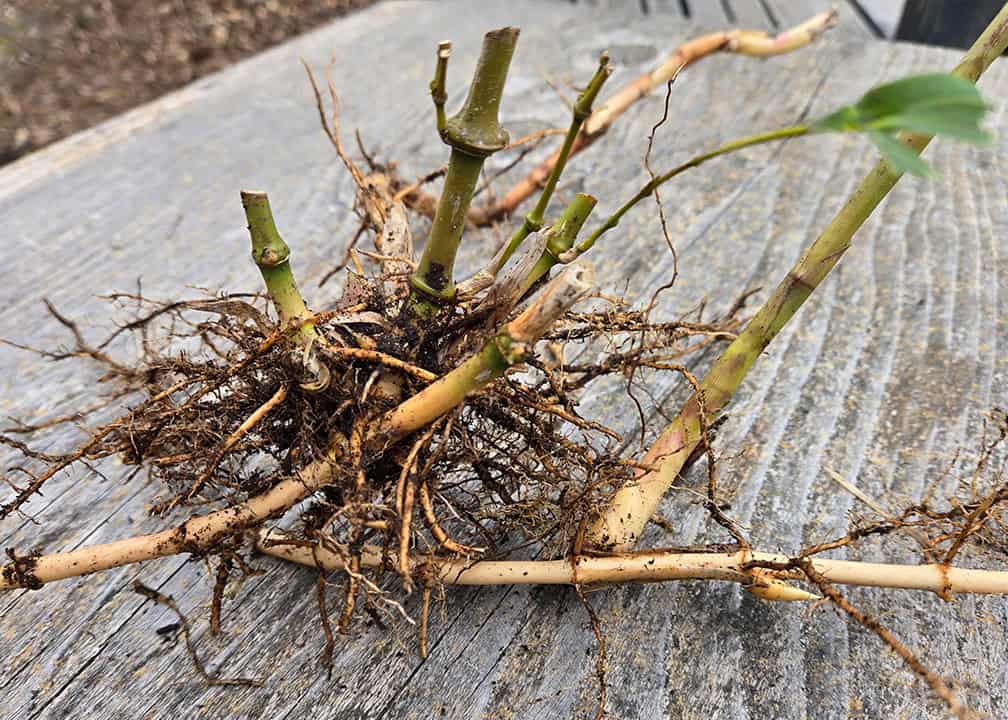


AMGPost_header5
field featuring 100's of dahlia varieties grown for cutting

Master Gardeners share their overwintering techniques

By Anne Hays, Skagit County WSU Master Gardener

Photo of writer

Anne Hays is a resident of La Conner and a Skagit County Master Gardener

Dahlias, first imported from Mexico and Central America, provide a rich and enthusiastic floral display in Pacific Northwest gardens. Continuous hybridization of Asteraceae has resulted in the development of a plethora of colors, flower forms, and sizes. The blossoms can be as tiny as the minion under 2 inches, or as large as the giant or dinner plate size at over 10 inches. Conventional wisdom incorporated in most PNW and national reference guides for Dahlia growers just about universally recommend digging Dahlia tubers in the fall and storing them in a cool dry place. The reference materials I consulted noted that while dahlias are considered hardy in our zones – digging and storing is their preferred recommendation for overwintering dahlias in our Zones 8-9.

I then looked out my window. My street garden is abundant with tall, healthy dahlias, and I didn’t dig them last winter. So, I decided to do a very unscientific survey of WSU Extension Skagit County Master Gardeners to see what their preferences and protocols for digging dahlias and overwintering them indoors.

Master Gardeners are a treasure trove of local gardening knowledge, underscoring the depth of their experience and knowledge and differing opinions. Their gardens represent a variety of unique “microclimates” found in our area. The following is a brief synopsis of replies I received with a notation on where their garden is located.

Karen from Camano has ten years’ experience raising dahlias. At first, she was a Dahlia digger, but now she leaves them in the ground after struggling with mold issues trying to store them. She cuts her 150 Dahlia stalks after the first frost, covers them with a layer of mulch and then with sword ferns and rocks to keep water from rotting the dahlias.

Dahlia_3

Among gardeners, selecting a favorite Dahlia is unique to each individual. Dahlias range in size from under 2″ to over 10″ and are classified into 18 categories by form. Photo by Anne Hayes

ThomasEdison

The Thomas Edison dahlia is a beautiful example of the deep vivid hues found among the fifteen different colors and color combinations recognized by the American Dahlia Society.  Photo by Anne Hayes

Dahlia_2

Though the dahlia’s origins can be traced back to the high mountains of Central America, the plants thrive in the moist, moderate climate of the Pacific Northwest, blooming from midsummer until the first frost.

Jan from La Conner is a recent convert to the in-ground overwintering school of thought. Until last year she routinely dug her dahlias, wrapped them in newspaper and stored them in plastic. She left them in the ground last season and intends to again, though she plans to cover the planting area with cardboard and heavy mulch.

Rin from Anacortes describes her soil as sandy and has determined her tubers do best when left in the ground — mostly because she hasn’t found an overwintering strategy that doesn’t result in mold issues.

Linda from Orcas Island digs her tubers, being careful not to damage or pierce the tubers. She then rinses the soil and lays them flat to dry for a day or two. She brushes the tubers – inspecting them for any signs of rot and places them in cardboard boxes using vermiculite. She places the top of the box on the tubers after barely moistening the vermiculite. She does not allow the tubers to touch and stores the box in her basement.

Allison on Samish Island digs her dahlias and stores them in cardboard with peat moss on top in a cool dry place in her garage.

Among all the WSU Extension Skagit County Master Gardeners I contacted, dividing dahlias is typically undertaken every three years in the spring. Many of the local Master Gardener’s caution that new Dahlia starts are “slug candy” and recommend careful slug containment and control at the start of a new Dahlia season. Dahlias need good soil, enriched with organic matter and some recommend bone meal. Planting depths vary from 6 inches to one foot, and many recommend placing stakes for larger varieties as you plant the tubers to avoid damaging the tubers.

I also asked each of the responders for their recommendations on their methods for placing cut dahlias in display vases. The consensus was to place them in water as soon as possible using a fresh cut and change the water frequently. Many mentioned using a floral preservative.

What was abundantly clear from the replies I received is the passionate enthusiasm among those in Dahlia growing communities! Color, abundance, ease of growing, all were mentioned as reasons to add dahlias to your garden. If you decide to include dahlias in your garden next spring, the WSU Extension Skagit County Master Gardeners are available at Plant Clinics throughout the county to offer guidance and answer questions. Please don’t hesitate to give us a call at 360-428-4270 to be directed to a Plant Clinic near you.


Resources:

Gardening in the Pacific Northwest, Carol Hall & Norman Hall, Timber Press, 2008 Ornamental

Bulbs, Corms &amp; Tubers, A. R. Rees, C A B International, 1992

Sunset Western Garden Book, Sunset Publishing, Edited by Kathleen Norris Brenzel Gardening in the Pacific Northwest, Paul Bonine and Amy Campion, Timber Press


Questions about home gardening or becoming a master gardener, may be directed to:  WSU Skagit County Extension Office, 11768 Westar Lane, Suite A, Burlington, WA 98233; by phone: 360-428-4270; or via the website: www.skagit.wsu.edu/mg

Washington State University Extension helps people develop leadership skills and use research-based knowledge to improve economic status and quality of life. Cooperating agencies: Washington State University, U.S. Department of Agriculture, and Skagit County. Extension programs and policies are available to all without discrimination.  To request disability accommodations contact us at least ten days in advance.